

Agnipath at the Crossroads
Agnipath was conceived in 2022 to give the Armed Forces a younger, fitter and more technologically adaptable profile. Under the original framework, Agniveers would serve for four years, after which up to 25 per cent of each batch could be selected for regular cadre on the basis of organisational requirements and objective performance criteria. The first intake was planned at 46,000 personnel. The design therefore deliberately separated military service into two outcomes: a smaller permanent cadre and a larger cohort returning to society with military training, discipline and a Seva Nidhi corpus.
The first major transition now makes the distinction between those two outcomes real rather than theoretical. The question is no longer whether Agnipath can recruit young people; it is whether the State can complete the second half of the architecture with the same seriousness with which it manages recruitment and training. The Government has already created significant post-service pathways, including a 50 per cent reservation for Ex-Agniveers in Constable GD/Rifleman vacancies in CAPFs and Assam Rifles, while Railways provides specified reservations across several levels. These are important steps, but a collection of reservations is not yet a national transition system.
The policy challenge, therefore, is not to defend or discard Agnipath, but to complete it. The first uniform should lead naturally to the second phase of service, employment or education. The State should not release trained manpower first and begin searching for destinations afterwards.
The first task is no longer recruitment; it is completing the journey beyond recruitment.
The 25 Percent Question
The original 25 per cent retention ceiling was designed around the requirement for a youthful force. Four years of experience, however, changes the manpower equation. An Agniveer who has completed training, operated equipment, served in difficult terrain, absorbed military culture and demonstrated performance is no longer simply a recruit. The State has already invested in making that individual operationally useful.
The arithmetic illustrates the scale. From an illustrative cohort of 46,000, retaining 25 per cent produces 11,500 regular personnel and leaves 34,500 for transition. If retention were differentiated by Service and requirement, an illustrative model of 50 per cent in the Army, 50 per cent in the Air Force and 75 per cent in the Navy would retain about 23,750 and transition about 22,250. The difference is 12,250 people moving from the transition pool into trained military manpower. This is not a recommendation for an already approved policy; it is a policy model showing what differentiated retention could mean.
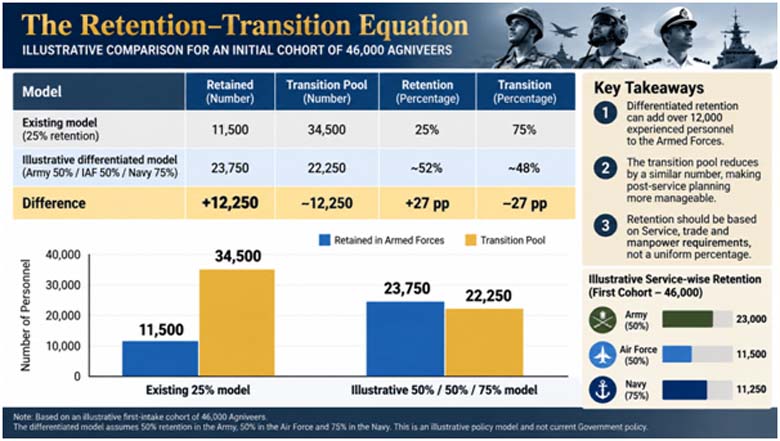
Reports in 2026 indicated that the Services were considering higher retention, with the Navy reportedly examining around 75 per cent and the Army and Air Force around 50 per cent, while the official framework remained 25 per cent. The logic deserves examination, particularly for technical trades and occupations where training on sophisticated platforms takes time. Retention should therefore not be a single percentage imposed uniformly across three very different Services. It should reflect operational requirements, trade complexity, experience value, technology and manpower projections.
The principle is simple: youth must remain the foundation, but experience must not become the casualty of youth.
No Soldier Between Two Systems
The larger weakness is not necessarily the existence of a four-year engagement; it is the possibility of an uncertain transition afterwards. A soldier who has served the State for four years should not finish his military obligation and then become an individual applicant moving from office to office in search of a second career.
Transition must become a Government function. The Agniveer may indicate preferences, but the State should own the process of profiling, matching, documentation, selection and placement. The Services are uniquely placed to begin this work because they already possess the individual’s training record, trade, qualifications, performance, medical status and service history. The transition should therefore start inside the military system rather than after the individual leaves it.
This principle requires a stronger safeguard during the initial years. If the assured transition architecture is not legally authorised, funded, staffed and operational before a cohort reaches release, those personnel should not simply be discharged into an unfinished system. A time-bound transitional continuation mechanism could be created under appropriate legal and Service-rule authority until the pathway is demonstrably functional. The objective is not to create indefinite military service; it is to prevent an administrative gap from becoming a personal crisis.
Most importantly, there should be no avoidable one-day gap between military service and the next identified national-service or employment pathway. Continuity is the real test of transition.
No soldier should stand between two systems waiting for the State to decide where he belongs next.
Seamless Second Service
The solution can be built around a Seamless Second Service architecture. Twelve months before completion, every eligible Agniveer should receive a National Transition Profile recording military trade, qualifications, certifications, skills, performance, preferences and additional training requirements. At nine months, this profile should be matched against forecast vacancies. At six months, selection and allocation should be completed. At three months, the destination and joining instructions should be issued. At the end of the military engagement, the individual should move directly into the next approved pathway.
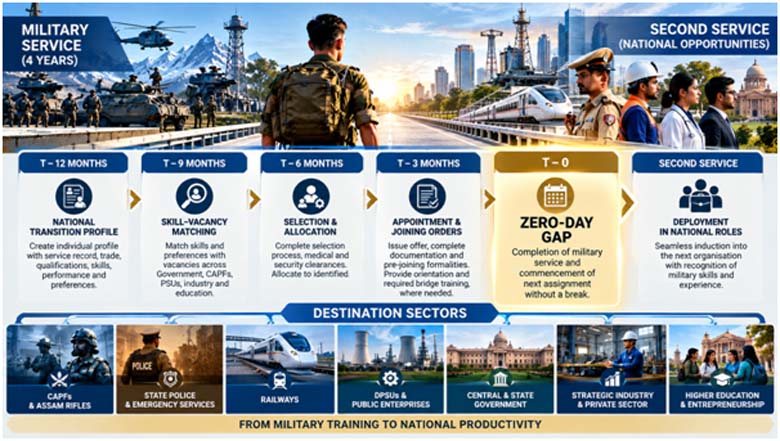
This would transform the present concept of post-service employment from a passive benefit into an active national manpower system. A National Ex-Agniveer Employment Grid should aggregate projected requirements from CAPFs, Assam Rifles, State police and emergency services, Railways, defence civilian organisations, Defence Public Sector Undertakings, public-sector enterprises, strategic industries and other approved employers. Existing reservations can become components of this larger grid rather than isolated schemes.
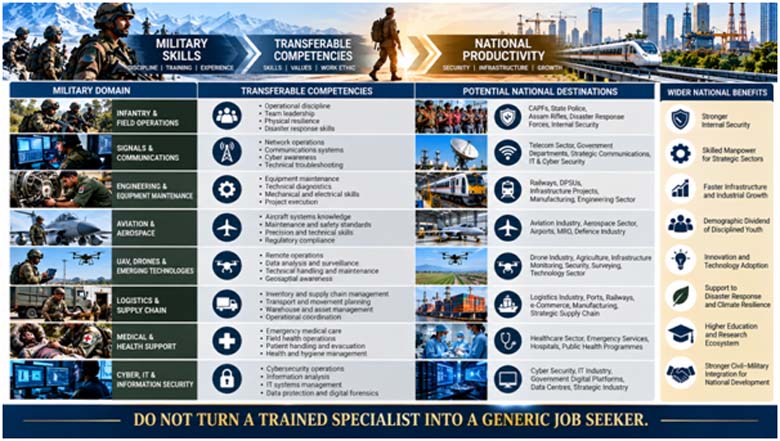
Skill matching is equally important. An engineer, signals specialist, aviation technician, drone operator, medic, logistics specialist or equipment maintainer should not automatically be channelled into a generic constabulary vacancy. The State has already paid for specialised training; transition policy should preserve that investment. The objective should be to move from military skill to productive civilian or national-service skill with minimum retraining and maximum utilisation.
The principle should be stated bluntly: do not release first and search for vacancies later; forecast the exit, identify the destination, complete the process and then release.
The transition centre should become the bridge between the first uniform and the next one.
From Existing Measures to a National System
India has already created pieces of the destination architecture, which makes the proposed reform practical rather than theoretical. In July 2026, the Ministry of Home Affairs announced 50 per cent reservation for Ex-Agniveers in Constable GD and Rifleman vacancies in CAPFs and Assam Rifles, along with age relaxation and exemptions from the physical and written stages specified in the order. Railways has separately provided horizontal reservations of 10 per cent in Level-1 posts, 5 per cent in Level-2 and above posts, and 10 per cent in RPF/RPSF constable recruitment. These measures demonstrate that the State can create preferential pathways at scale.
The next step is coordination. A young person should not experience these provisions as disconnected announcements from different ministries. The Government should bring them under one transition dashboard, with the Services projecting the number and skill profile of each exiting cohort and receiving organisations declaring their vacancies, eligibility and joining timelines. A central authority should monitor the complete chain, while the Services remain responsible for preparing and certifying their personnel.
The model can also draw on existing skill and education initiatives. Military trades have already been mapped in various programmes to civilian occupational standards, while educational pathways have been developed with institutions such as NIOS and IGNOU. The task now is to integrate these initiatives into the exit process rather than treating skill certification as an independent welfare measure.
The objective should be continuity of human capital. An Agniveer who leaves the Army with a recognised engineering, communications or logistics competency should enter the civilian economy carrying a credential that employers understand. The State should become the bridge between military competence and national productivity, not merely the issuer of a discharge document.
That is how scattered concessions become a coherent transition architecture.
Agnipath 2.0: Reform Compact
- Raise and differentiate Retention. The flat 25 per cent ceiling should be reviewed through Service- and trade-specific manpower studies. A 50–75 per cent range may be appropriate in some categories, while other categories may require less. Retention should be determined by operational need, experience value and future manpower requirements, not by an arbitrary uniform number.
- Establish a Transition Protection Clause. No Agniveer should be released into an employment system that the Government itself has not made operational. Until the assured transition mechanism is ready, an appropriately authorised, time-bound continuation arrangement should protect the affected cohort.
- Make transition Government-owned. The individual should not be responsible for navigating multiple recruitment agencies, submitting repetitive applications or repeatedly obtaining documents already held by the State. Choice should belong to the Agniveer; execution should belong to Government.
- Institutionalise Seamless Second Service through existing Service Recruitment and Training Centres. The transition process should begin at least twelve months before release and end with a confirmed destination, appointment or education pathway before military disengagement.
- Create a National Ex-Agniveer Employment Grid. Union ministries, States, CAPFs, Railways, DPSUs, public enterprises and identified strategic industries should provide annual and medium-term vacancy projections. These should be mapped against the projected Agniveer transition cohort before the cohort reaches its exit date.
- Create a Military-to-Civilian Skill Matrix. Infantry, communications, engineering, aviation, drones, cyber, medical, logistics, vehicle maintenance and other military skills should be translated into recognised civilian competencies. Existing skill certification and education pathways should be integrated rather than duplicated.
- Guarantee assured Transition, not guaranteed permanent Government Employment. Every eligible Agniveer should receive a transparent, time-bound pathway, but the destination can vary according to qualification and demand: continued military service, CAPFs, police, Railways, public-sector organisations, strategic industry, entrepreneurship or higher education.
- Measure Outcomes rather than Announcements. The system should publish cohort-wise data on retention, percentage transitioned without a gap, time taken to placement, skill utilisation, sectoral destination and longer-term career outcomes. A transition programme is successful only when the individual reaches a meaningful next destination.
These eight measures convert Agnipath from a recruitment reform into a national manpower architecture: retain where the nation needs experience, transition where it needs talent, and never leave service without a pathway.
The 50–75–100 principle captures the architecture: retain where justified, transition the remainder, and provide 100 per cent of eligible Agniveers an assured pathway.
Preserve the Core, Reform the Architecture
None of this requires abandoning the central logic of Agnipath. A youthful military remains essential. Shorter initial engagement can broaden the talent base, reduce the average age and expose a larger number of citizens to military discipline and national service. Merit-based selection for regular cadre must remain rigorous, and military standards must not be diluted to achieve retention or placement targets.
What must change is the architecture surrounding the four-year engagement. The 25 per cent ceiling should become a data-driven retention policy; post-service employment should become a coordinated national system; transition should be planned before release; and specialised military skills should be treated as national assets rather than temporary attributes.
The real measure of Agnipath will therefore not be how many young people enter the gates, but how intelligently the nation uses them after those gates open in both directions.
Preserve the youthful core; reform the architecture around it.
The Second Uniform
Agnipath was never merely a recruitment mechanism. Properly completed, it can become a national service pathway in which military training strengthens the wider manpower system of India. The first uniform may come off after four years, but discipline, technical competence, resilience and service orientation need not disappear with it.
The most important reform is therefore conceptual. An Agniveer should not have to knock on the doors of the State for a second career; having served the State once, the State should itself open the next door.
The objective is not to guarantee every person a permanent Government job. It is to guarantee that every eligible person who completes service successfully has a defined, credible and timely next pathway. That is the difference between discharge and transition, between an employment scheme and a national manpower system.
The reform should therefore be judged by continuity, capability and dignity: three outcomes that turn a temporary military engagement into enduring national value for India.
Agnipath should not be a four-year road that ends at the barracks gate; it should be a national pathway in which the first uniform may change, but the journey of service continues.
ABOUT THE AUTHOR

Lt Gen Rajeev Chaudhry (Retd) is a social observer and writes on contemporary national and international issues, strategic implications of infrastructure development towards national power, geo-moral dimension of international relations and leadership nuances in changing social construct.