The Country The World Still Misunderstands
Recently, the leading Norwegian newspaper chose to depict the visiting Prime Minister of India – the elected leader of the world’s largest democracy and representative of one of humanity’s oldest civilisations – through a crude and dismissive cartoon rooted in outdated stereotypes. The incident was not merely about satire; it reflected a deeper inability within sections of the global establishments to fully comprehend the scale, complexity and transformation of modern India.
For decades, large parts of the world viewed India through a narrow and outdated lens — a land of snake charmers, overcrowded streets, poverty, mysticism and chaos. Even today, in sections of the Western imagination, India often appears less as a modern strategic power and more as an unresolved developmental story.
Yet history is quietly staging one of its greatest reversals.
The same India that was once dismissed as a perpetually fragile post-colonial state today operates one of the world’s most sophisticated digital public infrastructures, conducts elections larger than the populations of continents, lands spacecraft near the Moon’s South pole, manufactures vaccines for much of the developing world, and is poised to become the third-largest economy on Earth.
The contradiction is striking. The world continues to underestimate India precisely at the moment India is becoming impossible to ignore.
No modern state has attempted governance at India’s civilizational scale. Nearly one-fifth of humanity lives within one democratic republic spread across deserts, floodplains, tropical coasts, dense megacities, Himalayan frontiers and insurgency-prone terrains. India contains almost every major religion, hundreds of languages, thousands of communities and immense economic disparities within a single constitutional framework.
What Europe achieved through multiple nation-states over centuries, India attempts within one political union.
The true miracle of India is not that it has problems. The true miracle is that India functions.
And yet, when global governance reports, democracy scorecards, media freedom indices and perception-based rankings emerge every year, India is frequently evaluated through frameworks that appear unable to fully comprehend the scale and complexity of the Indian experiment. Smaller, historically wealthy and culturally homogeneous nations often rank far ahead of India without adequate consideration of the vastly different burdens under which these societies operate.
This raises a larger and uncomfortable question: Are contemporary global rating systems genuinely objective, or are they shaped by institutional assumptions rooted primarily in Western historical experience?
That question has now become impossible to avoid.
Global Rating Industry: Structures, Power and Bias
The modern global rating ecosystem has become enormously influential in shaping international perceptions. Governance scorecards, ESG ratings, democracy indices, corruption rankings and media freedom reports today influence not only reputations but also economic outcomes.
These rankings affect:
- Foreign investment.
- Sovereign borrowing costs.
- Investor confidence.
- Tourism.
- Diplomatic standing.
- Multinational corporate decisions.
In many ways, ratings have become instruments of geopolitical soft power.
The problem, however, lies not in the existence of evaluation systems, but in the structures and methodologies through which they function.
Most influential governance and social-rating institutions are concentrated in Washington, London, Brussels, Berlin and New York. Their intellectual frameworks often emerge from liberal Western political experiences shaped within relatively smaller, economically advanced and culturally cohesive societies.
Concepts of governance, democratic functioning, institutional quality and freedom are frequently measured against standards derived from European and North American historical trajectories. These standards are then universalized across civilizations operating under vastly different historical, demographic and security conditions.
This creates an inherent asymmetry when such frameworks are applied uniformly to countries like India.
A Scandinavian country like Norway with 5.66 million people, high social cohesion, centuries of accumulated wealth, minimal security threats and relatively stable demographics is often evaluated through the same governance lens as India — a nation administering more than 1.44 billion people while simultaneously managing:
- Immense linguistic diversity.
- Religious plurality.
- Federal political competition.
- Terrorism.
- Hostile borders.
- Poverty transitions.
- Rapid urbanization.
- Climatic extremes.
Administrative difficulty is rarely incorporated into administrative evaluation.
Many contemporary indices are also heavily dependent on perception-based methodologies. Corruption rankings frequently measure perceived corruption rather than empirically measurable corruption. Democracy indices often rely upon subjective assessments from academic or activist networks. Media freedom rankings sometimes inadequately distinguish between authoritarian censorship and democratic attempts to regulate misinformation, separatism or extremist mobilization.
This does not mean such indices are entirely false or malicious. Many genuinely highlight serious institutional concerns. India continues to face undeniable challenges — judicial delays, bureaucratic inefficiency, pollution, social tensions, inequality and uneven human development.
A mature democracy must remain open to criticism.
But criticism itself must also remain open to scrutiny.
A nation administering one of the most complex societies in human history cannot be judged solely through the same metrics used for smaller and historically insulated states. The consequences of these asymmetries are not merely intellectual. They are deeply economic and geopolitical.
Global investors, sovereign wealth funds and multinational institutions increasingly integrate governance rankings and ESG scores into investment calculations. A weaker perception score can influence capital flows, borrowing costs and international business confidence for years.
Ratings, therefore, do not merely describe the world. They actively shape the distribution of global economic opportunity.
Yet despite these structural disadvantages and perceptional asymmetries, India’s rise has become historically remarkable.
India’s Rise Against Civilisational Odds
India’s achievements become extraordinary only when viewed against the scale of challenges confronting it.
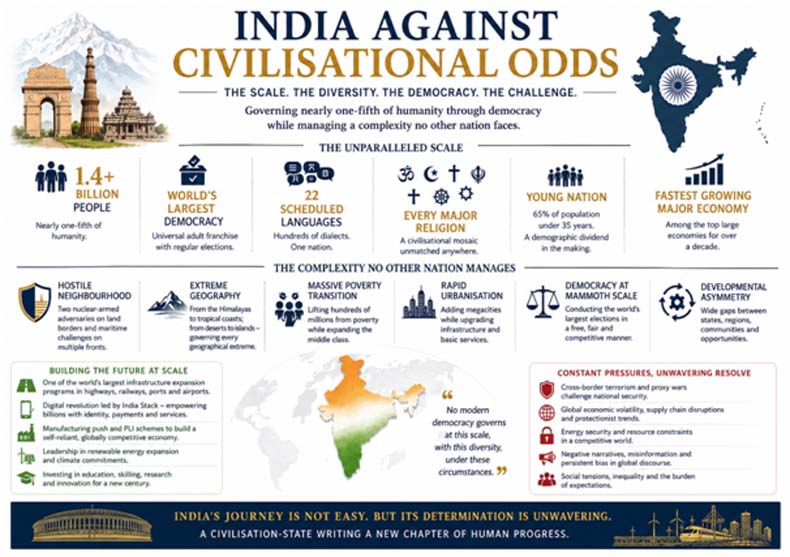
Few civilizations in history have attempted simultaneous nation-building, democratic consolidation and mass economic transformation at such scale. At independence, India inherited colonial impoverishment on a staggering level. Literacy was abysmally low, industrial capacity limited and life expectancy fragile. Partition produced one of the largest and bloodiest human displacements in modern history. Since then, India has fought five wars, faced terrorism, managed separatist movements and navigated repeated geopolitical pressures while attempting democratic development for hundreds of millions emerging from poverty.
- Internally, India’s complexity alone would overwhelm many states. It governs the world’s largest democratic electorate, every major religion, hundreds of languages, thousands of castes and communities, and immense regional disparities. Its federal structure attempts to balance national unity with linguistic, ethnic and regional aspirations. Its constitutional order simultaneously seeks to preserve secular democracy, civilizational continuity, social justice and political pluralism.
- Externally, India faces one of the world’s most difficult strategic environments. It shares contested borders with two nuclear-armed adversaries. It remains vulnerable to terrorism, maritime instability, energy insecurity and regional geopolitical volatility. It must balance relations simultaneously with the United States, Russia, Europe, West Asia and the Indo-Pacific without surrendering strategic autonomy.
Very few rising powers in modern history have attempted growth under such complex geopolitical pressures.
Geography itself compounds the challenge. India must govern across Himalayan glacial zones, cyclone-prone coastlines, drought regions, floodplains and some of the world’s most densely populated urban corridors. Climate vulnerability alone imposes governance burdens absent in many advanced societies.
And yet India continues to rise.
Within little more than a decade, India has risen from the world’s tenth-largest economy to the fourth-largest economy. It has become the fastest-growing major economy while maintaining democratic continuity and strategic independence.
Its infrastructure transformation has accelerated dramatically: highways, freight corridors, ports, rail modernization, airports, digital infrastructure, and manufacturing ecosystems.
Its technological leap has surprised much of the world.
India today operates one of the most advanced digital governance architectures ever attempted at population scale. The combination of Aadhaar, UPI and mobile connectivity has transformed financial inclusion and state delivery systems for hundreds of millions.
Its space program, led by the Indian Space Research Organisation, has demonstrated high scientific capability at remarkably low cost. Its pharmaceutical sector supplies affordable medicines globally. Its start-up ecosystem has emerged among the largest in the world.
Strategically, India has evolved into a pivotal balancing power within the emerging multipolar order. It is simultaneously: a Quad member, a BRICS member, a voice of the Global South, and an independent strategic actor refusing rigid bloc politics. What surprises many observers is not merely India’s growth, but the resilience underlying that growth.
Most countries confronting comparable burdens — demographic pressure, diversity, contested borders, poverty transitions and democratic turbulence — would struggle to sustain institutional continuity. India, however, continues to absorb shocks while maintaining national coherence.
India is not rising because conditions were favourable. India is rising despite conditions that would destabilise most nations.
That reality fundamentally changes how India should be evaluated. A fair assessment of nations cannot merely compare static outcomes detached from context. It must evaluate outcomes relative to the complexity of the burdens being carried.
The Indian story, therefore, is not merely an economic story.
It is a governance story. A resilience story. A civilizational story.
And perhaps that is precisely what many contemporary frameworks still struggle to understand.
Re-Evaluating India — Towards A Fairer Scorecard
If nations were evaluated not merely by outcomes, but by outcomes relative to the scale and complexity of the burdens they carry, India’s global position would appear profoundly different.
Most contemporary rankings assess countries through static indicators:
- Per capita income.
- Governance perception.
- Institutional efficiency.
- Media narratives.
- Social outcomes.
What they often fail to measure is the civilisational difficulty involved in producing those outcomes. Therefore, a fairer framework must judge nations not only by where they stand, but by the conditions under which they have risen.
Viewed through that lens, India’s contemporary trajectory appears historically significant.
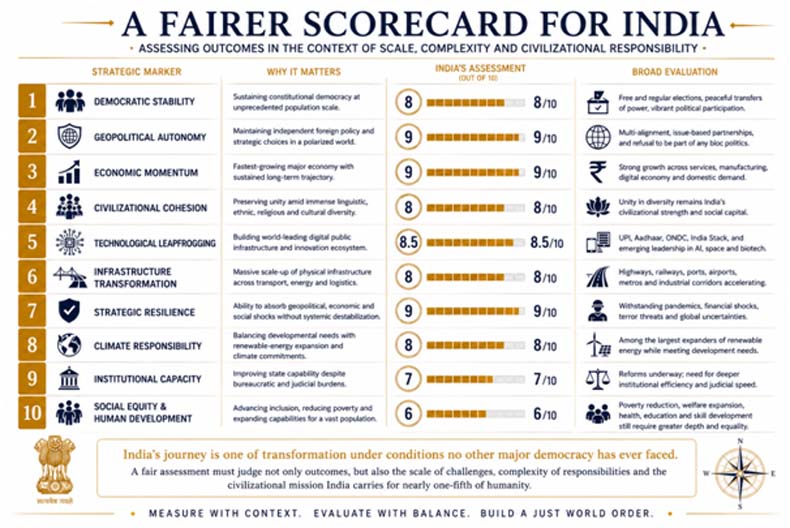
This assessment is neither romantic nor defensive. It acknowledges both India’s achievements and its unresolved weaknesses.
India continues to face serious structural challenges:
- Judicial delays.
- Pollution.
- Educational inequality.
- Urban stress.
- Healthcare gaps.
- Bureaucratic inefficiency.
- Uneven institutional quality.
A confident civilisation must remain open to introspection.
Yet fairness also requires proportionality.
The issue, therefore, is not whether India deserves scrutiny. Every major power does. The real issue is whether existing global frameworks possess sufficient depth to evaluate a civilization-sized democracy undergoing one of the largest socioeconomic transformations in human history.
At present, many such frameworks appear inadequately equipped for that task.
Reforming The Global Rating Architecture
The growing mismatch between global realities and existing evaluation systems raises an important strategic question: Can current rating architectures be reformed, or must alternative frameworks emerge?
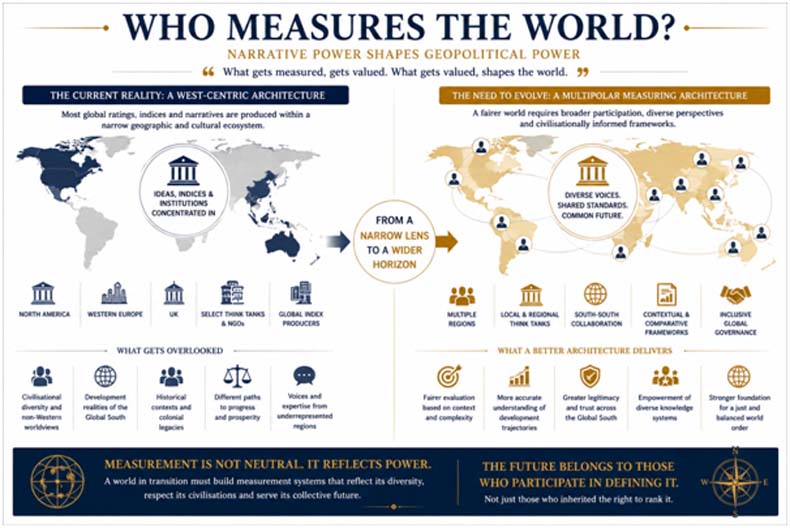
The first and preferable path is reform.
Global rating systems remain influential and, when properly designed, can provide valuable policy feedback and comparative analysis. But their legitimacy increasingly depends upon broader representational balance and methodological transparency.
Several reforms are urgently necessary.
- First, governance evaluation must move beyond purely perception-driven methodologies. Excessive dependence on elite surveys, activist networks and narrative ecosystems creates distortions that can reinforce pre-existing reputational biases. More weight must be given to measurable administrative outcomes, institutional resilience and long-term developmental performance.
- Second, evaluation systems must incorporate the concept of governance difficulty. Administering a civilisation-sized democracy under conditions of poverty transition, security stress and social diversity is fundamentally more complex than governing smaller, wealthy and historically stable societies. Metrics that ignore demographic scale, geographic hardship and developmental burden produce incomplete conclusions.
- Third, broader civilisational representation is essential. Today, many influential frameworks continue to be intellectually dominated by Western academic and institutional ecosystems. The Global South — representing the majority of humanity — remains underrepresented in defining the standards through which the world is measured.
That imbalance is becoming increasingly unsustainable in a multipolar century. Importantly, this debate is not about rejecting universal values or creating insulated nationalist standards. Transparency, accountability, institutional quality and human dignity remain important aspirations for all societies.
But universal aspirations do not require uniform historical templates.
Civilisations evolve differently. Democracies function differently. Social cohesion emerges differently across cultures and histories. A genuinely global evaluation architecture must recognize these differences without descending into relativism.
If meaningful reform proves impossible, however, alternative institutions may gradually emerge.
The twenty-first century is witnessing the rise of new geopolitical and economic centres outside the traditional Atlantic order. Organizations such as BRICS, the Shanghai Cooperation Organisation and various Global South forums increasingly seek greater institutional voice within international governance structures.
It is entirely plausible that future decades may also witness:
- Global South-led governance indices.
- Alternative ESG frameworks.
- Multipolar institutional rankings.
- Independent rating agencies reflecting wider civilizational perspectives.
This would not necessarily fragment the world; it could democratise global evaluation itself.
After all, who measures the world ultimately shapes how the world is perceived.
For too long, a narrow concentration of institutions has exercised disproportionate influence over defining legitimacy, governance quality and democratic performance for the rest of humanity. As global power diffuses Eastward and Southward, that monopoly over narrative construction will inevitably be questioned.
India occupies a particularly important position within this transition. Unlike authoritarian challengers to the Western order, India represents a democratic civilisational state attempting modernisation without complete Westernisation. It seeks technological advancement without abandoning cultural continuity. It seeks global integration without strategic subordination.
That makes India’s experience uniquely important for much of the developing world.
India and the Rewriting of Global Assumptions
India’s rise is not merely altering economic statistics; it is forcing the world to reconsider long-held assumptions about governance, democracy and development itself.
India remains noisy, argumentative, uneven and imperfect. Its democracy is turbulent. Its institutions remain under strain. Its developmental challenges are immense. But perhaps that is precisely what makes the Indian achievement historically remarkable. No civilisation-sized democracy in modern history has attempted to simultaneously:
- Lift hundreds of millions from poverty.
- Maintain electoral continuity.
- Preserve deep pluralism.
- Defend strategic sovereignty.
- Absorb technological transformation.
- Sustain national cohesion under such scale and diversity.
The world often evaluates India by asking why it still has problems. A more important question may be: How has India managed to achieve so much despite burdens that would overwhelm many nations?
As global order gradually shifts toward a more multipolar arrangement, existing rating systems must either evolve into more balanced and civilisationally sensitive frameworks or risk losing credibility across much of the developing world.
Perhaps the greatest story of modern India is not merely that it is rising, but that it is rising while carrying burdens no civilisation-sized democracy has ever carried before.
ABOUT THE AUTHOR

Lt Gen Rajeev Chaudhry (Retd) is a social observer and writes on contemporary national and international issues, strategic implications of infrastructure development towards national power, geo-moral dimension of international relations and leadership nuances in changing social construct.