
The Soldier’s Covenant
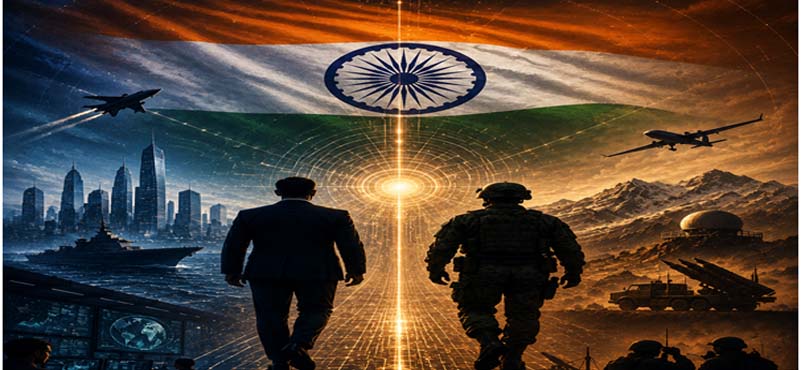
Is the Fauj a profession, a religion, a calling, or a way of life? Perhaps it begins as a profession, becomes a way of life and, at its highest expression, becomes a covenant between the soldier and the nation. The soldier signs a blank cheque. He does not know when it will be encashed, where, or what sacrifice it may demand. He only knows that when the nation calls, duty will come before self.
Yet the man who signs that cheque is entirely human. He is someone’s son, husband, father, brother and friend. He worries about his children’s education, ageing parents, family finances and his own future. His patriotism is not theatrical. It is lived quietly, through discipline, hardship and duty.
His sacrifice is not an abstraction. That is covenant.
The Life He makes Possible
While the soldier stands on the border, the nation lives its ordinary life. A child goes to school, a student builds a career, a farmer tends his field, a shopkeeper opens his shutters, a wedding takes place, a family celebrates a festival and a democracy thrives on slogans and protests. Parents attend to their children, friends meet and millions return home every evening without asking who makes that normality possible.
The soldier does not merely defend territory. He protects normalcy—the freedom to work, study, travel, celebrate, raise a family and pursue a dream. Most citizens can afford not to think about the border because someone else does. That may be the most invisible measure of military success: the nation can live normally because the soldier refuses to do so.
He stands at the frontier so that the frontier never becomes part of our everyday lives. It is a quiet national bargain.
The Last Stand
India’s military history is a long record of moments when that blank cheque was presented for payment: Saragarhi, Namaka Chu, Asal Uttar, Rezang La, Dograi, Longowal, Tololing and Tiger Hill. Different wars and terrains, but one ethic connects them: stand, hold, endure and protect.
These battles need not be retold. Their deeper significance lies in what they reveal about the soldier. At Saragarhi, 21 soldiers of the 36th Sikh held their post against overwhelming numbers in 1897. At Rezang La in 1962, Charlie Company of 13 Kumaon fought at extraordinary altitude in one of India’s most remembered last stands. In 1965, Asal Uttar and Dograi and in 1971, Longowal and Basantar became enduring chapters of courage; in 1999, Tololing and Tiger Hill carried that tradition into the Kargil War.
The last stand is not a celebration of death. It is an affirmation of responsibility. Behind every defended position lie people who may never know the name of the man protecting them.
The soldier does not fight because he loves death. He fights because he loves what lies behind him.
From Border to the Courtroom
The soldier can face the enemy. He can accept cold, altitude, separation, uncertainty and danger. What is harder to understand is why, after decades of service, he should encounter another battle over pay, pension, disability, service conditions or other legitimate entitlements.
This is not an argument against the Ministry of Defence. Government must scrutinise claims and defend its interpretation of rules. But the State must also learn from recurring disputes. Official data recorded 95,498 pending court cases involving the Ministry of Defence as of 29 January 2026. The number alone does not establish fault; it does, however, underline the scale of the administrative burden.
The larger question for us is: how many genuine grievances should reach a courtroom when they could have been resolved through a competent administrative process? The answer lies not merely in case management, but in examining the structure and processes through which military personnel matters are decided.
Who Administers the Soldier?
A defence administration cannot be responsive if those making decisions about military life are institutionally distant from it. This is not an argument for replacing civilians with soldiers. Civilian expertise in law, finance, procurement, administration and policy is indispensable. It is balance, domain knowledge and institutional accountability.
The structure of defence administration therefore deserves a comprehensive review.
- Review the AFHQCS structure. The role, composition and functioning of the Armed Forces Headquarters Civil Services cadre should be examined objectively, particularly in areas directly affecting service conditions, pay, pension, disability, personnel policy and veterans’ affairs.
- Put military domain expertise where military decisions are made. More serving or recently retired Armed Forces personnel with operational and personnel-management experience should occupy meaningful positions in soldier-facing policy and administration.
- Create integrated civil-military teams. Civilian and military professionals should work together, bringing complementary expertise rather than operating in parallel silos. The question should not be whether a file is handled by a civilian or a military officer; it should be whether the person deciding it understands both the rule and the reality behind that rule.
- Clarify institutional interfaces. The interfaces between the Ministry of Defence, Department of Military Affairs and Service Headquarters should be reviewed wherever responsibilities overlap or accountability becomes diffused.
- Establish identifiable ownership. Every major policy affecting soldiers should have a clearly identifiable owner responsible for implementation and consequences. Institutional responsibility cannot remain collective when accountability is required.
The question is not civilian versus military at all.
It is whether the system has enough people who understand the soldier.
From Litigation to Resolution
Changing the structure without changing the process will only move the problem from one desk to another. The objective must be an administration in which legitimate claims are resolved before they become litigation.
- Settled once, applied everywhere. When the Supreme Court, Armed Forces Tribunal or competent authority conclusively settles a recurring question of pay, pension or service entitlement, similarly placed personnel should not have to begin the same journey individually. A central precedent mechanism should identify the affected class and trigger administrative review.
- A time-bound pre-litigation window. Every veteran grievance should have an empowered single-window mechanism able to call for records, obtain responses from concerned authorities and issue a reasoned decision within a defined period.
- Mandatory litigation review. Before an adverse judgment is appealed, there should be a structured review. Is there a genuine question of law? Has the issue already been settled? How many similarly placed personnel are affected? The State retains its right to defend itself, but an appeal should be a conscious decision, not an automatic reflex.
- One secure digital service ledger. Every service member should have one authenticated digital record covering pay, increments, promotions, qualifying service, pensionable service and relevant entitlements. At retirement, the veteran should receive one authoritative statement of benefits generated from that record. A forty-year career should not have to be reconstructed from scattered files.
- A Veterans’ Administrative Ombudsman. An independent mechanism could provide an early avenue for persistent grievances, without replacing the Armed Forces Tribunal or courts. Its value would lie in authority, independence and timelines.
- Measure outcomes, not merely files. The system should track time taken to resolve grievances, percentage settled administratively, repeat litigation, implementation of settled judgments and recurrence of identical disputes.
The objective should not be to make the government lose cases. It should be to make unnecessary cases disappear.
The soldier should fight the enemy; the system should fight the paperwork.
When Trust becomes a File
The case of 82 Major Generals and equivalents illustrates the issue. A Military Service Pay anomaly could leave a senior Major General with lower pay and eventually lower pension than a junior Brigadier. The Armed Forces Tribunal ruled for the affected officers in March 2023. After execution proceedings, the Ministry of Defence issued a 31 August 2026 order providing retrospective stepping-up and consequential benefits to the 82 litigating officers, subject to pending litigation.
The correction is welcome. But if the same rule affected similarly placed officers, why should justice depend on who litigated? The State possesses the records. The answer should be administrative correction, not more court cases. Reports indicate that more than 900 retired Generals, Admirals and Air Marshals including many Army Commanders, Fleet Commanders, AOC-in-Cs and Vice Chiefs from three services are preparing to seek similar relief.
For decades, an officer saw the final figure in his bank account and trusted the system to calculate it. That figure represented trust. When a veteran must reconstruct his pay history with old pay slips, pension slips, vakalatnamas and affidavits to establish what the State owes him, the problem is larger than pension.
A lifetime of service should not end in proving service. A man who carried the nation’s responsibility should not have to carry a calculator and files to establish his own.
He Stands so the Nation can Sleep
Perhaps that is the way to understand the Fauj. It is a way of life built around a promise: when the moment comes, the nation will come before self. The battles we remember are reminders of men who stood between danger and everything behind them.
Behind that line is the child studying, the farmer working, the young person building a career, the family celebrating and the citizen sleeping at home. That ordinary life is what the soldier protects.
The uniform eventually comes off, but the service remains worthy. The nation owes the soldier more than remembrance: it owes him a system worthy of his trust.
He gives the nation a blank cheque. The nation owes him a system worthy of that signature. He stands so the nation can sleep. When his watch is over, the nation must stand behind him.
ABOUT THE AUTHOR
Lt Gen Rajeev Chaudhry (Retd) is a social observer and writes on contemporary national and international issues, military affairs, strategic infrastructure, leadership nuances, governance and the changing relationship between the soldier, the State and society.