
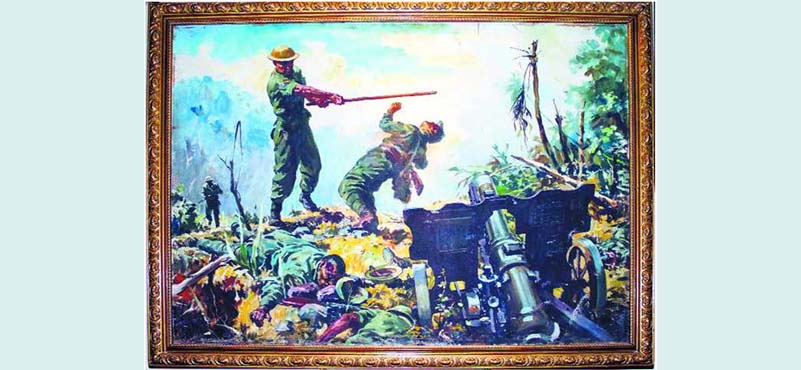
The extraordinary valour of Havildar Umrao Singh, Victoria Cross
For one and a half hours, Japanese guns and mortars hammered the gun position in the darkness of the Kaladan Valley. Then came the infantry. They attacked again and again, determined to overrun the gun position and capture the guns.
Havildar Umrao Singh had already been wounded twice. Around him, his men were being killed or wounded and ammunition was running short. Yet, as the Japanese closed in, he remained at his gun and continued to direct its defence.
It was the night of 15–16 December 1944. Umrao Singh was a field-gun detachment commander in an advanced section of his gun battery of the Royal Indian Artillery, supporting operations against the Japanese in Burma. The position came under intense fire from 75-mm guns and mortars before two Japanese companies launched their first assault.
Umrao Singh’s personal example inspired his men to stand and fight. The first attack was beaten back. Though wounded twice by grenade fragments, he continued to direct the defence. When the Japanese came within five yards of the gun, Umrao Singh took up a Bren gun himself and fired over the shield of the field gun. The attackers were driven back. A third attack followed, and then a fourth. Umrao Singh and his dwindling detachment beat both back. By then, all but two of his men had been killed or wounded. Then came the final assault.
The other gun had been overrun and all the ammunition for Umrao Singh’s gun was exhausted. For most soldiers, there would have been little with which to continue the fight. For Umrao Singh, there was still the gun. He seized a gun bearer and, calling on those who remained, closed with the Japanese in hand-to-hand combat. He was seen to strike down three of them before being overwhelmed and knocked unconscious.
Six hours later, a counter-attack recovered the position. Umrao Singh was found lying beside his gun, exhausted and grievously wounded. He had suffered seven severe wounds. Around him lay ten dead Japanese soldiers. The gun was still there. More remarkably, it was found to be fit to fire. Later that same day, it was back in action.
For this extraordinary act of courage, Havildar Umrao Singh was awarded the Victoria Cross. The official citation described his conduct as a “supreme example of gallantry and devotion to duty.”
The citation records the facts with characteristic military restraint. Behind those few words, however, lay an extraordinary act of courage and endurance. What makes Umrao Singh’s story endure is not simply the number of wounds he suffered or the number of enemy soldiers who fell around him. It is the extraordinary clarity of his sense of duty. He had been wounded. His men were falling. His ammunition was exhausted. The position was being overrun. Yet he continued to fight because the gun remained his responsibility.
There is another dimension to his courage. Umrao Singh was not fighting in isolation from his comrades or merely for the preservation of a weapon. The gun represented the fire support that other soldiers depended upon. To surrender it, was to surrender a capability that could no longer support them.
His determination therefore went beyond personal survival; it was an expression of responsibility towards the mission and those who depended upon him. A Gunner understands this instinctively. The gun is not merely a weapon. Behind it lies a responsibility—to the soldiers being supported, to the mission and to the comrades who depend upon its fire. The Gunner’s duty is to keep the gun firing for as long as the battle demands.
That bond between the Gunner and his weapon has survived generations of technological change. From the primitive gun lines of earlier campaigns to today’s sophisticated artillery systems, the equipment has evolved enormously.
Yet the final responsibility still rests with the gunner who serves, operates and fires the weapon. Umrao Singh carried that responsibility to its most extreme expression.
Much has changed since that night in the Kaladan Valley. The Gunner of today operates sophisticated weapon systems supported by digital fire-control systems, surveillance systems, drones, precision ammunition and increasingly networked battlefields. Range, accuracy and technology have transformed the artillery battle. But technology does not alter the fundamental equation of war. There is still a soldier behind the weapon. There is still a mission to accomplish. And there are still moments when courage, determination and devotion to duty matter more than anything else.
On 28 September every year, celebrated as Gunners Day, the story of Havildar Umrao Singh, VC, deserves to be remembered not merely as an episode from the Burma Campaign or as the citation of a Victoria Cross. It is a reminder of what the word Gunner has always meant.
On that dark night in the Kaladan Valley, a wounded Havildar stood between the enemy and his gun. He had every reason to leave it. He chose not to.
ABOUT THE AUTHOR
 Lt Gen Tarun Chawla, was commissioned into the Regiment of Artillery in Jun 1984. He has served with the United Nations Mission in Liberia and has been an instructor at the College of Defence Management at Secunderabad. The officer has commanded an Artillery Brigade in the LC Sector in J&K, and an Artillery Division as part of Army’s Western Command. He was the Director General Financial Planning, prior to assuming the role of Director General of Artillery.