
Powering Maritime Excellence in an Age of Maritime Insecurity
The Ocean is the Final Auditor
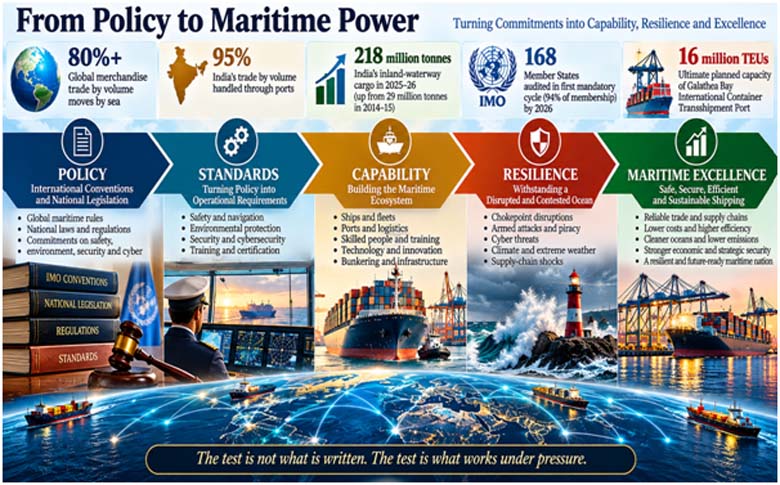
A regulation written on land can save a life only when it reaches the deck of a ship. That is the deeper meaning of World Maritime Day 2026, whose theme, “From Policy to Practice: Powering Maritime Excellence,” could not be more timely. The sailing boat belongs to an older age, when wind, wood and judgement carried commerce across uncertain seas. Today, ships are technological systems, ports are nodes in global supply chains, and oceans are exposed to geopolitical competition. More than 80 per cent of goods traded worldwide by volume move by sea, making maritime transport the backbone of globalisation. For India, about 95 per cent of trade by volume and around 70 per cent by value is handled through ports. The ocean is an economic artery, a security frontier and the final auditor of maritime policy.
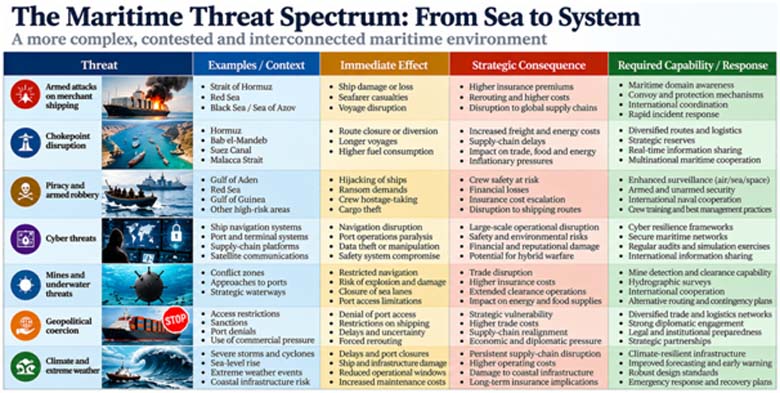
When the Sea Becomes a Battlefield. The maritime environment of 2026 has stripped away any illusion that commercial shipping exists outside geopolitics. The IMO reports that merchant ships have been attacked in multiple conflict zones, including the Strait of Hormuz, the Black Sea and the Sea of Azov, with seafarer deaths and disruption to critical supply chains. In the Strait of Hormuz, the IMO recorded 84 confirmed incidents and 23 seafarer fatalities as of 23 September 2026. In the Red Sea and Gulf of Aden, piracy and armed robbery also remain serious: the IMO recorded 24 incidents during a three-month period in 2026, while global incidents rose from 146 in 2024 to 171 in 2025. These are not isolated statistics. They show maritime policy must account for missiles, drones, piracy, mines, hostage-taking, cyberattack and geopolitical coercion alongside navigational hazards.
The Chokepoint Problem. Shipping vulnerability becomes more consequential at maritime chokepoints. Hormuz, Bab el-Mandeb, Suez and Malacca are geographical passages with economic and strategic significance. When one is disrupted, voyages lengthen, fuel consumption rises, and insurance and freight costs increase. UN Trade and Development warns that maritime disruptions can transmit shocks through freight and insurance costs, energy and food prices, supply chains, currencies and debt markets. Resilience must therefore become a measurable component of maritime excellence. A country that operates efficient ports in normal conditions but cannot absorb prolonged disruption has capacity, but not necessarily resilience. The objective should be continuity: alternative routes, inventories, diversified capacity, reliable information, emergency coordination and rapid recovery. Maritime resilience is consequently no longer a specialist concern of shipping companies or navies. It is an element of national economic resilience, because a disruption at sea can rapidly become a disruption on land.
The Seafarer: The Most Vulnerable Link. At the centre of every maritime system remains a human being. Nearly two million seafarers keep global shipping functioning, often far from home and in areas affected by conflict. The IMO has emphasised that seafarers must not become collateral victims of geopolitical conflicts. Their responsibilities are changing as ships adopt alternative fuels, digital navigation, automation and autonomous systems. Training is more than certification. A crew must respond to fire, cyber incident, collision, security warning, communications loss or attack; masters need timely information; shore authorities must support vessels under stress. The distinction between policy and practice is therefore measured in seconds. A regulation may require an action, but only trained people can execute it under pressure. Maritime excellence begins when legislation, equipment, procedures and human judgement converge on the bridge of a ship. The most sophisticated vessel remains vulnerable if the person operating it lacks the training, information or authority to respond decisively.
From Regulation to Resilience. The central challenge identified by this year’s theme is an implementation gap. The IMO completed its first mandatory Member State Audit Scheme cycle in 2026, covering 168 States, or 94 per cent of membership. Findings showed difficulties translating international rules into national law, shortages of technical expertise and infrastructure, and weak oversight. Maritime excellence cannot be legislated into existence. It requires institutions capable of inspection, certification, search and rescue, pollution response, investigation, enforcement and crisis management. The four tests are simple: Does the rule exist in national law? Can the country implement it? Is compliance monitored? Can the system respond when conditions deteriorate? The fourth is increasingly decisive, because resilience is revealed when something suddenly does not work. This is precisely why the IMO’s two-year 2026–27 theme focuses not merely on adopting rules, but on national legislation, enforcement, training, technical assistance and measurable outcomes.
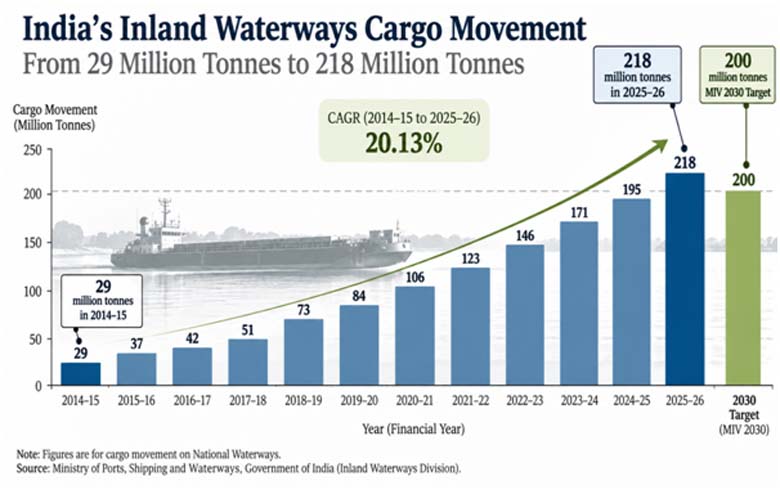
India’s Maritime Equation. India’s maritime geography offers opportunity, but geography becomes power only when converted into capability. With 95 per cent of India’s trade by volume and around 70 per cent by value handled through ports, maritime infrastructure is inseparable from economic security. There are indicators of transformation. Inland-waterway cargo movement rose from 29 million tonnes in 2014–15 to 218 million tonnes in 2025–26, a CAGR of 20.13 per cent, exceeding the 200-million-tonne Maritime India Vision 2030 target. Maritime Amrit Kaal Vision 2047 also seeks transformation across ports, shipping, shipbuilding, logistics, skills, green transition and innovation. Digitalisation is also advancing, with maritime single-window systems and port platforms intended to reduce friction between ships, ports, customs and logistics providers; MSW-Sagarsetu has on-boarded all 12 Major Ports and 56 other-than-Major Ports. The strategic question is larger than throughput: can India’s maritime ecosystem remain functional when shocks disrupt energy flows, shipping routes, insurance, freight markets or critical supply chains?
Galathea Bay: Where Trade Meets Strategy. The proposed International Container Trans-shipment Port at Galathea Bay, Great Nicobar, offers a concrete example of policy becoming capability. The project lies near the Malacca Strait on an international trade route, with natural depth of about 20 metres, suitable for large container ships. Its first phase is planned for about 4 million TEUs, with an ultimate capacity envisaged at 16 million TEUs. Government estimates say nearly 75 per cent of India’s trans-shipped cargo has historically been handled outside India, with Colombo, Singapore and Port Klang handling most of it. The economic case includes lower trans-shipment dependence, foreign-exchange savings, logistics efficiencies and ancillary services such as bunkering, ship repair, crew changes and warehousing. The strategic case is significant. Great Nicobar sits close to major east-west shipping routes and the approaches to the Malacca Strait. An integrated port, airport, communications, logistics and security ecosystem can convert geographical proximity into operational resilience. One port cannot guarantee security; it can, however, become an important node in India’s wider maritime architecture.
The New Maritime Battlefield is also Digital. The maritime threat spectrum is no longer confined to what can be seen from a bridge. Modern ships depend on satellite communications, electronic navigation, operational technology, cargo systems and digital links with ports and shore authorities. A cyber-attack can therefore produce physical-scale disruption without a missile being fired. The IMO has explicitly placed cyber-security, digitalisation and resilience within the practical implementation agenda of the 2026–27 theme. Autonomous shipping is also moving from concept towards regulation. The IMO adopted a non-mandatory Maritime Autonomous Surface Ships Code in 2025, while a mandatory goal-based code is under development. The implications extend beyond technology to accountability, human oversight, cyber protection and emergency intervention. Maritime excellence will increasingly depend on securing both the hull and the network, both the bridge and the algorithm. The future maritime security architecture must therefore integrate physical security with digital resilience rather than treating cyber protection as a separate technical function.
Green Shipping in a Dangerous World. Decarbonising shipping demands new fuels, bunkering infrastructure, port facilities, vessel redesign, safety standards, financing and trained personnel. A regulation requiring lower emissions cannot succeed if the fuel required to comply is unavailable, unaffordable or unsafe to handle. The transition also intersects with strategic resilience. Dependence on particular fuels, technologies, equipment or supply chains can create new vulnerabilities. The objective should be a maritime system that is cleaner, safer, efficient and resilient. Implemented well, these goals can reinforce each other through better infrastructure, modern fleets, efficient ports, data and professional standards. This is another reason why policy cannot remain at the level of declarations. The green transition must be translated into bunkering networks, technical standards, port capabilities, vessel design, crew competence and emergency procedures. Environmental policy becomes maritime capability only when the infrastructure exists to make compliance operational.
Maritime Excellence Is a System, Not a Certificate. The key conceptual shift is to stop treating maritime excellence as a certificate of compliance. Excellence is a system. It is a trained seafarer who can act under pressure, a port that can absorb a surge, a navigation system protected against interference, a cyber network that can withstand attack, a maritime authority capable of responding quickly, and a supply chain with enough redundancy to keep essential goods moving. It is also an environmental regime that prevents today’s efficiency becoming tomorrow’s ecological liability. Maritime performance statistics should therefore extend beyond cargo handled or vessel turnaround. They should include response time, training readiness, cyber resilience, emergency capacity, environmental performance and recovery after disruption. The IMO’s implementation framework captures this broader ambition: safe, secure, efficient and environmentally sound shipping. What cannot be measured is difficult to improve, and what is not practised cannot be called capability.
The Final Mile
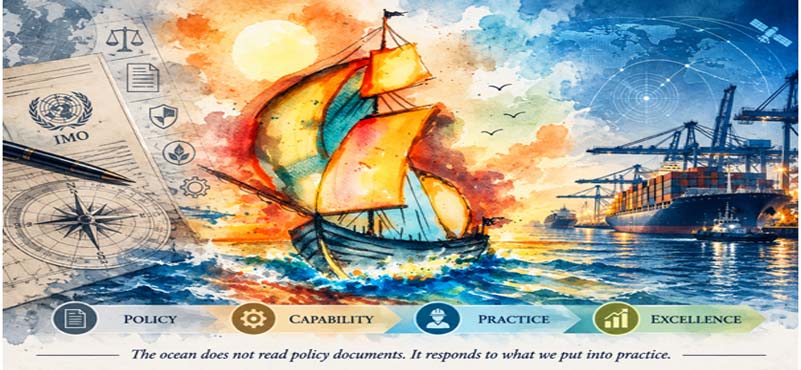
The maritime world has spent decades constructing conventions, codes and institutions. The challenge of 2026 is not to add another layer of aspiration, but to ensure existing commitments survive contact with reality. A regulation matters when it changes behaviour; a technology matters when it improves safety; a port matters when it strengthens connectivity and resilience; and maritime power matters when a nation can keep its economic arteries functioning during uncertainty. From the small sailing vessel in a painting to the autonomous ship navigating a digitally connected ocean, the journey is the same: converting intention into reliable action. The sea rewards preparation and exposes weakness. Amid geopolitical conflict, chokepoint vulnerability, cyber threats and climate transition, that lesson has become strategic.
The ocean does not read policy documents. It responds to what we put into practice.
ABOUT THE AUTHOR

Lt Gen Rajeev Chaudhry (Retd) is a social observer and writes on contemporary national and international issues, strategic implications of infrastructure development towards national power, geo-moral dimension of international relations and leadership nuances in changing social construct.