
A Perspective on the Union Budget 2026
The Union Budget 2026–27, presented on February 1, 2026, comes at a time of heightened global uncertainty, shifting domestic macroeconomic priorities, and India’s ongoing effort to consolidate its position as the world’s fastest-growing major economy. Rather than opting for headline-grabbing announcements, the government has chosen a path of continuity, predictability, and calibrated reform, signalling confidence in the broad direction of economic policy while acknowledging the limits imposed by global and fiscal realities.
Geopolitical and Global Economic Environment
The global economy entering 2026 remains fragile, uneven, and volatile. Global growth is projected at around 3.3 per cent in 2026 and 3.2 per cent in 2027—resilient by post-pandemic standards, yet still below long-term pre-COVID trends. Inflationary pressures, though easing in some advanced economies, remain persistent in parts of the world, while higher-for-longer interest rates continue to weigh on investment sentiment.
Geopolitical tensions, most notably ongoing conflicts in Eastern Europe and West Asia, continue to disrupt energy markets, global trade routes, and investor confidence. Strategic decoupling and geo-economic fragmentation, particularly between the United States and China, are reshaping global supply chains. Protectionist tendencies and industrial policy activism have become defining features of the global economic order.
 In this environment, India is increasingly perceived as a neutral, credible, and stable economic partner. Multinational corporations pursuing “China-plus-one” or diversification strategies view India as a key beneficiary. However, this opportunity is accompanied by risks: volatile capital flows, uncertain export demand, and exposure to global financial tightening cycles. Consequently, the Budget reflects an implicit recognition that India must strengthen domestic growth engines while preserving fiscal space to respond to external shocks.
International institutions echo this cautious outlook. The IMF has noted that technology investments and accommodative financial conditions are helping offset trade headwinds, but warns of downside risks stemming from geopolitical fragmentation and persistent monetary tightening in advanced economies. The World Bank’s Global Economic Prospects estimates global growth at 2.6 per cent in 2026 and 2.7 per cent in 2027, while highlighting that nearly one in four developing economies still has lower per capita income than in 2019. For India, this suggests that external demand, particularly for goods exports, will likely remain subdued, even as services and digital trade show greater resilience.
Against this backdrop, the Budget appropriately leans on domestic demand drivers—public investment, private capex crowd-in, consumption support through employment and productivity gains, and structural reforms—rather than excessive reliance on export-led growth.
Key Highlights of the Budget
Fiscal deficit for FY27 is estimated at 4.3 per cent of GDP, a marginal improvement from 4.4 per cent in the previous year, underscoring the government’s commitment to gradual fiscal consolidation.
Debt-to-GDP ratio is projected at 55 per cent, with a medium-term target of reducing it to 50 per cent by 2030, reinforcing credibility in debt sustainability.
Public capital expenditure has been increased to ₹12.2 lakh crore for FY27, reaffirming the CapEx-led growth strategy.
Total Union expenditure is pegged at ₹53.5 lakh crore, reflecting prioritisation rather than expansionary excess.
₹1.4 trillion has been allocated for tax devolution to states, in line with the 16th Finance Commission’s recommendations, highlighting continued emphasis on cooperative federalism.
Contextual Significance of the Budget
The Budget marks an important moment in India’s medium-term fiscal and developmental trajectory. It follows a full year of the new government’s mandate, a period during which expectations of structural reform, fiscal prudence, and inclusive growth have steadily built up.
Notably, the Union Budget 2026–27 stands out not for dramatic policy shifts but for its emphasis on continuity and consolidation. In a global environment characterised by inflationary pressures, geopolitical fragmentation, and uneven recovery, the government has consciously prioritised stability over surprise. This reflects a strategic choice of deepening earlier reforms, maintaining policy predictability, and focusing on long-term growth drivers rather than short-term populist measures.
The “Three Kartavya” Framework
The Budget is framed around a “three-Kartavya” (three duties) approach—accelerating growth, empowering citizens, and enhancing inclusivity. This framework seeks to balance macroeconomic discipline with developmental aspirations. While the Budget largely meets these objectives on paper, its ultimate success will depend on execution capacity, inter-governmental coordination, and the translation of allocations into measurable outcomes.
CapEx-Led Growth and Infrastructure Push
The centrepiece of the Budget remains its strong emphasis on public capital expenditure, which has risen to ₹12.2 lakh crore—an increase of around 8–9 per cent over the previous year. The government continues to view CapEx as a high-multiplier instrument capable of stimulating employment, crowding in private investment, and raising long-term productivity.
Investments in transport infrastructure, urban development, logistics, and regional connectivity are expected to strengthen supply chains and improve factor mobility. The announcement of seven high-speed rail corridors—linking major economic hubs such as Mumbai–Pune, Pune–Hyderabad, and Chennai–Bengaluru—signals an ambition to modernise India’s transport ecosystem and reduce logistical frictions across key industrial clusters.
However, these ambitions are not without risk. Infrastructure execution in India has historically been constrained by land acquisition bottlenecks, regulatory delays, inter-governmental coordination challenges, financing sustainability, and cost overruns. High-speed rail projects, in particular, are capital-intensive with long gestation periods, raising concerns about affordability, prioritisation, and demand forecasting. Without parallel reforms in project governance, contract enforcement, and institutional accountability, higher allocations alone may not yield commensurate economic returns.
Tax Policy: Predictability without Major Relief
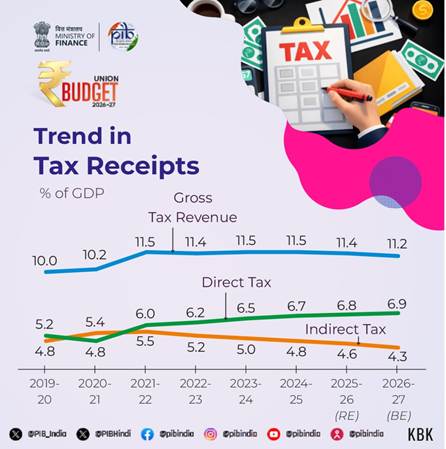
On the taxation front, the Budget prioritises predictability and administrative refinement rather than sweeping reform. Unlike earlier Budgets that introduced significant personal income tax relief, this year saw minimal changes to direct tax rates. While this may disappoint segments of the middle class, it reflects fiscal constraints and the government’s intent to avoid revenue volatility.
That said, procedural improvements. such as staggered return-filing timelines and incremental compliance simplification, are positive steps, particularly for salaried taxpayers and small businesses. However, in a context of stagnant real wage growth and rising living costs, a calibrated and targeted tax relief could have supported consumption without undermining fiscal discipline. The absence of such measures suggests that the government is consciously privileging investment-led growth over consumption-led stimulus in the short term.
Manufacturing Push and Structural Transformation
A defining feature of the Budget is its strong focus on manufacturing and strategic sectors. The expansion of the India Semiconductor Mission (ISM 2.0), the development of rare earth corridors, and targeted support for bio-pharma, chemicals, and textiles reflect India’s ambition to integrate more deeply into global value chains and reduce import dependence.
These initiatives align with the broader objective of technological self-reliance and high-quality job creation. However, manufacturing competitiveness ultimately depends on more than fiscal incentives. Structural constraints, such as labour market rigidities, power reliability, logistics efficiency, regulatory predictability, and contract enforcement, remain critical. Without sustained progress on these fronts, fiscal support may deliver only limited gains in scale and global competitiveness.
Services Sector and Human Capital Alignment
Recognising the continued dominance of services in India’s economy, the Budget proposes the creation of an E2E (Education to Employment and Enterprise) standing committee to better align education outcomes with labour market needs. This is strategically significant, particularly as India aims to expand its share of global services exports in the coming decades.
However, committees and policy frameworks must translate into concrete reforms—curriculum modernisation, vocational training expansion, industry-academia collaboration, and continuous skill upgrading. India’s demographic dividend risks becoming a demographic liability if skill mismatches persist. The effectiveness of this initiative will depend on whether it produces measurable improvements in employability, productivity, and wage outcomes.
MSMEs and the SME Growth Fund
The proposed ₹10,000 crore SME Growth Fund is a welcome recognition of the central role played by MSMEs in employment generation, exports, and innovation. Access to patient and risk capital can help SMEs scale up, adopt technology, and integrate into global markets.
Yet, credit availability is only one part of the MSME challenge. Regulatory complexity, delayed payments, limited digital adoption, and high compliance costs continue to constrain growth. Without complementary reforms to ease doing business at the grassroots level, the impact of the fund may remain uneven. Strong governance, transparent allocation, and outcome-based monitoring will be essential to ensure that genuinely growth-oriented enterprises benefit.
Social Inclusion and Human Capital Investments
The Budget also includes socially inclusive initiatives, such as proposals for girls’ hostels in every district, farm diversification, productivity enhancement, and the formal integration of fisheries into market value chains. These measures reflect a long-term approach to human capital formation and rural income enhancement.
However, relative to the scale of structural challenges—healthcare access, unemployment, learning outcomes, and nutritional deficits—the allocations appear modest. As with many social sector initiatives, success will hinge less on intent and more on implementation quality at the state and district levels.
Financial Sector Reforms and Fiscal Discipline
The proposal to constitute high-level committees to review the banking sector and refine foreign investment frameworks signals an intent to strengthen financial stability and attract long-term capital. A resilient financial system is crucial to sustaining private investment and managing systemic risks in a volatile global environment.
Crucially, the Budget maintains a disciplined fiscal trajectory, with a gradual reduction in the fiscal deficit planned for FY27 and beyond. This reinforces macroeconomic stability and policy credibility, even as it limits short-term spending flexibility.
Conclusion
Overall, the Union Budget 2026–27 represents continuity with calibrated change. It prioritises fiscal discipline, CapEx-led growth, and strategic sectoral support while consciously avoiding populist excesses. Its focus on infrastructure, manufacturing, technology, services, and MSMEs has the potential to strengthen India’s long-term growth prospects and global competitiveness, while inclusive measures aim to enhance social equity.
Ultimately, however, the Budget’s success will depend not on allocations alone but on execution—implementation capacity, institutional reform, and cooperative federalism. If stability is matched by effective delivery, the Budget could provide the foundation for sustained, inclusive, and resilient growth in an increasingly uncertain world.
ABOUT THE AUTHOR
 Dr. Manoranjan Sharma, Chief Economist, Infomerics Ratings is a globally acclaimed scholar. With a brilliant academic record, he has over 350 publications and six books. His views have been published in Associated Press, New York; Dow Jones, New York; International Herald Tribune, New York; Wall Street Journal, New York.