For most of India’s independent history, the idea of a national border conjured a fixed image. A line on a map, a fence, a river, or a ridgeline held by soldiers. That image no longer captures the full range of India’s vulnerabilities. Today, some of the most consequential borders are the channels through which money, data and influence enter the country. These borders are harder to see, harder to regulate and, in many cases, easier to exploit.
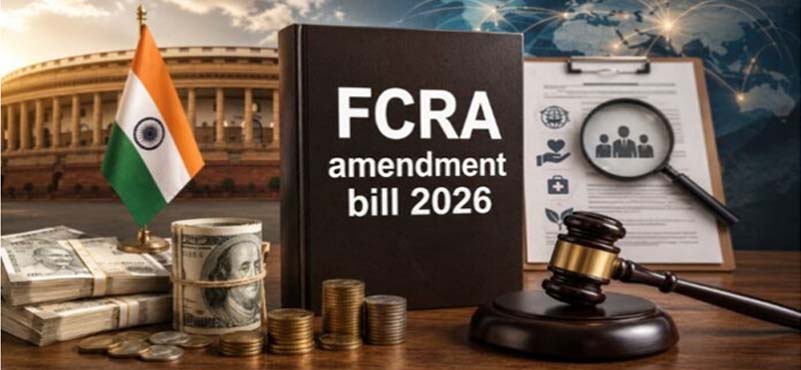
The debate around the Foreign Contribution (Regulation) Amendment Bill, 2026 should therefore be seen as part of a larger national-security question: how does India protect its sovereignty when financial flows and information can cross jurisdictions almost instantly?
Start with the financial border. Three decades ago, moving money across India’s frontier meant a bank draft, a wire transfer routed through a handful of correspondent banks, and a paper trail that a determined investigator could eventually follow. Today, money can move through payment intermediaries, digital platforms and complex financial structures before it reaches an Indian account. That makes tracing the origin and ultimate beneficiary of funds more difficult than it was in the past.
The FCRA framework has had to adapt to this changing environment. The proposed Foreign Contribution (Regulation) Amendment Bill, 2026 remains under consideration in Parliament, while the FCRA Amendment Rules notified in June 2026 are already in force. The Bill proposes a framework for the supervision and management of foreign-funded assets when an organisation’s FCRA registration ends. The Rules introduce more specific requirements relating to registration, utilisation and reporting.
The legitimate policy question is not whether the state should have such oversight. It is how that oversight can be exercised without creating disproportionate discretion or weakening legitimate civil society activity.
India is not alone in confronting this challenge. Major democracies have strengthened mechanisms to identify foreign capital, foreign influence and transactions that may carry national-security implications. These legal instruments are not direct equivalents of the FCRA. Their broader lesson, however, is relevant to India: foreign money can have implications beyond economics when it intersects with strategic sectors, public institutions or social outcomes. Greater transparency is therefore legitimate, provided the rules remain clear, proportionate and subject to review.
The digital border tells a parallel story. India has built extraordinary real-time payment infrastructure through UPI, but the same digital speed can complicate the detection of illicit financial flows. Financial crime can move through layered transactions, payment intermediaries and digital platforms that do not fit neatly into traditional regulatory categories. The challenge for the state is visibility: who is moving money or information, through which channel, for what purpose, and with what potential consequence for India?
The two borders converge where foreign funding and information influence intersect. A foreign-funded organisation may lawfully conduct research, advocate a position or campaign for a public cause. That activity should not be treated as suspicious merely because it is critical of government policy. The concern arises where there is evidence of foreign direction, financing or coordination designed to influence Indian institutions or public discourse outside the law.
The FCRA framework can provide financial visibility; cyber and digital institutions can provide another part of the picture. The policy challenge is to connect these capabilities without turning legitimate dissent into a security offence.
This wider framing has gained ground in public debate, shifting the conversation on the FCRA Bill beyond religion towards questions of economic, strategic and institutional security. Any such argument, however, must rest on evidence rather than assumption. If foreign funding is alleged to have influenced regulatory decisions, commercial interests or strategic infrastructure projects, the funding trail, institutional connection and resulting activity should be demonstrated.
The Andaman and Nicobar Islands are an important example because of their strategic and economic significance, but any claim that foreign funding has influenced such projects must be supported by evidence. Financial transparency can identify relationships and funding flows; it cannot, by itself, establish an influence operation.
On religious activity, precision matters. The FCRA framework regulates the acceptance and use of foreign contribution and restricts specified activities. The 2026 Rules set out permissible faith-based purposes more specifically, including maintenance of places of worship, religious education, moral instruction and preservation of faith traditions. These provisions apply across communities.
The important distinction is between legitimate religious activity and the use of foreign contribution for purposes outside the legal framework. Enforcement should therefore rest on conduct, funding and evidence, not religious identity.
Critics of the Bill have argued that its implications for civil society and minority-run institutions warrant greater parliamentary scrutiny. They also question the proposed asset-vesting mechanism. The Bill provides for provisional vesting when an organisation’s FCRA registration ends, with restoration if registration is restored. Permanent vesting is proposed in specified circumstances if registration is not restored within the prescribed period, or where an organisation has ceased to exist or become defunct. Orders of the Designated Authority would be subject to revision and judicial appeal.
These safeguards are important, but their effectiveness will depend on clear criteria, recorded reasons and meaningful review.
This is where the constitutional dimension becomes critical. A state must have the power to protect national security, but the exercise of that power must remain bounded by law. Greater visibility into financial flows also means greater state power. That power requires procedural discipline, particularly where property, civil society activity or fundamental rights may be affected.
Agencies dealing with cross-border financial intelligence need clear legal boundaries, appropriate oversight and an auditable record of how sensitive information is obtained and used. India has built considerable technical capability in financial intelligence, digital payments and cyber security. The next step is to build an accountability architecture of equal strength. That is not a concession to critics of national security policy. It is what makes national security policy legitimate, durable and trusted.
There is also a competitiveness argument. Investors and legitimate civil-society organisations prefer jurisdictions where rules are clear, and enforcement is predictable. India’s long-term interest lies in firm but transparent oversight. A legitimate foreign contribution should be distinguishable from a suspicious one, and an organisation acting lawfully should know what compliance requires before enforcement begins. Clarity reduces litigation, improves compliance and strengthens the credibility of the regulatory system.
The Bill also proposes to reduce the maximum imprisonment for violations from five years to one year. This is worth noting because the legislation is not simply an expansion of punitive power. It combines stronger administrative control in some areas with a lower maximum criminal penalty.
The task ahead is not simply to strengthen FCRA or cybersecurity in isolation. India needs an integrated framework for foreign influence across money, data and narrative. Relevant agencies should be able to share information within clearly defined legal mandates rather than operate in separate silos.
That framework should rest on five safeguards: clear statutory thresholds, recorded reasons for coercive action, effective review and appeal where provided by law, judicial oversight where fundamental rights are engaged, and periodic parliamentary scrutiny.
This is not an argument for closing India to the world. India benefits enormously from legitimate international engagement in education, health, science, disaster relief, religion, research and civil society. It is an argument for knowing where foreign money comes from, how it moves and what it seeks to influence. A confident democracy does not fear legitimate foreign engagement. It insists on transparency when foreign money, information or organised influence can affect its strategic interests.
The border India needs to guard most carefully in this decade is not only the line on a map. It is the space where money, data and narrative converge. Influence can travel through that space without a uniform, without a vehicle and sometimes without an obvious trail.
The FCRA 2026 debate is an important part of that larger conversation. It should be judged not only by the powers it gives the state, but also by the clarity of its rules, the evidence required for enforcement and the safeguards built around those powers.
India does not have to choose between sovereignty and openness. It has to build a system capable of protecting both.
ABOUT THE AUTHOR
 Lieutenant General A B Shivane, is the former Strike Corps Commander and Director General of Mechanised Forces. As a scholar warrior, he has authored over 200 publications on national security and matters defence, besides four books and is an internationally renowned keynote speaker. The General was a Consultant to the Ministry of Defence (Ordnance Factory Board) post-superannuation. He was the Distinguished Fellow and held COAS Chair of Excellence at the Centre for Land Warfare Studies 2021 2022. He is also the Senior Advisor Board Member to several organisations and Think Tanks.