How China, Russia and India are redrawing Eurasia—not with borders, but with corridors
When Moscow Looked South
Sometimes a railway proposal tells us more about geopolitics than a summit meeting does.
On 9 August 2026, Russia floated an idea that would have sounded almost fanciful a decade ago: exploring a direct railway connection from Russia towards India and the Indian Ocean, potentially traversing Central and South Asia. Russian Deputy Prime Minister Marat Khusnullin argued that such a connection could reduce Russia’s vulnerability to maritime chokepoints such as the Bosphorus and the Strait of Hormuz.
The proposal is still exactly that—a proposal. It is not yet a funded corridor, nor a railway whose alignment has been settled. But its strategic significance lies elsewhere. It tells us how Moscow is beginning to think about geography. Russia is no longer looking only Westwards towards Europe, or Eastwards towards China. It is looking Southwards towards the Indian Ocean.
That is a profound shift.
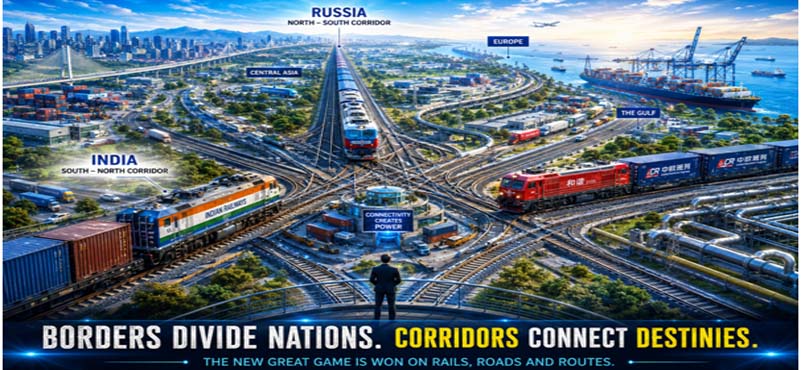
For Russia, connectivity is becoming an instrument of strategic resilience. The International North-South Transport Corridor, conceived by India, Russia and Iran in 2000, already envisages a roughly 7,200-kilometre multimodal connection between Russia, Iran and India, with extensions into the wider Eurasian space. The Ukraine war and Western sanctions have given the project renewed urgency.
The new Russian proposal therefore should not be viewed as an isolated railway idea. It is another expression of a much larger transformation: Eurasia is being re-engineered through connectivity.
The railway is not merely seeking a route to India; Russia is seeking a route out of strategic vulnerability.
The New Great Game
The Great Game has not disappeared; it has changed its vocabulary.
The 19th-century contest between empires was fought over territory, mountain passes and political influence. The 20th century added ideology, military alliances and nuclear deterrence to the equation. The 21st century is quietly introducing another instrument of power: connectivity.
A railway can determine where goods move. A port can determine where trade terminates. A pipeline can determine who receives energy. A logistics hub can determine which country becomes commercially indispensable. Fibre-optic cables can determine how information travels.
Infrastructure, therefore, is no longer merely the physical foundation upon which an economy operates. Infrastructure itself is becoming an instrument of statecraft. The logic is simple. Infrastructure creates connectivity. Connectivity creates trade. Trade creates economic dependence. Dependence creates leverage. And leverage, when sustained over time, becomes geopolitical influence.
This is why China’s Belt and Road Initiative, Russia’s North-South ambitions and India’s IMEC and INSTC cannot be treated simply as transport projects. They are competing visions of how Eurasia should breathe.
The new Great Game is no longer fought primarily over who owns the land; it is fought over who controls the routes through which the land trades.
China: Building the Network
China understood earlier than most that the power of infrastructure lies not in individual projects but in networks.
The Belt and Road Initiative has consequently evolved far beyond the image of a Chinese-funded railway or highway. Its architecture encompasses ports, railways, highways, pipelines, power infrastructure, industrial parks, telecommunications and logistics systems across a vast geography. Central Asia occupies a particularly important place in this network because it provides China with a Western continental bridge towards Russia, the Caspian region, the Middle East and Europe.
The genius of the BRI is therefore not necessarily that every individual project will generate spectacular commercial returns. Its deeper significance lies in creating connectivity ecosystems. Over time, physical infrastructure can therefore produce something far more valuable than toll revenue: structural influence.
China is moving from being the factory of Eurasia to becoming one of the architects of how Eurasia connects.
Russia: Searching for Strategic Redundancy
Russia’s connectivity strategy is being driven less by expansion than by the fear of isolation.
For Moscow, geography has always been both an asset and a vulnerability. Russia spans Europe and Asia, possesses immense natural resources and occupies enormous strategic space. But its traditional economic arteries have been heavily oriented towards Europe, while several important maritime exits are vulnerable to geopolitical disruption.
The post-2022 world has made this vulnerability impossible to ignore.
The response is diversification. The INSTC is therefore acquiring a significance beyond its commercial promise. It offers Russia a route southwards through Iran towards the Persian Gulf and India. Its eastern possibilities can also connect into Central Asian networks. Yet the corridor still has serious physical and geopolitical constraints, including incomplete rail links and infrastructure bottlenecks.
The newly floated Russia-India railway idea takes this thinking one step further. Its importance is not whether a Moscow-to-India railway becomes operational tomorrow—or even whether the exact proposal ultimately materialises. Its importance is that Moscow is thinking in terms of alternative arteries.
In geopolitics, redundancy is not inefficiency. It is insurance. A country with one route is vulnerable to disruption. A country with several routes possesses choices. And choices, in international affairs, are power.
Russia’s new connectivity doctrine can therefore be reduced to one word: resilience.
Central Asia: From Buffer to Bridge
The most consequential transformation may not happen in Moscow, Beijing or New Delhi, but in the landlocked heart of Eurasia.
For centuries, Central Asia was primarily a buffer between competing empires, its geography defined by frontiers, invasions and spheres of influence. That meaning is changing. Kazakhstan, Uzbekistan, Turkmenistan, Kyrgyzstan and Tajikistan are increasingly becoming connectivity states—not merely countries located between major powers, but bridges between competing economic regions. Railways, highways, pipelines and logistics hubs can convert geographical disadvantage into strategic relevance. Kazakhstan can connect China with Europe; Uzbekistan can open routes towards Afghanistan and South Asia; Turkmenistan can connect the Caspian with Iran and beyond.
As multiple corridors converge, Central Asia could acquire something it historically lacked: choice. And choice creates bargaining power. The emerging Eurasian network will therefore not be a collection of isolated corridors but an interconnected mesh linking China, Russia, Iran, India, the Gulf and Europe. A single corridor is vulnerable; a network offers alternatives. The country—or region—with multiple viable routes possesses resilience, commercial leverage and strategic autonomy.
Central Asia is thus moving from being Eurasia’s buffer zone to becoming its connectivity bridge—and the future contest will be over the most resilient network, not merely the longest corridor.
China–Russia Paradox
China and Russia may be strategic partners today, but connectivity could eventually expose an uncomfortable asymmetry between them.
Russia retains enormous military, political and historical influence across Central Asia. China, however, possesses growing economic weight. That distinction matters.
China is increasingly capable of becoming the principal economic connector between Central Asia and the wider global economy. Russia remains deeply embedded in the region’s security architecture and historical relationships.
The two systems can coexist for years, perhaps decades.
But infrastructure changes relationships slowly and silently. If Central Asian trade, investment and supply chains increasingly orient themselves towards China, Russia’s traditional influence could gradually become more security-centric and less economically central.
Moscow therefore faces an interesting paradox. It needs connectivity with China. But it also needs connectivity that prevents excessive dependence upon China. That is where India becomes strategically important. India is not simply another market for Russia. It can become an alternative economic pole in a Eurasian network in which Russia does not have to choose between dependence on the West and dependence on China.
Russia’s search for a route to India is therefore also a search for strategic space between Europe and China.
The Larger Strategic Equation
What is emerging across Eurasia is not a conventional contest for spheres of influence but a competition to shape the arteries of the future.
China brings capital, manufacturing scale and network-building capacity. Russia brings geography, resources and an enormous Eurasian footprint. India brings a vast market, an expanding economy and something uniquely valuable: access to the Indian Ocean combined with relationships spanning East, West and Central Asia.
Their strategies are therefore different.
China seeks connectivity for influence. Russia seeks connectivity for resilience. India must seek connectivity for strategic autonomy.
And that final distinction is likely to determine India’s place in the emerging Eurasian order. Because India’s objective should not be to defeat China’s connectivity architecture. It should be to ensure that India has enough alternative routes that nobody can hold India’s connectivity hostage.
The great strategic question is no longer who builds the road; it is who has the freedom to choose which road to take.
Indian Connectivity Arc: IMEC to Indian Ocean
India’s connectivity strategy should not be viewed as a collection of individual projects, but as an integrated architecture of strategic access.
IMEC can become India’s Western bridge to Europe, connecting Indian manufacturing with Gulf capital, energy and logistics and European markets, but its passage through a volatile Middle East makes redundancy essential. Chabahar is India’s continental gateway, providing access to Afghanistan and Central Asia while bypassing Pakistan and linking potentially with the INSTC towards Russia and the Caspian.
The Gulf itself is evolving from India’s traditional energy reservoir into a strategic logistics and investment partner, with its ports, capital, energy systems and emerging industrial capabilities giving it a central role in India’s western connectivity. Yet India’s greatest and most enduring advantage remains the Indian Ocean. The Arabian Sea links India with the Gulf, Africa and Europe, while the Bay of Bengal opens the route to Southeast Asia and the wider Indo-Pacific. This unique geography allows India to become the southern hinge between continental Eurasia and maritime Asia. The objective, therefore, is not to choose between IMEC, Chabahar or INSTC, but to make them mutually reinforcing.
India’s strategic advantage will lie not in owning one corridor, but in becoming indispensable to several.
Three Giants, Three Geopolitical Models
The emerging connectivity competition reveals three distinct models of power.
China is the Network Builder. It seeks to construct the physical, economic and digital architecture through which Eurasia increasingly interacts.
Russia is the Resilience Seeker. It wants multiple routes to markets so that geopolitical confrontation cannot isolate it from the global economy.
India can become the Network Balancer. It does not need to own the network. It needs to ensure that several networks intersect with India and that none can exclude India. That distinction could become India’s greatest strategic advantage.
China’s strength is scale.
Russia’s strength is geography.
India’s strength is connectivity optionality.
And optionality becomes particularly powerful when combined with a huge market, a growing economy and a strategic location between East and West.
China wants to build the network around itself; Russia wants enough networks to avoid isolation; India must build enough networks to remain dependent on none.
Infrastructure: The New Geopolitical Power
The 21st century may ultimately be remembered as the age when infrastructure stopped being the servant of geopolitics and became one of its principal instruments.
China is building networks to expand its economic and strategic influence. Russia is seeking alternative arteries to preserve its strategic space. India stands at a unique crossroads. It can watch these networks pass around it. It can choose one camp. Or it can do something much more ambitious.
It can become the hinge through which several of them intersect.
The Russian railway proposal, whether it eventually becomes steel on the ground or remains an idea on paper, has already performed an important strategic service. It has exposed the direction in which Eurasian geopolitics is moving.
Russia is looking towards India. China is building across Eurasia. The Gulf is becoming a logistics and investment hub. Central Asia is becoming a bridge rather than a buffer. Europe is searching for resilient Asian supply chains. And India sits where the continental and maritime worlds meet.
The strategic opportunity is therefore larger than IMEC. Larger than INSTC. Larger than Chabahar. Larger even than BRI. It is the emergence of a new Eurasian connectivity architecture in which roads, railways, ports, pipelines, cables, data and trade routes become instruments of national power.
The winners will not necessarily be those who build the most infrastructure. They will be those who create the greatest freedom of movement, freedom of choice and freedom from dependence. For India, that is the essence of strategic autonomy in the age of connectivity.
And perhaps the most consequential geopolitical truth of all is this: Borders tell us where countries end. Corridors will increasingly tell us where their influence begins.
ABOUT THE AUTHOR

Lt Gen Rajeev Chaudhry (Retd) is a social observer and writes on contemporary national and international issues, strategic implications of infrastructure development towards national power, geo-moral dimension of international relations and leadership nuances in changing social construct.