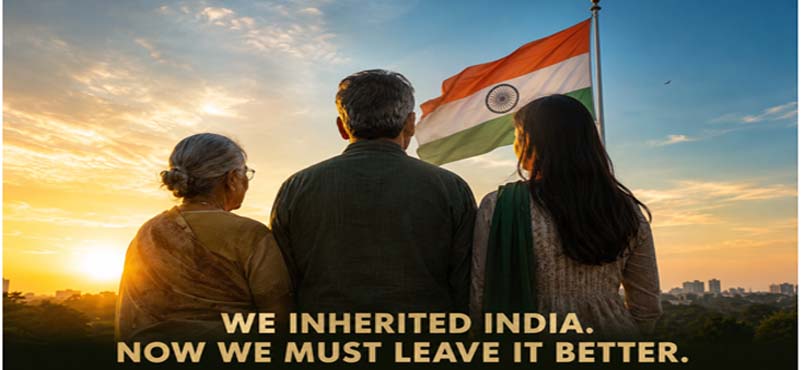
My mother was born in 1944. She was three years old when India became free. She could not possibly have understood what was happening on that August morning in 1947, when the Tricolour rose over a country that had just awakened from two centuries of colonial rule. Yet, at eighty-two, she has lived almost the entire life of independent India. She has watched it grow from a hesitant young Republic into a country that today speaks with confidence to the world.
I was born in 1963. My India was different. I grew up in a country still learning how to stand on its own feet, where scarcity was familiar, opportunities were fewer and ambition had to work harder for expression. I saw India pass through wars and droughts, through uncertainty and political turbulence, through the licence-permit era and finally into the economic opening of 1991. I entered the Army and spent four decades seeing another India—an India of soldiers, mountains, villages, roads, bridges and frontiers; an India that often lived far beyond the cities that spoke about it.
My daughter was born in 1991, the year India began opening its windows to the world. Her childhood belonged to a different country. Liberalisation, television, computers, the internet, mobile phones, global travel, startups and digital technology were not historical events to her. They were simply the world she knew.
Three generations. Three different Indias.
My mother inherited a nation that had just found freedom. My generation inherited a nation that was still finding its feet. My daughter inherited a nation beginning to find its confidence. The young Indians of today are inheriting something far more consequential: a country that increasingly believes it can shape its own destiny.
Every generation receives an India. Every generation must decide what India it will leave behind.
My mother’s generation had very little, but it possessed something invaluable—faith. They believed that this country could become better. They accepted hardship without believing that hardship was India’s destiny. They built schools when there were too few, dams when resources were scarce, factories when technology was limited and institutions when experience was minimal. They built quietly, patiently and often without recognition.
My generation grew up watching that belief become reality, slowly and unevenly. We saw roads stretch further, electricity reach more homes, education expand, industries emerge and technology transform possibilities. We saw India fight wars, overcome crises and repeatedly discover reserves of resilience that even Indians sometimes underestimated.
For me, however, India was never an abstraction. She was the flag on a soldier’s shoulder. She was the young man standing at a remote post in freezing winds. She was the road worker cutting through a mountain so that a village could finally feel connected to the country whose flag flew above it. She was the child in a border village looking at a bridge and discovering that the Republic had not forgotten him.
I spent forty years in uniform. In those years I learnt something that no textbook could have taught me: a nation is not merely its territory, institutions or economy. A nation is a relationship between millions of ordinary people and an idea larger than themselves.
A country becomes powerful when its people begin believing that their own effort matters to its destiny.
That is perhaps the greatest transformation I have witnessed.
The India my mother saw was struggling for capability. The India I served was building capacity. The India my daughter inherited began discovering possibility. The India her generation is handing to the young today has the opportunity to become a national force of extraordinary scale.
But this is precisely where our responsibility becomes greater.
For the first time in our history, we have enough capability to dream very big. Yet capability without character can become arrogance. Technology without wisdom can become distraction. Freedom without responsibility can become licence. And criticism without the willingness to contribute can slowly turn into cynicism.
This is where I would make a humble request to India’s young.
Do not stop questioning India. A healthy democracy needs questions. Do not stop challenging governments or demanding accountability. Institutions become stronger when citizens insist that they perform better. Do not surrender your right to protest when something genuinely demands protest. But remember the difference between dissent and destruction, between criticism and contempt, between protest and paralysis.
You have every right to question the Republic. But you also have a responsibility to strengthen it.
Do not allow a social-media feed to become your definition of India. Do not mistake every failure for proof that the country itself has failed. Do not become so fascinated by what is broken that you become blind to what is being built.
And above all, do not inherit cynicism from anyone.
India has faults. She has inequality, corruption, injustice, poverty, institutional weaknesses and social divisions that demand our attention. Pretending otherwise is neither patriotism nor honesty.
But there is another truth.
India has lifted hundreds of millions from deprivation. She has built capabilities that earlier generations could scarcely imagine. She has sent spacecraft into the unknown, connected villages with roads and digital networks, produced scientists, entrepreneurs, soldiers, doctors, engineers, artists and innovators who compete anywhere in the world. She has preserved a civilisation of extraordinary diversity while remaining a functioning democracy.
The answer to India’s imperfections cannot be hatred of India. It must be more India.
More integrity. More competence. More compassion. More enterprise. More discipline. More scientific temper. More civic responsibility. More courage to cross the fault-lines that have divided us. We have spent too much time asking who is responsible for the country we have. Perhaps the more important question now is:
What are we prepared to do for the country we want?
India’s next transformation will not come from one government, one political party, one institution or one generation. It will come from millions of focused efforts converging towards a common national purpose. This is where the idea that the Republic starts at me becomes more than a phrase. It becomes a personal contract.
The Republic does not begin in Parliament alone. It begins at home, in classrooms, laboratories, farms, offices, factories, barracks and streets. It begins whenever a citizen chooses duty over convenience, excellence over mediocrity and nation over narrowness.
And now I look at the young and wonder what India they will create.
They need not agree with us. They need not think like us. They need not preserve every idea we inherited. Every generation has the right to reinvent its country. But they must never lose faith in the possibility of India. Because nations are not destroyed only by enemies. Sometimes they weaken when their own citizens stop believing that they are worth building.
So, as India celebrates its 80th Independence Day, perhaps we should not merely ask how far she has travelled. We should ask ourselves what she expects from us now.
India is not our inheritance. It is our assignment. And our time to deliver it is now.
ABOUT THE AUTHOR

Lt Gen Rajeev Chaudhry (Retd) is a social observer and writes on contemporary national and international issues, strategic implications of infrastructure development towards national power, geo-moral dimension of international relations and leadership nuances in changing social construct.