
The Great Nicobar Island Development Project
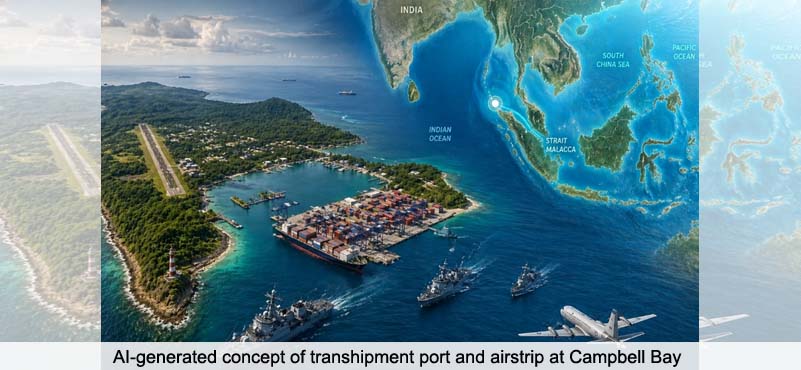
India’s strategic geography in the Eastern Indian Ocean is undergoing a transformational shift with the Great Nicobar Island Development Project, anchored on Campbell Bay and the broader Great Nicobar framework. This plan aspires to combine an International Container Trans-shipment Port (ICTP) at Galathea Bay, an international dual-use airport, enhanced strategic infrastructure and associated civil-military facilities to create a forward maritime node that leverages proximity to the Strait of Malacca — one of the world’s most crucial sea lines of communication (SLOCs).
The inherent logic of this initiative arises from a convergence of economic, security and geopolitical imperatives: establishing India as a credible trans-shipment hub, strengthening maritime domain awareness, enabling rapid deployment across the Eastern Indian Ocean and, crucially, anchoring a sustained sovereign presence at the maritime crossroads linking the Indian Ocean with Southeast Asian and Pacific trade routes.
Geography and Strategic Geometry
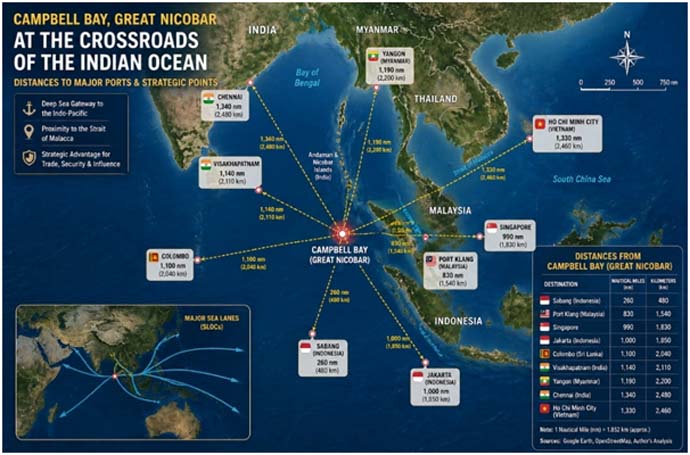
Great Nicobar is India’s Southernmost landmass, located roughly 150–200 km from the Northwest tip of Indonesia’s Sumatra and directly overlooking the key maritime corridors leading into the Malacca Strait and beyond. Positioned near the Six-Degree Channel — the navigational route separating Great Nicobar from Sumatra — the island serves as an unparalleled geographic vantage for observing and, if necessary, influencing maritime traffic belonging to both commerce and naval assets in the Indo-Pacific theatre.
Campbell Bay and Galathea Bay, situated on the North-eastern and South-eastern coasts respectively, sit within this strategic geometry. The Galathea Bay ICTP is proposed to be situated less than 50 km from the existing naval air base at Campbell Bay (INS Baaz), forming a tight constellation of economic and strategic infrastructure.
Malacca and SLOC Imperatives
The Strait of Malacca — a narrow seaway between the Malay Peninsula and Sumatra — handles a significant proportion of global trade, including crude oil from the Middle East, manufactured goods from East Asia, and containerised cargo destined for Europe. Its strategic value is amplified by the absence of viable alternative routes that are as efficient or direct.
Given this backdrop, Campbell Bay and Galathea Bay’s geographic proximity to the Malacca corridor offers a rare opportunity for India to host infrastructure that captures not only economic opportunities but also provides a forward platform for maritime security engagement. Such a position permits faster response times for surveillance, interdiction, humanitarian assistance/disaster relief (HADR) missions and sustainment operations spanning from the Bay of Bengal to the wider Indo-Pacific.
The Great Nicobar Project: Components and Rationale
Launched in 2021 under the aegis of NITI Aayog and approved by the Ministry of Environment, Forest & Climate Change, the Great Nicobar Project is envisioned as a ₹81,000 crore multi-decadal initiative. Its core constituents include: a deep-draft International Container Trans-shipment Terminal (ICTP) at Galathea Bay; a greenfield, dual-use international airport; power generation (gas/solar hybrid); township development; and associated logistics and marine support infrastructure.
The economic rationale is clear: today India’s trans-shipment dependence lies heavily on foreign hubs such as Singapore, Colombo and Port Klang. A functional ICTP at Great Nicobar, with natural depths >20 m and direct access to major East-West shipping lanes, could reduce logistic costs, time-in-transit and India’s reliance on external logistical chokepoints.
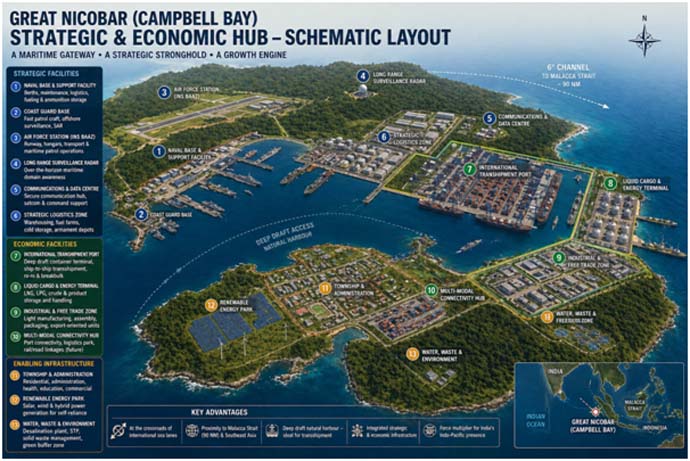
From a strategic vantage, this infrastructure could anchor India’s forward presence, dovetailing with Maritime India Vision 2030 to not only catalyse economic growth but also fortify national security objectives in the Indo-Pacific.
Military Facilities: Upgradation & Strategic Value
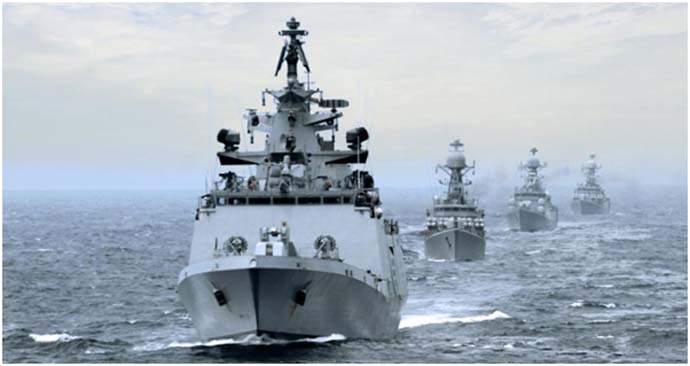
Naval Component: Forward Maritime Power and Sea Control
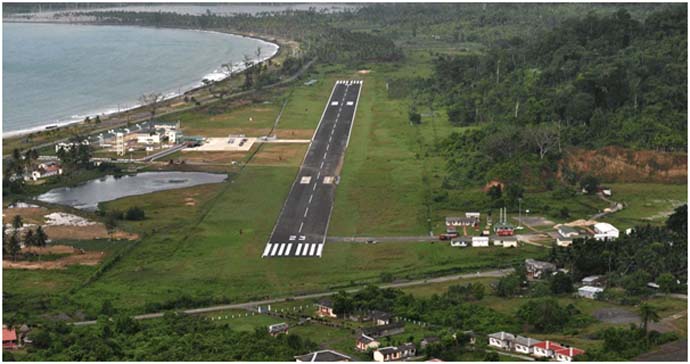
Existing infrastructure at Campbell Bay includes INS Baaz, the Indian Navy’s Southernmost air station, commissioned in 2012 to monitor the Six-Degree Channel and serve surveillance roles over the Indian Ocean approach. Historically, INS Baaz has operated reconnaissance aircraft like the Dornier 228 and rotary assets, while infrastructure improvements have aimed at accommodating larger platforms. Forward airfield upgrades — coupled with the planned greenfield dual-use international airport at Galathea Bay — are set to enhance rapid deployment, force projection, and air logistics support for both military and civil purposes.
Naval planners view the Six-Degree Channel and approaches to the Malacca Strait as critical monitoring zones. Persistent maritime domain awareness (MDA) requires layered assets: long-range maritime patrol aircraft, unmanned aerial systems, undersea sensors and surface combatants. Infrastructure upgrades at Campbell Bay would allow rotational basing of P-8I aircraft, improved data-fusion centres and integration into India’s Information Management and Analysis Centre (IMAC) network.
Forward replenishment capability is equally important. In crisis contingencies, the ability to refuel and rearm closer to operational theatres enhances endurance and deterrence credibility. A logistics node at Great Nicobar reduces dependence on mainland bases and supports distributed maritime operations, a doctrinal shift increasingly emphasised in Indian naval thought.
The naval component must also consider undersea surveillance. Submarine movements through Malacca and adjacent channels remain strategically significant. Establishing seabed acoustic arrays, seabed mapping infrastructure and anti-submarine warfare (ASW) coordination cells in the vicinity of Campbell Bay would reinforce India’s situational awareness.
Air Force Infrastructure
The proposed airport is intended to be controlled in its airside operations by the Indian Navy and Indian Air Force (IAF) for tactical and strategic missions, while the civil apron and passenger facilities can be managed by the Airports Authority of India (AAI). This dual-use model mirrors other successful integrated facilities globally and is critical in ensuring that the infrastructure operates flexibly across defence and civilian domains.
Enhanced airfield capabilities at Campbell Bay and Galathea Bay would allow increased sorties by maritime patrol aircraft (including long-range IAF assets), Airborne Early Warning & Control platforms, and rapid airlift operations for logistics and HADR. In addition, the upgraded runways and support facilities could support fighter, transport and AEW&C aircraft on rotational basing — extending India’s air power footprint to the heart of the Eastern Indian Ocean.
Army Presence and Coastal Defence Infrastructure
Strategic infrastructure upgrades for the Indian Army around Great Nicobar are equally essential. While explicit open-source details remain limited on precise Army deployments on Great Nicobar, broader defence modernisation plans for the Andaman and Nicobar Islands envisage enhanced troop accommodations, integrated coastal artillery or missile batteries, and expanded logistics hubs to support rapid land force insertion and defence of key installations.
These upgrades would enhance survivability and rapid response at the island level — a key attribute if maritime lines of communication are contested or if joint operations are necessary in a large-scale contingency. Future Army infrastructure could include hardened barracks, ammunition depots with protective blast shelters, advanced surveillance radars and coastal defence towed launch systems under Indian Army engineers, integrated closely with naval and coast guard networks.
Indian Coast Guard Expansion
The Indian Coast Guard (ICG) plays a complementary role in maritime security, particularly in peacetime roles such as anti-smuggling, anti-piracy, fisheries protection, and search & rescue. In the Andaman and Nicobar Islands, Coast Guard assets operate under the broader command but have distinct vessels and aviation elements.
Upgrading ICG facilities in the region — including at Campbell Bay — would reinforce a layered maritime security architecture. Potential enhancements include dedicated ICG coastal surveillance radar stations, expanded base facilities for Fast Patrol Vessels (FPVs), hovercraft units for shallow coastal zones, forward operating refuel and supply depots, and joint air-sea coordination centres that link naval, air force and ICG platforms.
Strengthened ICG presence not only supports civilian maritime domain tasks but also acts as a force multiplier for national security missions, especially in multi-agency operations alongside the Indian Navy and Indian Air Force.
Joint Force Integration through ANC
The Andaman and Nicobar Command (ANC) remains India’s only tri-service command. Strengthening Campbell Bay aligns directly with ANC’s mandate of integrated operations across maritime, air and land domains.
Tri-service integration requires more than infrastructure; it demands interoperable command-and-control systems, shared logistics frameworks and common operational doctrine. A future-ready Campbell Bay could host a Joint Operations Centre (JOC) linking naval task groups, IAF surveillance aircraft, Army coastal defence units and Coast Guard patrol elements into an unified battle-space picture.
Joint logistics hubs reduce duplication and improve responsiveness. For instance, shared fuel depots, ammunition storage and medical facilities can support multiple services while preserving operational redundancy. Hardened shelters and protected communication nodes would increase survivability against natural disasters and potential hostile action.
From a doctrinal standpoint, Great Nicobar offers a laboratory for India’s evolving integrated theatre command concept. The island’s geographic compactness allows testing of joint logistics, rapid reinforcement protocols and maritime-air coordination under realistic operational constraints.
Regional Geopolitics and Strategic Signalling
The Indo-Pacific strategic environment is increasingly shaped by maritime competition, infrastructure diplomacy and strategic partnerships. China’s port investments across the Indian Ocean — often described as a “String of Pearls” — have intensified India’s focus on sovereign maritime capabilities.
Campbell Bay, positioned near one of the world’s most vital chokepoints, inevitably carries geopolitical symbolism. Yet the project need not be framed as confrontational. Instead, it can be presented as a stabilising infrastructure initiative serving global commerce, humanitarian response and regional connectivity.
India’s participation in multilateral groupings such as the Quad underscores the importance of resilient maritime supply chains and secure sea lanes. Enhanced facilities at Great Nicobar could support joint exercises, coordinated patrols and humanitarian assistance operations without compromising sovereignty. India’s approach should prioritise calibrated dual-use development rather than overt base expansion. Transparent communication with ASEAN partners and adherence to international maritime norms will mitigate perceptions of escalation.
Infrastructure alone does not confer influence; credibility depends on sustained operational presence, diplomatic engagement and economic viability. Therefore, Campbell Bay should complement, not replace, India’s broader maritime outreach through SAGAR (Security and Growth for All in the Region).
Environmental, Tribal and Social Considerations

Great Nicobar Island is ecologically rich and hosts endemic species and important nesting sites (e.g., giant leatherback turtles). The island’s forests, mangroves and biodiversity hotspots have raised concerns among environmentalists regarding large-scale infrastructure development.
Indigenous communities, including the Nicobarese and particularly the vulnerable Shompen, are among the most affected stakeholders. Questions remain about land rights, cultural preservation and socio-economic impacts. The rights and welfare of Indigenous communities remain paramount. Ensuring meaningful consultation, healthcare access, livelihood continuity and cultural preservation strengthens the moral legitimacy of the project. Transparent monitoring mechanisms and periodic public reporting would reinforce trust.
Mitigation measures should include phased forest clearance limits, compensatory afforestation within the archipelago, marine biodiversity protection zones and independent ecological audits. Coastal engineering must prioritise minimal disruption to nesting beaches and coral ecosystems. Ultimately, sustainability is not antithetical to strategy. On the contrary, resilient ecosystems and community consent enhance long-term operational stability. Balancing long-term national security and economic goals with ethical stewardship of ecology and tribal rights will define the legitimacy and ultimate success of the project.
Operational Risks and Mitigation
Great Nicobar is seismically active and was severely affected by the 2004 Indian Ocean tsunami. Infrastructure planning must incorporate worst-case disaster scenarios. Elevated structures, tsunami-resilient harbour designs, redundant communication systems and rapid evacuation protocols are essential.
Supply-chain sustainability also warrants attention. As an island territory, Great Nicobar depends heavily on maritime resupply. Fuel storage, freshwater systems and renewable energy integration should ensure autonomy during extended disruptions.
Financial viability presents another risk. Trans-shipment hubs operate in competitive markets dominated by established players. Achieving throughput targets requires efficient customs processes, competitive tariffs and seamless feeder connectivity to Indian ports.
Institutional Framework and Governance
The size and complexity of the Great Nicobar Project demand an integrated governance structure to coordinate civilian infrastructure development, strategic upgrades and socio-ecological safeguards. A proposed Great Nicobar Project Authority could harmonise efforts across ministries — including Defence, Environment, Ports/Shipping, Tribal Affairs, and Home — while incorporating independent expert oversight on environmental and tribal welfare compliance.
Effectively, this authority would function akin to project delivery units used in other national megaprojects, with enforceable performance benchmarks, transparent reporting mechanisms and stakeholder participation.
Policy Recommendations
- Phased Development. Begin with core port and airfield upgrades tied to strict environmental and social performance benchmarks.
- Integrated Command Hub. Establish a Joint Operations Centre under ANC to coordinate Army, Navy, IAF and Coast Guard functions.
- Dual-Use Design. Ensure infrastructure serves both commercial and strategic roles without overt militarisation.
- Regional Engagement. Engage ASEAN partners through transparency and cooperative maritime initiatives.
- Sustainability Framework. Institutionalise independent ecological audits and tribal welfare oversight.
- Disaster Resilience Planning. Incorporate advanced engineering and redundancy across all installations.
Conclusion: India’s Maritime Moment
Campbell Bay represents more than an infrastructure project; it embodies India’s aspiration to translate geography into strategic advantage. Situated at the mouth of the Malacca Strait, Great Nicobar offers a rare confluence of economic opportunity and maritime leverage. Through careful integration of naval, air, army and coast guard components — supported by ecological prudence and regional diplomacy — India can transform this island from a peripheral outpost into a forward fulcrum of Indo-Pacific stability.
Strategic patience will determine success. Infrastructure must evolve alongside doctrine, environmental stewardship and diplomatic outreach. If implemented with foresight and restraint, Campbell Bay can anchor India’s maritime century — not as a symbol of confrontation, but as a platform for secure commerce, cooperative security and sustainable growth.
Congress’s Opposition to the Nicobar Project: Strategic Self Goal
- The Great Nicobar Project is not merely a transshipment hub but a project with significant strategic consequences, given its proximity to the Strait of Malacca and its role in strengthening India’s only tri-services command, the Andaman and Nicobar Command.
- Congress has repeatedly shown a pattern of opposing projects of strategic national importance, including defence infrastructure, border development, and critical security initiatives, as seen in its opposition to the Rafale deal despite Supreme Court clearance, criticism of border infrastructure development during the India-China standoff, and objections to strategic projects like the Great Nicobar development.
- What makes this opposition contradictory is that leaders from the same party, including Pranab Mukherjee and A. K. Antony, had earlier recognized the strategic importance of the Andaman and Nicobar Islands and called for strengthening infrastructure in the region.
Strategic Importance
- The Great Nicobar project lies just 40–90 nautical miles from the Strait of Malacca, through which nearly 30% of global trade passes, giving India a strong strategic hold over key global sea lanes.
- Its proximity to routes carrying 75–80% of China’s energy imports provides India direct leverage over China’s critical supply lines, known as the Malacca Dilemma.
- Disruptions at chokepoints like the Strait of Hormuz, handling around 20–30% of global oil flows, and instability in the Red Sea highlight the need for India to secure alternative sea routes through Great Nicobar.
- China’s growing naval presence and strategic footholds in the Indian Ocean, including Hambantota, Myanmar, and near the Coco Islands, make Great Nicobar critical for monitoring and countering Chinese activity.
- The Andaman and Nicobar island chain stretches from Myanmar to Indonesia, forming a natural strategic bridge between the Indian Ocean and the western Pacific.
Military Importance
- The project strengthens India’s forward military posture by building on the Andaman and Nicobar Command, India’s only tri-services command.
- The development of a dual-use international airport with a military and naval enclave enables rapid deployment of fighter aircraft, surveillance systems, drones, and logistics support during conflicts or emergencies.
- The infrastructure effectively turns Great Nicobar into an “unsinkable aircraft carrier”, ensuring continuous military presence and forward operations.
- It enhances Maritime Domain Awareness by enabling real-time monitoring of commercial and naval activity, especially from China.
- It strengthens deterrence by giving India the ability to oversee and potentially control critical sea routes during conflicts.
- The project improves capabilities for long-range surveillance, anti-submarine operations, and sustained operational presence in the eastern Indian Ocean.
Maritime Importance
- The island sits along major global shipping routes connecting the Indian Ocean to the Pacific, enabling India to monitor and influence maritime traffic across Asia, the Middle East, and Europe.
- Its location allows oversight of multiple chokepoints such as Malacca, Sunda, and Lombok, significantly expanding India’s maritime surveillance reach in the Indo-Pacific.
- The project strengthens sea lane security and ensures safer and more reliable maritime trade routes in a strategically critical region.
- It reinforces India’s Indo-Pacific strategy by supporting its role as a net security provider and strengthening regional maritime partnerships.
- https://presidentofindia.nic.in/sites/default/files/sp110114.pdf
- https://www.thehindu.com/news/national/Antony-calls-for-securing-coasts-island-territories/article16302110.ece
- https://indianexpress.com/article/explained/as-ngt-clears-great-nicobar-project-a-look-at-its-strategic-importance-and-ecological-fallout-10539365/
- https://www.indiatvnews.com/explainers/great-nicobar-project-gets-ngt-nod-strategic-importance-india-s-counter-to-china-and-why-it-matters-2026-02-17-1030616
- https://chintan.indiafoundation.in/articles/securing-the-sea-lanes-the-case-for-developing-great-nicobar-island/
- https://travel.economictimes.indiatimes.com/news/aviation/international/exciting-development-indias-dual-use-green-field-airport-at-great-nicobar/126134097
ABOUT THE AUTHOR

Lt Gen Rajeev Chaudhry (Retd) is a social observer and writes on contemporary national and international issues, strategic implications of infrastructure development towards national power, geo-moral dimension of international relations and leadership nuances in changing social construct.