India’s domestic tourism has been largely growing on its own steam. It is the growing desire of Indians to travel more, spend more, create memories. Especially after the covid lockdown, when we had the first signs of the YOLO concept – you only live once – and you may as well make the best of this ‘one’ time. What can we do to boost this energy, give it a further impetus, to give it wings? It needs a simple strategy. To bring greater awareness of what you can explore, more, around your own home.
India’s domestic tourism story is no longer merely about leisure. It is increasingly becoming an economic strategy, an energy strategy, and perhaps even a national resilience strategy.
The Prime Minister’s recent emphasis on domestic tourism must therefore be seen in a much larger context than simply encouraging Indians to “see their own country.” The backdrop today is a world facing prolonged geopolitical instability, rising oil prices, disrupted supply chains, uncertain air routes, and the possibility that the global energy crisis may not ease anytime soon.
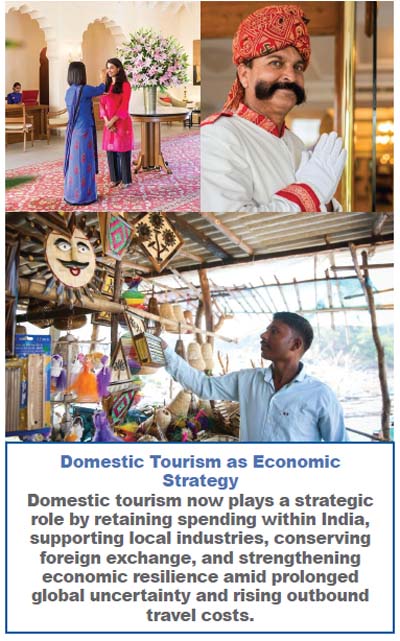 For a country like India, which still imports nearly 85% of its crude oil requirements, this becomes a matter not merely of economics, but of strategic survival. If oil prices remain elevated for a prolonged period — even 50 to 60% above historic averages — the pressure on India’s import bill can become enormous. A nation that was once obsessed with conserving foreign exchange had, over the past two decades, gradually become more comfortable as reserves crossed the US$600 billion mark. But the present crisis is a reminder that even large reserves are not infinite.
And therefore, suddenly, a phrase that belonged to another era has returned to relevance: conserving foreign exchange.
Every overseas holiday undertaken by millions of Indians means outbound spending in foreign currency — on airlines, hotels, shopping, entertainment, food, local transport, visas and experiences abroad. In good times, this was viewed simply as the natural aspiration of a growing middle class. But in periods of prolonged global stress, every dollar conserved becomes meaningful.
This is where domestic tourism acquires a new national importance.
The Prime Minister’s argument has been simple but effective: for the cost of one international holiday, an Indian family can often undertake five or six domestic trips. More importantly, the money remains within the Indian economy. It circulates through Indian airlines, Indian hotels, Indian restaurants, Indian transporters, Indian guides, Indian artisans, and local communities.
Domestic tourism therefore becomes an internal economic multiplier.
At another level, there is also an emotional and cultural argument. Travel within India is no longer seen as a compromise. Indians are increasingly rediscovering the extraordinary diversity of their own country — its mountains, beaches, forests, deserts, cuisines, spiritual circuits, heritage towns and experiential destinations.
The shift is already visible.
Only a few years ago, domestic leisure tourism was heavily concentrated around a handful of destinations — Goa, Rajasthan and Kerala being the most prominent examples. Today, the map has expanded dramatically. Jammu and Kashmir saw a remarkable rebound in tourism before the recent Pahalgam disturbances briefly impacted sentiment. Himachal Pradesh is witnessing unprecedented tourist flows. Spiritual tourism circuits around Ayodhya, Varanasi and the Char Dham routes are expanding rapidly. Northeastern India is beginning to enter the mainstream tourism conversation.
 And yet, despite this surge, India remains vastly under-travelled internally compared to its own potential.
There are still hundreds of unexplored destinations across the country that can absorb significantly larger tourist numbers. There are entire regions where tourism infrastructure exists but occupancy levels remain moderate for large parts of the year. There is also the enormous opportunity of off-season travel, which means when neither Indians or foreigners tend to travel, for one reason or the other.
For instance, much of northern India’s plains experience softer hotel demand through the summer and monsoon months, particularly between May and September. With proper promotion and pricing, these periods could be transformed into major domestic travel seasons. Hotels, airlines and state tourism boards could together create value-driven packages encouraging shorter, more frequent domestic breaks. More than packages which may be best left to local tour operators, it is just the larger consciousness of larger cluster zones that can together bring exponential experiences. Travel in one direction, explore a hundred ideas.
Infrastructure is no longer the constraint it once was.
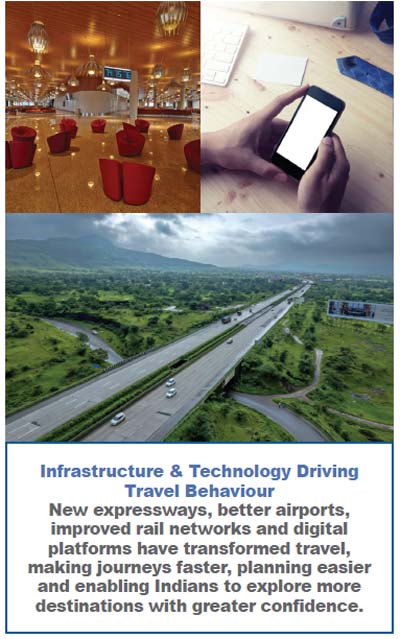
The India of today travels differently from the India of even ten years ago. New expressways, upgraded airports, better regional connectivity, expanded rail networks and improved highways have fundamentally altered travel behaviour. Journeys that were once exhausting have now become manageable road trips.
From Delhi, travellers can now comfortably drive to Ayodhya in nearly 10 to 12 hours. Amritsar is reachable within 8 to 9 hours. Even hill destinations beyond Shimla have become far more accessible. Across India, highway tourism is quietly emerging as a major trend. Families are increasingly willing to take shorter, spontaneous trips because the travel experience itself has improved dramatically.
Technology has become another major enabler.
The modern traveller today operates in a world of complete transparency. Through navigation platforms, digital booking systems, online reviews, reels, travel influencers and social media recommendations, people can instantly evaluate destinations, road conditions, hotel tariffs, restaurant options and crowd density. Tourism promotion is no longer dependent only on government advertising campaigns. Word-of-mouth, amplified by social media, has become one of the most powerful marketing tools.
The government’s role therefore may not necessarily be to “sell” destinations in the old-fashioned sense, but rather to facilitate, organise and inspire confidence. Or, simply put, to inspire people to travel, giving them ideas they did not have.
One powerful strategy could be to piggyback tourism promotion around recent infrastructure achievements. Every new expressway, new airport, new rail corridor or new tourism circuit can become the basis for a national “Explore India More” campaign. The message would not merely be patriotic; it would also be practical, economical and strategically wise.
At the same time, India must also be cautious about the dangers of over-tourism.
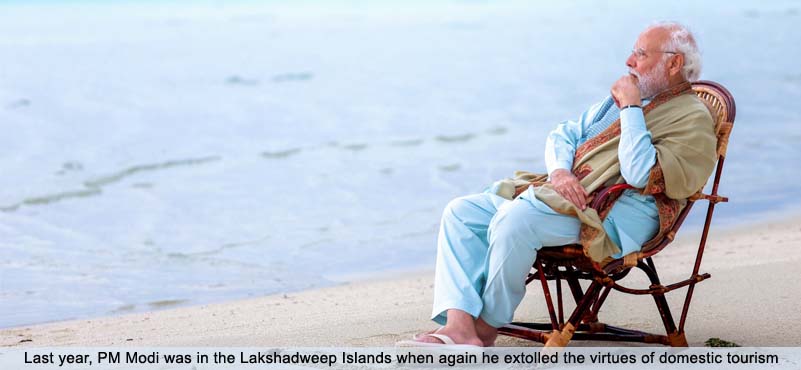
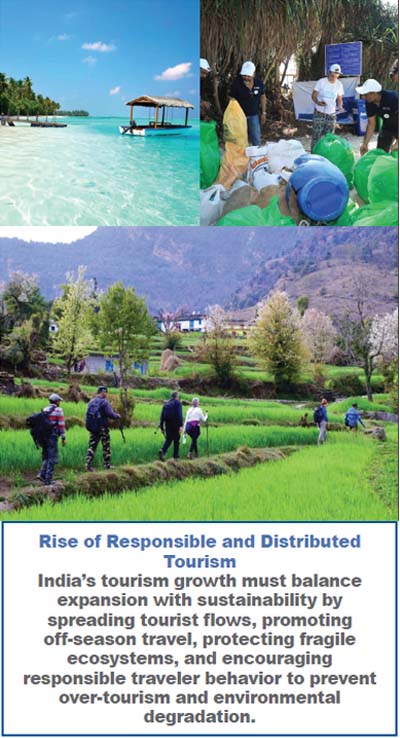 The debate surrounding Lakshadweep Islands highlighted an important reality. While tourism can create employment and economic opportunity, fragile ecological zones cannot sustain unlimited growth. Environmentalists rightly warned that several island and mountain ecosystems are already approaching tipping points. Water scarcity, waste management, traffic congestion and unregulated construction are becoming serious concerns in many destinations.
India therefore cannot afford to repeat the mistakes seen globally, where uncontrolled tourism damages the very environments that attract visitors in the first place.
The future lies in balanced tourism — spreading tourist flows across more destinations, encouraging off-season travel, developing smaller experiential circuits, strengthening civic infrastructure, and ensuring ecological safeguards. Tourism planning must become integrated with urban planning, environmental policy and carrying-capacity management.
What is unfolding today may ultimately become one of the biggest structural shifts in Indian travel behaviour.
The combination of geopolitical uncertainty, high fuel costs, improved domestic infrastructure, digital discovery tools and rising national confidence is pushing Indians inward — towards their own geography, heritage and experiences. And once habits change at scale, they often become permanent.
Domestic tourism in India is therefore no longer merely a fallback option when foreign travel becomes expensive or difficult. It is becoming a mainstream lifestyle movement.
In many ways, this may actually be India’s tourism decade. Not only because more foreigners may visit India, but because Indians themselves are finally beginning to travel through India like never before.
The appeal to explore domestic must extend beyond patriotism, though it must include it. It must also highlight the advantage of staying home, there is no segment of attraction that India does not have. Yes, the experience may not be as seamless but then ensuring it does is also our own responsibility. Can we arrive at a destination without a confirmed booking for any kind of accommodation? Can we say that check out times are not sacrosanct? Or, how we conduct ourselves in public places is only our concern? It must also be that time in history when our own people must call us out, for every indiscretion.
And can the organized tourism industry continue to deny that it is also their role to educate the Indian traveller – every responsible industry must have a role. Like the auto industry must tell motorists on how to drive safely, on the correct side of the road, observe traffic regulations, that blowing the horn is not the best way to announce your arrival. But that for another time and place.
It is time for responsible discovery of our own country; we will be dazzled by her beauty. Promotions can piggy back on infrastructure growth seen in the last decade; leave aside individual destinations, regardless of whether they are tourism ready or not, and leave it to discerning travellers to book in advance, explore responsibly and happily build memories for a lifetime.
In this unfolding dynamics, the hotel industry has a more pro-active responsibility, to become a part of this learning process. Not just reap the benefits but to also pay back, as it were, as a shared national responsibility. Further, charge well you must, but within limits. Imagine a lakh a day per room is also being heard of; impressive and perhaps sustainable too, but only in select pockets. A campaign on how to travel and explore responsibly can be the need of our times, best suited to national bodies and associations, not just for the government to initiate.
ABOUT THE AUTHOR
 Navin Berry, Editor, CS Conversations, over five decades has edited publications like CityScan, India Debates and Travel Trends Today. He is the founder of SATTE, India’s first inbound tourism mart, biggest in Asia.
Blogs at: https://www.csconversations.in/nb-blogs