

The Podium has a Story
The podium has a way of making struggle disappear. It is built quietly, patiently, and repeatedly. Under the lights, a medal looks clean, complete and inevitable, as though the athlete who wears it was always destined to stand there. But the journeys of Neeru Dhanda, Vithya Ramraj, Gulveer Singh and Kumkum Mohod tell a different story. Their disciplines were different, their circumstances were different, and their routes to the international arena were different. What connects them is not poverty alone, nor talent alone, but the extraordinary transformation that occurs when talent born in modest circumstances meets opportunity, coaching, family sacrifice, institutional support and an unyielding will to improve.
Neeru — The Target
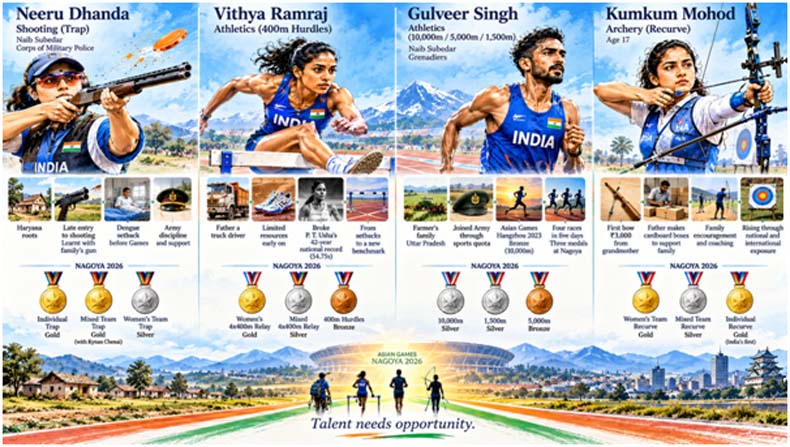
Neeru Dhanda arrived in Nagoya as a Naib Subedar of the Corps of Military Police, already carrying the discipline of a soldier and the confidence of a world-class shooter. Born in Jind, Haryana, she had not entered shooting as a privileged prodigy. She was drawn to the sport after watching her maternal cousin Lakshay Sheoran win silver at the 2018 Asian Games. In her early days, she practised with her family’s double-barrel gun and shot at tin cans; her cousin later lent her his gun and helped her find a pathway into formal training. She took up the sport at an age when many elite shooters have already accumulated years of competition.
The odds were hardly made easier by illness. Before the Games, dengue disrupted her preparation, yet she recovered in time to produce the defining performance of her career. In Nagoya she won individual gold in women’s trap, becoming the first Indian woman to win an individual Asian Games gold in the event, while also winning gold in the mixed trap team event with Kynan Chenai and silver in the women’s team event. Her achievement was not simply a triumph of eyesight and reflex. Trap shooting demands an extraordinary marriage of stillness and speed: the mind must remain quiet, the body controlled and the response instantaneous. Neeru’s story is therefore about more than shooting. It is about learning to aim when circumstances have not promised an easy shot.
Vithya — The Barrier
Vithya Ramraj’s journey began even farther from the glamour of international athletics. Growing up in a family supported by a father who worked as a truck driver, she and her sisters had to negotiate the practical realities of limited means. There were times when proper sporting shoes were difficult to afford, yet the young athlete continued to run. Her family made sacrifices because they saw something in her that circumstances could not measure. Sport was not a comfortable career choice; it was a wager on talent.
At Nagoya, Vithya turned that wager into history. She won silver in the mixed 4x400m relay, bronze in the 400m hurdles and then gold in the women’s 4x400m relay. In the hurdles, she ran 54.75 seconds, becoming the first Indian woman to go below 55 seconds in the event and breaking P T Usha’s national record of 55.42 seconds, which had stood for 42 years. Vithya had already equalled Usha’s mark at Hangzhou in 2023; three years later she finally moved beyond it.
A daughter of a driver, running with resources that were once limited, eventually crossed a barrier created by one of India’s greatest athletes. She did not defeat Usha; she extended her legacy. Records are meant to be broken, but some records become psychological walls because they survive long enough to appear permanent. Vithya showed that even a wall four decades high can have a door. Her story is about rising—not because life was easy, but because difficulty did not persuade her to lower the height of her ambition.
Gulveer — The Distance
Gulveer Singh’s story is written not in seconds alone, but in distance. A Naib Subedar from the Grenadiers, he grew up in a farmer’s family in Uttar Pradesh and initially dreamt of joining the Army. Running was first a means to that end; after entering the Army through the sports quota, he discovered that the track could become another form of service. His rise in athletics has been remarkably rapid, especially considering that his serious competitive journey began relatively late. At Hangzhou in 2023 he won bronze in the 10,000m. Nagoya offered him an opportunity to turn that first taste of the podium into something much larger.
He did exactly that, but at a cost measured in exhaustion. Between September 25 and 29, Gulveer contested four races and three finals, winning silver in the 10,000m and 1,500m and bronze in the 5,000m. He became the first Indian to win three middle- and long-distance medals at a single Asian Games edition. The 1,500m demands speed, the 5,000m combines pace with stamina, and the 10,000m tests the athlete’s relationship with fatigue itself. To return repeatedly to the starting line after the body has already suffered requires a different kind of courage.
His military identity adds another dimension to the story. The discipline of the Grenadiers and the discipline of distance running are not the same, but both demand consistency when motivation alone is insufficient. Gulveer has also spoken of the quiet spiritual ritual that accompanies his preparation, carrying a small image of Lord Hanuman and praying before training and competition. His medals therefore represent not only physical capacity, but a life organised around discipline, faith, recovery and repetition. His lesson is simple: endurance is not merely the ability to go far; it is the ability to begin again after going far.
Kumkum — The Bow that wasn’t supposed to Matter
Then comes Kumkum Mohod, only 17, and perhaps the most striking reminder that great sporting journeys can begin with remarkably little. From Amravati in Maharashtra, Kumkum grew up in a modest family. Her father, Anil Mohod, makes cardboard boxes for sweet shops to support the household. Her mother encouraged her towards archery, while her grandmother provided money for her first bow—a wooden bow costing around ₹3,000. Later, the family had to stretch its savings further for better equipment. There was simply a family willing to believe before the world had any reason to.
Eight years after that first bow, Kumkum stood on the Asian Games podium three times. She won gold in the women’s recurve team event, silver in the mixed recurve team event and then historic gold in the individual recurve. In the final she recovered from a 3–1 deficit against South Korea’s Oh Yejin, forced the contest into a 5–5 shoot-off and then delivered a perfect 10 to claim the title. She became the first Indian woman to win individual recurve gold at the Asian Games.
The symbolism is irresistible, but it should not be romanticised. A ₹3,000 bow did not create a champion. Hardship by itself never does. What created Kumkum was talent nurtured by coaching, family faith, opportunity, training and extraordinary discipline. Yet the humble beginning makes her achievement speak louder. The bow may have been modest; the dream was not.
What Hardship Teaches
These four stories invite a larger question about Indian sport. Is it coincidence that so many remarkable athletes are emerging from ordinary homes, farming families, working-class households and places far removed from the traditional centres of privilege? We should be careful not to turn this into a simplistic claim that hardship produces better athletes. Hardship can just as easily crush talent when opportunity never arrives. What these stories demonstrate is something more hopeful: when talent survives hardship and finally encounters the right support system, it can become extraordinary.
Neeru’s journey shows what disciplined institutional support can do when an athlete finds her calling. Gulveer’s story shows how the Army can provide a pathway through which sporting talent from a modest background can be discovered and developed. Vithya’s journey reveals what family sacrifice can achieve when a young athlete refuses to accept economic limitation as destiny. Kumkum’s story reminds us how a small intervention—a first bow, a coach who recognises potential, a family that keeps believing—can alter the trajectory of an entire life.
Their stories also challenge the way we understand sporting infrastructure. Facilities, equipment, professional coaching, nutrition, travel and competition exposure are not luxuries when the objective is to build champions; they are the bridges between raw ability and international excellence. The lesson for India is therefore not merely to celebrate medals after they are won, but to build systems capable of finding talent before it disappears for want of money, guidance or opportunity.
Somewhere today, in a village, a small town, a school field or an Army training centre, another young athlete may possess extraordinary ability without possessing extraordinary means. The distance between that child and the podium may be only opportunity. That is why the stories of these four athletes matter beyond their individual achievements. They show that India’s sporting reservoir is far deeper than the medals already visible on the table, provided we learn to search in places where talent is often hidden behind circumstance.
The medals won in Nagoya will eventually become statistics in record books. Their deeper value, however, lies in the stories behind them. Four athletes began from different starting lines, crossed different obstacles and competed in different arenas, yet arrived at the same destination beneath the same flag. Their achievements remind us that excellence is not the privilege of those who begin with abundance. It belongs also to those who begin with determination and are fortunate enough to find the opportunity to match it.
The podium tells us who won. Their journeys tell us where champions can come from. And perhaps that is the real message of Nagoya: we should not merely celebrate the athletes who have found their way to the podium; we should become much better at finding the millions who are still waiting for their chance.
ABOUT THE AUTHOR
Lt Gen Rajeev Chaudhry (Retd) is a social observer and writes on contemporary national and international issues, strategic implications of infrastructure development towards national power, geo-moral dimension of international relations and leadership nuances in changing social construct.