
The Silence after Atal
Eight years after Atal Bihari Vajpayee left us, there is something unusual about remembering him.
His demise brought end to the life of one of independent India’s most consequential political figures. His greatest contribution was not a particular government, scheme or political victory. It was something deeper: he changed the way India looked at itself.
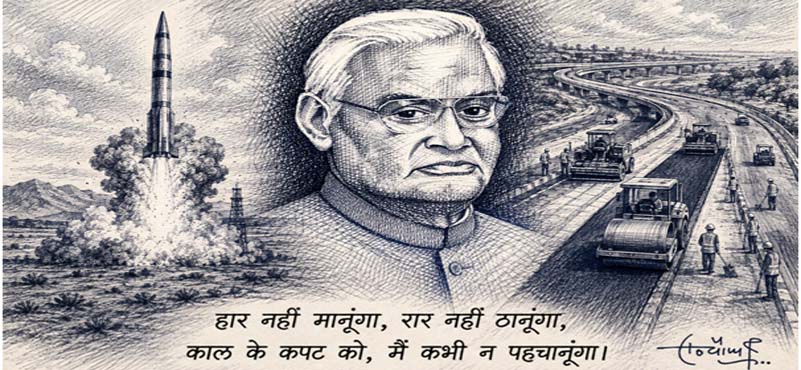
To understand that transformation, look at the image of Vajpayee between two extraordinary symbols of his era. On one side is Pokhran—the desert where India announced that its strategic choices would no longer be dictated by the anxieties of others. On the other is the Golden Quadrilateral—the great road-building enterprise that began connecting India’s four major metropolitan centres and symbolised an India determined to move.
Between the two stands Atal. The symbolism is profound.
One gave India the confidence to stand. The other gave India the confidence to move.
That may ultimately be the most enduring story of Vajpayee: he helped India discover its confidence.
Pokhran: When India stopped asking for Permission
In May 1998, India conducted the Pokhran-II nuclear tests.
The significance went far beyond the explosion itself. For decades, India had lived in a world in which strategic choices were often accompanied by an instinctive question: What will the major powers say?
Vajpayee’s government decided that another question mattered more: What does India’s national interest require?
The tests brought sanctions, criticism and international pressure. But Vajpayee did not retreat. Nor did he turn India’s new capability into an instrument of bluster. That distinction is crucial. Pokhran was not a declaration that India wanted war. It was a declaration that India wanted strategic autonomy.
Indeed, Vajpayee’s response to the strategic transformation was to place science alongside security and agriculture in the national imagination. The phrase “Jai Vigyan” became a powerful expression of that broader vision.
He understood something fundamental: national power is not merely military power. It is the combined strength of science, technology, economy, infrastructure, diplomacy, institutions and national will. Pokhran therefore represented more than a nuclear capability. It represented a psychological crossing of the Rubicon.
India had stopped seeking permission to become powerful.
The Golden Quadrilateral: India started Moving
If Pokhran gave India a strategic spine, the Golden Quadrilateral began giving it an economic one.
Vajpayee understood that national power must eventually travel on roads. The Golden Quadrilateral connected Delhi, Mumbai, Chennai and Kolkata and became one of the defining infrastructure initiatives of his tenure. His government also launched the Pradhan Mantri Gram Sadak Yojana, taking road connectivity into the villages. The scale of the subsequent transformation has been enormous.
This was not merely road construction. It was nation-building through connectivity. A road reduces distance between a farmer and a market, a worker and an opportunity, a village and a hospital, a manufacturer and a consumer. It changes the economics of geography.
Vajpayee saw infrastructure not as concrete and asphalt but as possibility.
That insight has acquired even greater significance today, when highways, expressways, freight corridors, logistics networks and rural connectivity are central to India’s economic ambitions. Much of today’s infrastructure revolution rests on foundations laid during that period.
He did not merely build roads across India. He began building movement into the Indian imagination.
He understood that Power has two Faces
The real genius of Vajpayee’s vision lies in the apparent contradiction between Pokhran and the Golden Quadrilateral.
One was about deterrence. The other was about development.
One demonstrated India’s ability to say no. The other expanded its ability to say yes.
But Vajpayee understood that they were not contradictions. They were two halves of national power. A nation that can defend itself but cannot develop cannot become a great power. A nation that can grow economically but cannot protect its strategic interests cannot remain autonomous. Strength without development becomes brittle. Development without strength becomes vulnerable.
Vajpayee’s India therefore sought both.
The bomb and the bridge.
The missile and the highway.
Strategic autonomy and economic connectivity.
This was the architecture of confidence.
The Paradox of Atal: Strength without Swagger
There was another quality that made Vajpayee different. He could be uncompromising on national interest without becoming consumed by confrontation.
He could speak with force without cultivating hatred. He could be a formidable political opponent and still command affection across ideological boundaries. That was not weakness. It was self-confidence. A person who is genuinely secure does not need perpetual anger to establish his strength. Vajpayee possessed that security.
His speeches could thunder, but his personality could disarm. Contemporary tributes repeatedly recalled his warmth, humour, compassion and unusual ability to connect across political differences. He demonstrated that nationalism could have a human face. He demonstrated that patriotism did not require contempt for the other.
And he demonstrated something increasingly rare in politics: the capacity to disagree without declaring the opponent an enemy.
Lahore, Kargil and the Statesmanship of Restraint
Perhaps nowhere was this more visible than in his handling of Pakistan.
The Lahore bus journey was an extraordinary act of political imagination. After Pokhran, when India had demonstrated its strategic capability, Vajpayee chose to travel to Pakistan and extend the hand of peace.
Then came Kargil. The betrayal could easily have produced an uncontrolled escalation. Instead, India fought with determination while maintaining political and strategic restraint. That combination deserves greater attention.
Vajpayee understood that peace without strength can become appeasement. But he also understood that strength without restraint can become recklessness. His statesmanship rested on a difficult balance:
Be prepared for war.
Work relentlessly for peace.
And never confuse restraint with weakness.
That remains one of his most relevant lessons.
Coalition PM who made Disagreement Democratic
Vajpayee also demonstrated that democracy need not be a permanent war between political camps.
He led a coalition of 23 parties, a formidable exercise in political accommodation and consensus-building. In an age when coalition governments were often dismissed as inherently unstable, he demonstrated another possibility: leadership through persuasion.
He knew that allies had interests of their own. He also knew that a government required a larger national direction. This was not easy politics. It required patience. It required humour. It required the ability to absorb criticism without treating disagreement as betrayal. And perhaps most importantly, it required an understanding that democracy is not the elimination of disagreement.
Democracy is the management of disagreement without destroying the nation that contains it.
The Poet inside the Prime Minister
Yet to understand Atal fully, one must finally return to the poet. The poet explains the politician.
Vajpayee’s politics carried an awareness of struggle, uncertainty, failure, hope and renewal that is difficult to find in purely transactional politics. His famous declaration—“हार नहीं मानूँगा, रार नई ठानूँगा”—was not merely poetry. It was almost a biography.
He knew defeat. He knew political isolation. He knew the loneliness of opposition. He knew what it meant to lead a government that could fall by a single vote. Yet he retained the ability to look beyond the immediate battle. That may be the secret of his enduring appeal.
He was a politician who understood that politics is temporary, but the nation is permanent.
Where is Atal needed today?
Perhaps the best way to remember Vajpayee on his eighth death anniversary is not to ask what he would have thought about every issue confronting India today.
It is to ask what qualities he would have brought to them. He would have reminded us that a strong nation must possess both confidence and humility. That technological ambition must be accompanied by human development. That infrastructure must ultimately serve people. That strategic autonomy requires economic strength. That democracy requires room for disagreement. And that leadership is not merely the ability to win power, but the ability to enlarge the national imagination.
The India of 2026 is far more confident than the India of the late twentieth century. But confidence must never become complacency. The road ahead is longer than the road already travelled. And perhaps that is where Atal’s poetry speaks most powerfully to the present.
Eight years after he left, India is still travelling on the roads he helped build—and still discovering the confidence he helped awaken. That was Atal’s greatest architecture.
(The pen sketch accompanying this article has been drawn by the author as a humble tribute to Bharat Ratna Shri Atal Bihari Vajpayee)
ABOUT THE AUTHOR
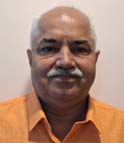
Lt Gen Rajeev Chaudhry (Retd) is a social observer and writes on contemporary national and international issues, strategic implications of infrastructure development towards national power, geo-moral dimension of international relations and leadership nuances in changing social construct.