
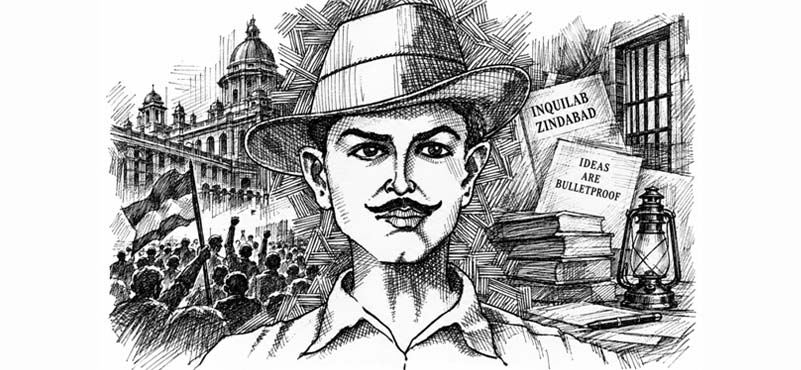
The Face that Refused to Fade
Look at the face in the familiar hat: composed eyes, a clipped moustache, a youthful countenance carrying an almost unsettling calm. The face has travelled across generations, from schoolbooks to posters, from village walls to digital screens. Yet behind that iconic portrait stood a young man who was not content merely to fight an empire. He wanted to understand power, society, freedom and the India that would emerge after colonial rule. Born on 28 September 1907 in Banga, Punjab, Bhagat Singh entered a family already touched by the freedom struggle. Jallianwala Bagh left a deep impression on his generation, and the political turbulence around him accelerated his journey from an angry young nationalist into a revolutionary thinker. At twenty-three, he went to the gallows. But by then, Bhagat Singh had already begun becoming something more enduring than a martyr: an idea.
That distinction matters. India has remembered the revolutionary for his courage, but the historical record also reveals a reader, writer and political thinker who used his life to educate himself, persuade others and interrogate the meaning of revolution.
From Revolutionary Emotion to Revolutionary Thought
Bhagat Singh’s early revolutionary journey cannot be separated from the violence and humiliation of colonial India. The Jallianwala Bagh massacre of 1919, the repression that followed, and the withdrawal of the Non-Cooperation Movement shaped the political consciousness of young Indians. Singh moved towards revolutionary organisations and eventually became associated with the Hindustan Socialist Republican Association. Yet his political evolution was not simply a movement towards greater militancy. It was a movement towards greater intellectual seriousness. He read widely, engaged with socialist and anti-imperialist ideas, and increasingly asked what freedom would mean for workers, peasants and ordinary citizens. His later writings show that revolution, for him, meant social reconstruction rather than merely replacing British rulers with Indian rulers. In his February 1931 document, To Young Political Workers, he argued for political education, mass organisation and a clearly defined social objective. The young revolutionary was therefore not merely learning how to resist power; he was thinking about what should replace it.
The Bomb, the Courtroom and the Message
On 8 April 1929, Bhagat Singh and Batukeshwar Dutt threw bombs in the Central Legislative Assembly in Delhi. The act was deliberately designed as political theatre, and the two men did not attempt to escape. Their subsequent trial gave them an extraordinary public platform. Their joint statement explained that the action was intended to make the deaf hear and to register a protest, while also asserting that human life was sacred. The historical controversy surrounding revolutionary violence remains important, but Bhagat Singh’s own explanation reveals why the Assembly episode became larger than the explosion itself. The courtroom became his second printing press. He used it to communicate with an India that newspapers, speeches and political organisations could not always reach. The young accused transformed the proceedings into an argument about colonial authority, political awakening and revolution. His objective was no longer simply to confront the colonial state physically; it was to challenge its legitimacy intellectually before a watching public.
The Prisoner who turned the Cell into a Platform
Prison did not silence Bhagat Singh. It expanded his audience. The hunger strike by Bhagat Singh and his fellow prisoners in 1929 drew public attention to the treatment of political prisoners and their demand for dignity and equality. Contemporary accounts record the seriousness of their prolonged fast and the concern it generated among Indian leaders and the public. Nehru, writing in July 1929, acknowledged their courage and noted that their protest was intended to improve the condition of political prisoners. Inside prison, Bhagat Singh continued reading, writing, debating and refining his political ideas. His essay Why I Am an Atheist revealed another dimension: a young revolutionary examining belief, reason, ego and intellectual honesty with remarkable directness. The prison cell therefore became more than a place of confinement. It became a workshop of ideas. Every day that narrowed his physical freedom seemed to enlarge the intellectual space around him.
Martyrdom: 23 March 1931
On 23 March 1931, Bhagat Singh, Rajguru and Sukhdev were executed in Lahore. He was twenty-three. The gallows ended a life that had barely entered adulthood, but they could not determine what that life would mean. His death transformed a revolutionary activist into a national symbol whose image, words and story travelled far beyond the political circumstances of 1931. Martyrdom gave his name extraordinary emotional power, but reducing Bhagat Singh to martyrdom alone risks diminishing the very mind that made his martyrdom consequential. He had left behind arguments, questions, writings and an unfinished intellectual journey. His most remarkable legacy was therefore not simply that he died without fear. It was that he had spent his short life asking what freedom should accomplish after the oppressor was gone.
What does Bhagat Singh ask of India Today?
The most meaningful way to remember Bhagat Singh is not to freeze him inside a heroic photograph. It is to encounter the restless mind behind it. He asks whether patriotism can exist without intellectual courage; whether freedom can remain meaningful without social justice; whether young citizens should inherit opinions or learn to examine them; and whether a democracy can flourish when questioning becomes uncomfortable. His political conclusions belonged to his time and should be understood in that historical context. But his insistence on reading, reasoning, organising and thinking beyond slogans remains a powerful part of his legacy. That is why the hat, moustache and fearless eyes continue to speak across nearly a century. They do not merely ask us to remember a young man who died for India. They ask us to consider what kind of India he imagined, what kind of citizens freedom requires, and whether we possess the courage to think for ourselves.
The British Empire could execute Bhagat Singh. It could not execute the question he left behind. His life was short; his conversation with India was not.
(The accompanying sketch of Shaheed Bhagat Singh has been drawn by the author, in homage to the revolutionary whose ideas outlived the gallows.)
ABOUT THE AUTHOR
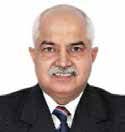
Lt Gen Rajeev Chaudhry (Retd) is a social observer and writes on contemporary national and international issues, strategic implications of infrastructure development towards national power, geo-moral dimension of international relations and leadership nuances in changing social construct.