
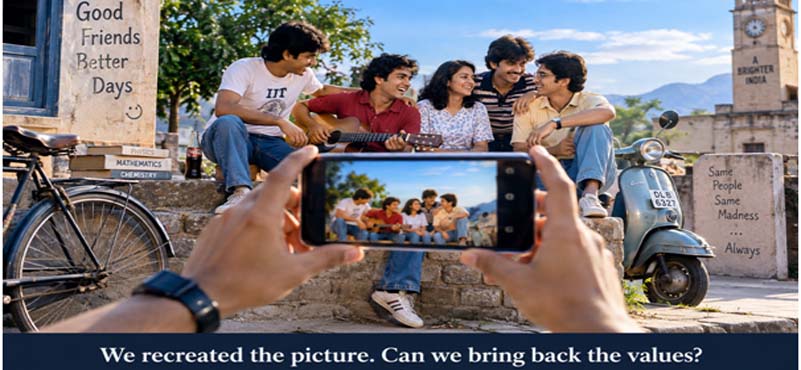
There is something curious about the way we remember the 1980s. We are surrounded by photographs of people who were young in that decade, some rescued from old albums, others recreated by AI. Bell-bottoms return, scooters reappear, hair grows abundant, and yesterday is given the flattering glow of nostalgia. We smile at old photographs and say, “Those were the days.” But perhaps we are asking the wrong question. If we recreate the clothes, hairstyles, streets and faces of the 1980s, should we not also ask what made the people of that decade different? What values did we leave behind, and which are worth bringing back?
The 1980s were hardly perfect. India had shortages, slow communication and fewer choices. Yet the absence of convenience demanded patience, resourcefulness, conversation and dependence on one another. An evening did not disappear into a screen. Friends met because nothing substituted for meeting. Neighbours noticed when you were unwell. Life was technologically poorer, but its human transactions were often genuinely richer, somehow.
Friendship was one of those invisible currencies. People made friends without calculating what the relationship might be worth professionally. A friend shared your lunch, lent you a bicycle, waited outside the principal’s office, walked with you after an argument or simply sat beside you. Friendships could be quarrelsome, but they were sustained by presence. Today we have hundreds of contacts and thousands of followers, yet loneliness remains. We have become extraordinarily good at staying connected and sometimes strangely poor at staying close.
Then there was patience. In the 1980s, waiting was not a malfunction of life; it was part of life. You waited for a letter, a telephone call, a train or a photograph to be developed. Waiting created anticipation, and anticipation gave ordinary moments value. Today, almost everything is instant, yet our appetite for immediacy grows faster than satisfaction. Perhaps the old ability to wait is not an outdated virtue. It may be inner strength.
The decade also understood community differently. A neighbourhood was not merely a collection of addresses. Children moved between homes, elders watched over them, families borrowed without embarrassment and festivals spilled across doors and courtyards. Someone else’s mother could feed you, someone else’s father could correct you, and nobody needed a formal invitation to knock on a familiar door. Connectivity has multiplied, but community requires something technology cannot manufacture: attention. We knew one another because we looked up and participated.
Even failure had a different texture. A poor examination result, a lost match, a scolding from a teacher or a foolish mistake could hurt deeply, but it did not become a permanent public record. There was room to recover, apologise, learn and begin again. Today, young people live under cameras, comments and digital memory. We have become anxious about mistakes because mistakes can travel farther and last longer. The 1980s remind us that resilience grows by learning that a bruise is not the end of the story.
Most importantly, character mattered more than image. Reputation was built slowly through conduct. People discovered who you were through repeated encounters: whether you kept your word, returned what you borrowed, stood by a friend, respected an elder or helped without expecting recognition. Today, image can travel faster than character. We can appear generous without being generous, connected without being present and successful without being content. The old world knew little of personal branding, but demanded personal conduct.
We should be careful not to romanticise the past. We do not need the shortages, prejudices, rigid hierarchies or limitations of the 1980s. Progress is valuable, and technology has transformed lives for the better. The point is not to turn back the clock but to distinguish what technology replaced from what it made unnecessary. We can keep the smartphone and recover conversation; keep instant communication and recover patience; keep global networks and recover the neighbour; keep ambition and recover contentment.
That is why the fascination with 1980s photographs may contain a deeper longing than nostalgia. Perhaps people are not yearning for old clothes or cameras. They are yearning for a version of themselves that seemed less hurried, less performative and more available to life. The AI-generated photograph can recreate the face, but it cannot recreate the friendship behind the face, the patience behind the waiting, the courage behind the failure or the generosity behind the shared meal. Those cannot be generated. They have to be lived, one human choice at a time.
So perhaps our journey back to the 1980s should not end with a photograph. It should begin with a question: what if, along with the fashion of that decade, we brought back some of its virtues? What if we called a friend instead of merely liking a photograph, visited instead of reacting, waited without irritation, helped without announcing it, disagreed without abandoning one another and measured life by people touched rather than impressions created?
We should not return to the 1980s. The future deserves progress, but may also need the humanity of the past. If we recreate the 1980s on our screens, it is time to recreate them in our conduct. We can leave bell-bottoms in the wardrobe, cassette players in museums and artificial photographs on our feeds. What deserves to return is the habit of being there for one another. We do not need to go back to the 1980s; we need to bring the best of the 1980s back to us.
ABOUT THE AUTHOR

Lt Gen Rajeev Chaudhry is a social observer and writes on modern life through the prism of Indian spiritual wisdom through his column ‘The Moral Pivot’ .


