Eighty-five Years After Tagore, Are We Still Listening?
Some poets write verses. A few write history. Once in a century, one writes the conscience of a civilization.
Every Indian has heard the opening words of Rabindranath Tagore’s immortal prayer: “Where the mind is without fear…”. We recite it in schools, quote it in speeches, and invoke it on ceremonial occasions. Every year we celebrate his birth anniversary, remember his death anniversary, honour his Nobel Prize, and proudly sing Jana Gana Mana. Yet an uncomfortable question lingers in the silence after the applause: how many of us have actually read Tagore?
Perhaps the greatest irony of modern India is that we have preserved Tagore’s image better than we have preserved his ideas. Eighty-five years after his passing, Tagore does not need another floral tribute. He needs readers.
The Nobel Prize made Tagore a global literary icon, but it did not define his greatness. He was the first Asian Nobel laureate in Literature, a poet, novelist, philosopher, dramatist, composer, painter and visionary educationist who founded Visva-Bharati with the dream of blending the best of India with the best of the world. Above all, he remains the only writer whose compositions became the national anthems of two sovereign nations—India’s Jana Gana Mana and Bangladesh’s Amar Sonar Bangla. Many writers have won Nobel Prizes. Only one has taught two nations how to sing of themselves. History remembers Nobel laureates; civilizations remember the poets who become their voice.
Yet Tagore’s greatest gift to India was neither a medal nor an anthem. It was a dream. That dream lives in a poem scarcely forty lines long.
“Where the mind is without fear…”
Notice that Tagore did not pray first for wealth, military strength or political power. He prayed for fearless minds. He understood that the strongest chains are often invisible—the fear of questioning, the fear of failure, the fear of standing alone, the fear of speaking the truth. A nation may achieve freedom from foreign rule and yet remain imprisoned by intellectual timidity. Fear is the silent enemy of creativity, science, literature and democracy alike. Every generation must therefore ask itself a difficult question: are we merely protecting our freedom, or are we nurturing fearless minds?
He then prayed, “Where knowledge is free.” The line is even more relevant today than it was a century ago. We have built more schools, universities and digital platforms than Tagore could ever have imagined. Information travels at the speed of light. Yet knowledge is not merely information, and education is not merely certification. When examinations become more important than curiosity, when marks matter more than imagination, and when careers overshadow character, education loses its soul. Tagore wanted classrooms that produced free thinkers, not merely successful test-takers.
Then comes perhaps the most prophetic line of all: “Where the world has not been broken up into fragments.” In an age of endless divisions—political, religious, linguistic, ideological and digital—his words sound less like poetry and more like a warning. Tagore loved his country deeply, but he refused to let patriotism harden into hostility or identity shrink into intolerance. He believed that love for one’s nation becomes stronger, not weaker, when it is accompanied by respect for humanity.
Finally, he prayed for a land “where words come out from the depth of truth.” Every civilization ultimately rests not merely on economic strength or military power but on the credibility of its words. Truthfulness in public life, honesty in institutions, integrity in leadership and sincerity in citizenship are not abstract virtues; they are the foundations upon which enduring nations are built. Without truth, trust erodes. Without trust, freedom itself becomes fragile.
If Tagore were to return today, much would fill him with hope. He would marvel at India’s democratic resilience, scientific achievements, digital transformation, remarkable space programme, growing role of women, youthful confidence and rising global stature. He would see a nation that has travelled an extraordinary distance since the days of colonial subjugation.
But being Tagore, he would ask questions before offering applause.
Are our children learning to think, or merely to compete? Are we producing informed citizens or anxious achievers? Are we listening to those who disagree with us? Are we preserving nature with the same passion with which we pursue prosperity? Above all, are our minds truly without fear?
Great writers are never imprisoned by the century in which they lived because they write about permanent truths. That is why Tagore still speaks to us. Not as a distant literary giant wrapped in nostalgia, but as a gentle, persistent voice inviting India to become the nation it once dreamed of being.
Perhaps the greatest tribute we can pay Rabindranath Tagore is not another anniversary speech, nor another garland before his portrait. It is to strive, in our homes, our schools and our public life, to build the India he envisioned—where minds are truly without fear, knowledge is truly free, the world is not broken into fragments, and words still emerge from the depth of truth.
Only then will we have remembered him well. Until then, Rabindranath Tagore waits—not to be worshipped, but to be read.
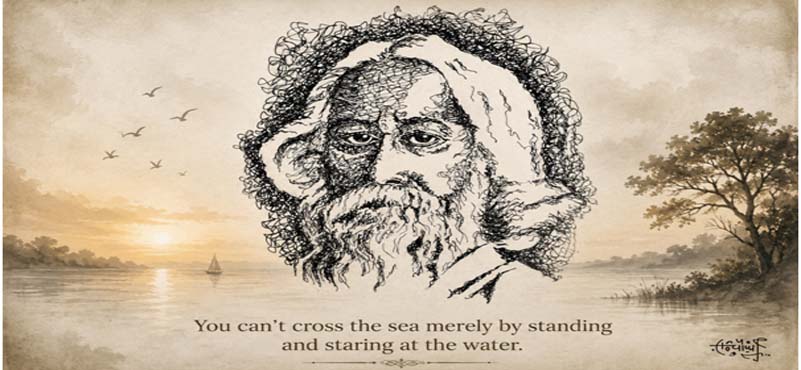
(The opening pen sketch of Gurudev Rabindranath Tagore is the author’s own humble tribute.)
ABOUT THE AUTHOR
Lt Gen Rajeev Chaudhry (Retd) is a social observer and writes on contemporary national and international issues, strategic implications of infrastructure development towards national power, geo-moral dimension of international relations and leadership nuances in changing social construct.