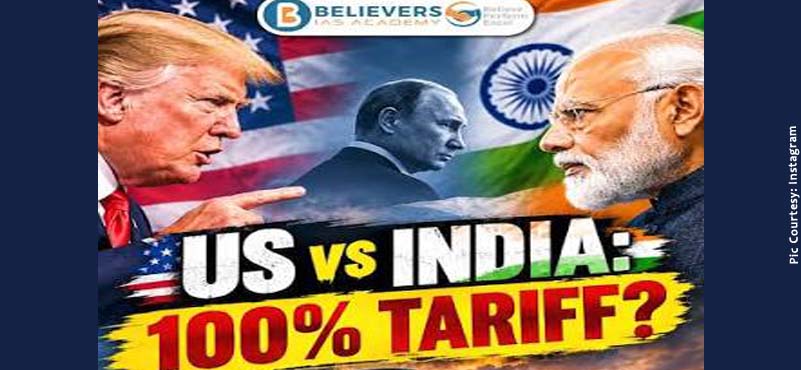
US President Donald Trump has signed the ‘Lindsey O Graham Sanctioning Russia and Iran Act of 2026 ‘, approving up to 100 per cent tariffs on countries buying Russian oil and gas, and putting India and China under threat. This new American law is a grim warning for India. It is not, however, at this stage, a 100% tariff imposed on all Indian exports. This distinction is important because the law equips the U.S. President with discretionary authority, subject to specified conditions and waiver provisions; it does not automatically trigger an across-the-board levy on India. Yet, precisely because India is among the largest buyers of Russian crude, the threat has become a potent instrument of economic and geopolitical pressure.
A large commercial exposure
The United States is India’s largest merchandise-export market. India exported goods worth about $87.3 billion to the U.S. in FY2025–26, against $86.5 billion in FY2024–25; imports from the U.S. were $53.5 billion, leaving India with a goods-trade surplus of roughly $33.8 billion. U.S. total goods trade with India was estimated at $129.2 billion in 2024.
The exposure is evident even in the latest data. India’s merchandise exports to the U.S. rose 6.2% to $42.79 billion in April–August 2026–27, from roughly $40.3 billion in the corresponding period a year earlier. This resilience is encouraging, but it should not foster complacency: orders already negotiated, inventories in U.S. warehouses, currency movements and selective tariff exemptions can delay the visible impact of trade barriers.
A punitive 100% tariff would be particularly damaging for sectors that compete on price and employ large numbers of workers: textiles and garments, leather and footwear, gems and jewellery, engineering goods, auto components, chemicals, marine products and certain consumer manufactures. In these sectors, American buyers have alternative sourcing options, e.g., Vietnam, Bangladesh, Mexico, Türkiye and China. A sudden doubling of the landed price of Indian goods would force exporters either to compress already thin margins or lose orders and market share.
The danger, therefore, is not merely an immediate fall in export volumes. It is the erosion of supply-chain relationships assiduously built over years. Once an American retailer, wholesaler or manufacturer redesigns sourcing around another country, winning that business back can be far harder than retaining it in the first place.
Not an automatic economic collapse
A 100% tariff would plainly be a severe competitiveness shock, but it would not mean that India’s exports to America fall by 100%. The actual outcome would depend on the goods covered, the scope of exemptions, the duration of the levy, exchange-rate movements, product-specific demand, exporters’ margins and the extent to which the cost is passed on to American consumers.
This is important because India has already seen that tariff arithmetic is not the same as trade arithmetic. Earlier U.S. measures, including the additional 25% penal tariff announced in 2025 in connection with India’s purchases of Russian oil, did not cause India’s exports to the U.S. to collapse. Exports subsequently continued to expand, though the burden was uneven across products and firms.
Still, a sustained 100% levy would be qualitatively different. It could disrupt investment decisions in export-oriented manufacturing, discourage firms from expanding capacity for the U.S. market and weaken employment in labour-intensive clusters. The macroeconomic impact cannot be estimated by mechanically doubling earlier projections of a 50% tariff. Much would depend on exemptions, substitution, policy response and global demand. But the sectoral pain could be concentrated, persistent and politically significant even if the national GDP effect appears modest.
India’s export base offers some insulation. Total goods and services exports reached a record $863.1 billion in FY2025–26, comprising $441.8 billion of merchandise exports and $421.3 billion of services exports. This diversification means the U.S. market, though indispensable, is not India’s only economic outlet. But services strength cannot fully compensate a factory worker or small exporter who loses a merchandise order.
The Russian-oil dilemma
At its core, this is not a conventional bilateral trade dispute over tariffs, agricultural access or digital rules. It is an attempt to use trade coercion to reshape India’s energy choices and increase pressure on Russia’s war economy.
India’s position is not irrational. For a fast-growing, energy-import-dependent economy, reliable and affordable crude supplies are a strategic necessity. Abruptly abandoning Russian oil could raise import costs, worsen the current account, increase inflation risks and expose Indian refiners to greater volatility in West Asian supply conditions. New Delhi has accordingly stated that it will protect its economic interests and energy security, while warning that U.S. tariff action could damage the wider bilateral relationship.
Yet India must also recognise that access to the American market is a strategic economic asset. The choice is not between capitulation and defiance. It is between managing a difficult transition intelligently and allowing external pressure to impose an abrupt adjustment.
India’s practical strategy
India should pursue a calibrated four-part response:
- Negotiate before retaliating. New Delhi should seek product-specific exclusions, tariff-rate quotas, transition periods, a phased reduction in Russian crude purchases and a clear ceiling below the statutory 100% maximum. The waiver provision in the U.S. law creates diplomatic space; India should use it.
- Link energy adjustment to commercial concessions. If Washington expects India to diversify its oil basket, it should help make that transition economically feasible. India can seek long-term U.S. energy supply arrangements, greater access for Indian pharmaceuticals, engineering goods, gems and jewellery, and relief for supply chains where U.S. companies depend on Indian inputs.
- Protect vulnerable exporters, not every exporter. Temporary interest subvention, enhanced export-credit insurance, faster duty refunds, logistics support and working-capital assistance should be targeted at firms and labour-intensive clusters demonstrably affected by U.S. measures. Broad subsidies would be fiscally costly and may blunt incentives to upgrade.
- Accelerate market and product diversification. India should urgently convert trade diplomacy with the European Union, United Kingdom, Canada, Gulf economies and other partners into commercially meaningful market access. But diversification must mean more than finding new destinations for the same low-margin products. It requires higher quality, design capability, trusted standards, local distribution networks and movement into technology-intensive goods.
The central lesson is clear: India cannot build a durable export strategy around permanent dependence on any one market, however valuable that market may be. Nor can it surrender energy security to unilateral external demands. The most credible response to America’s tariff threat is firm but non-theatrical diplomacy, selective support for affected producers, deeper trade diversification and a gradual, commercially viable reduction of energy concentration risk. This is a tall order but by no means undoable.
ABOUT THE AUTHOR
 Dr. Manoranjan Sharma is Chief Economist, Infomerics, India. With a brilliant academic record, he has over 250 publications and six books. His views have been cited in the Associated Press, New York; Dow Jones, New York; International Herald Tribune, New York; Wall Street Journal, New York.