India’s foreign policy establishment has a comforting habit. Whenever a hard question is asked, the answer arrives dressed in a familiar phrase: strategic autonomy. It sounds firm. It sounds historic. But a doctrine repeated without renewal becomes a shield for indecision rather than a tool of statecraft. That is the real danger facing India today, not the loss of autonomy, but its slow decay into drift dressed up as principle.
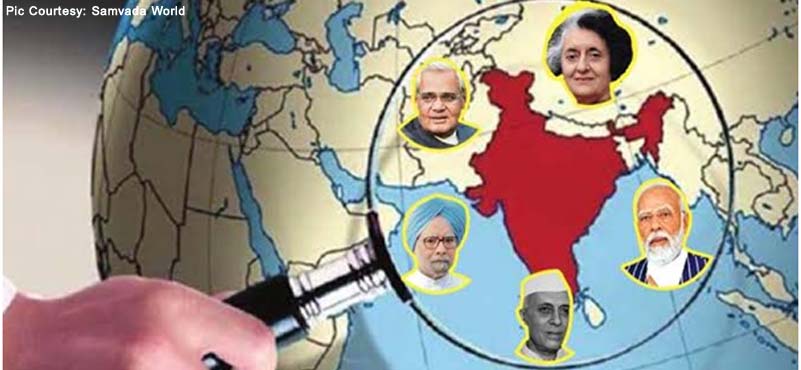
Strategic autonomy was never conceived as diplomatic passivity. From Nehru’s non-alignment to Vajpayee’s nuclear decision and India’s refusal to compromise its energy security during the Ukraine conflict, its essence has always been freedom of action rather than freedom from responsibility.
Consider the record of the past year. New Delhi stayed largely silent as war engulfed Gaza and later widened to strike Iran directly. It offered measured statements calling for restraint, de-escalation, dialogue. Every word was correct. Diplomacy is judged not only by what it avoids saying but also by what it chooses to communicate. Strategic ambiguity is useful only when it serves a deliberate objective. Silence without strategic signalling is usually interpreted as uncertainty. Compare this to India’s posture during the Ukraine war, where its abstentions at the United Nations were loud in their own way, because they were backed by an unmistakable logic: India buys energy where it serves Indian interests, and it will not be lectured by either Washington or Moscow. That was autonomy with a spine. The silence on West Asia has no equivalent spine. It reads as absence, not choice.
India’s relationship with the United States demonstrates both the resilience and the limits of strategic autonomy. They cite a quarter-century of India-US relations and a durable pattern: every crisis in the relationship has been followed by expansion rather than contraction. The 1998 nuclear tests were followed by a civil nuclear deal in 2005. Trade disputes have repeatedly led to deeper defence cooperation. The tariff standoff earlier this year, in which Washington imposed a punitive duty tied to India’s Russian oil purchases and then rolled it back after a Modi-Trump phone call, fits the same pattern. Jaishankar’s answer at the Munich Security Conference was unambiguous. India would decide its energy purchases based on cost, risk, and availability, not on political pressure from any partner. That is precisely what strategic autonomy should sound like. Firm, specific, and tied to a concrete national interest.
But here is the analytical error in treating that single data point as proof that all is well. A trend line over twenty-five years tells you about resilience. It tells you nothing about capability. Autonomy is not a mood. It is a function of hard power, economic weight, and the willingness to absorb cost. Strategic autonomy therefore rests on three foundations: economic resilience, military credibility and political resolve. Weakness in any one eventually constrains the others. Of the three, military power remains the ultimate guarantor. India could afford ambiguity in the 1990s and 2000s because the international system was relatively permissive. Washington was focused elsewhere. China had not yet built the military and economic muscle it commands today. The current environment offers no such comfort. A war has redrawn the Middle East. Russia has rebuilt long-range strike capacity over three years of continuous combat. China fields autonomous systems and grey zone tools that outpace the doctrines meant to govern them. In this environment, silence is not neutral. It is read by every capital as an absence of position, and that absence is quietly filled by others.
China no longer shapes India’s strategic choices solely through military pressure along the Himalayan frontier. Its influence increasingly extends into supply chains, digital infrastructure, shipbuilding, rare earth processing, battery technology, and critical manufacturing. Strategic autonomy, therefore, requires reducing vulnerabilities across the entire spectrum of national power rather than only strengthening military capabilities.
This is where military logic becomes essential, because strategic autonomy is fundamentally a hard-power concept before it is a diplomatic one. No nation sustains independent decision-making without the capacity to defend the consequences of those decisions. The delay in indigenous aero engines, long-range precision strike systems, advanced semiconductors and undersea capabilities illustrates that autonomy remains uneven across critical sectors. Import dependence on Russian systems, ranging from air defence to submarine propulsion, is not merely a procurement inconvenience. It is a structural constraint on how independently India can act when Moscow’s interests diverge from its own, as they eventually will in Central Asia and the Indo-Pacific. A nation that speaks of strategic autonomy while relying on a single supplier for a large share of its major weapons platforms is describing an aspiration, not a present reality.
The same logic applies to India’s economic statecraft. Energy security cannot rest on discounted Russian crude alone. That dependency is itself a form of exposure, as Moscow’s calculus is increasingly subordinate to Beijing’s. India needs a genuinely diversified energy architecture, drawing on the Gulf, the United States, and West Africa, so that no single relationship becomes load-bearing for national security. Diversification is not an alternative to affordability. It is the price of resilience. The Japan summit earlier this month, which produced sweeping commitments on semiconductors, critical technology, and defence cooperation, points to the right model. Partnerships that build indigenous capacity, rather than transactional purchases, are what genuine autonomy requires. Tokyo understood this. New Delhi should build on it deliberately, rather than treat it as one good headline among many.
India’s chairmanship of BRICS this year offers another test. The temptation will be to use the platform for rhetorical balancing between Washington and Beijing, producing communiques that satisfy no one and commit India to nothing. A better use of the chair is more focused and tougher. Push for consensus-based expansion rather than yuan-denominated trade mechanisms that would hand China quiet leverage over the grouping’s financial architecture. Use the platform to keep Russia engaged on India’s terms, preventing Moscow’s further drift into dependence on Beijing. This is statecraft with teeth, not a seat at another summit table. India’s comparative advantage within BRICS lies not in balancing rival powers but in preventing any single power from dominating the institution.
There is also a maritime dimension to this that deserves more attention than it receives in Delhi’s commentary. The Strait of Hormuz has been under repeated strain amid the recent Iran conflict, and roughly two-fifths of India’s crude imports transit that chokepoint in any given year. A nation serious about strategic autonomy treats chokepoint exposure as a planning problem, not a talking point. That means expanding strategic petroleum reserves well beyond current levels, building a genuine blue-water escort capability for tanker traffic, and negotiating standing arrangements with Gulf partners that do not depend on goodwill alone. The Indian Navy has made real strides in the western Indian Ocean over the past decade. But naval presence without a funded, multi-year shipbuilding and munitions pipeline is presence on borrowed time. Autonomy at sea is bought with tonnage and sustained industrial output, not with port calls and joint statements.
Technology sovereignty belongs in the same conversation because the next contest for autonomy will be fought as much in semiconductor fabrication and artificial-intelligence compute as in territorial waters. India’s dependence on foreign chip architecture and cloud infrastructure is a strategic vulnerability comparable to energy dependence, yet it rarely receives the same urgency in public debate. The Quad framework offers a partial answer here, particularly through technology and supply chain initiatives with Japan, Australia and the United States. But partial answers invite partial autonomy. Delhi needs a funded, time-bound programme to build domestic fabrication capacity, not a series of memoranda that look good in photos but deliver slowly. Data, algorithms and trusted compute are becoming strategic resources no less important than oil reserves or ammunition stocks. Nations unable to control these assets will gradually lose decision-making freedom even without military defeat. A great power that cannot build its own critical technology stack will find its autonomy quietly hollowed out long before any adversary fires a shot.
None of this argues for abandoning strategic autonomy. It argues for taking the doctrine seriously enough to fund it, arm it and speak through it when the moment demands. Silence on Gaza and Iran was not autonomy. It was the absence of a defensible position, mistaken for restraint. Real autonomy would have meant stating plainly that India opposes the targeting of civilians regardless of which side commits it, while continuing energy and trade ties on India’s own terms. That is a harder sentence to construct than saying nothing. But it is the sentence a serious power delivers.
Strategic autonomy today cannot rest on diplomatic skill alone. It is sustained by the combined strength of every instrument of national power working towards a common purpose. Diplomacy creates space for independent choices, but that space is preserved only when supported by credible military capability, economic resilience and technological self-reliance. Cyber security protects the digital networks on which governance, finance and military operations increasingly depend. Space assets provide the communications, navigation and intelligence that underpin both military effectiveness and economic activity. Information has become an equally decisive domain. In an age of relentless disinformation, influence campaigns and cognitive manipulation, a nation’s ability to shape the narrative, maintain public confidence and communicate strategic intent is no longer a matter of public relations but an essential element of national security. None of these capabilities can compensate for the absence of another. Together they form the foundation that enables a state to resist coercion, absorb external pressure and retain the freedom to pursue its interests on its own terms. Strategic autonomy therefore is not preserved by balancing between competing powers. It is earned through the patient development of national capacity across every domain that determines power in the twenty-first century.
India stands at a genuine inflexion point, not because its doctrine is wrong, but because the gap between the doctrine and the capability behind it has widened. Strategic autonomy without indigenous defence production, a diversified energy architecture, and the willingness to state uncomfortable positions is not autonomy. It is drift wearing autonomy’s uniform. The correction is not rhetorical. It requires sustained investment in the instruments of hard power and the diplomatic courage to use the voice that comes with them. India has the weight to lead. What it needs now is the will to speak with the full authority that weight commands, and the strength behind its words to make that authority credible.
Strategic autonomy in the Indian tradition has never implied equidistance from competing powers. It has implied the freedom to engage each on terms defined by India’s own interests. In a fragmented international order, success will depend less on balancing relationships than on preserving sovereign strategic choice despite external pressure. Strategic autonomy is ultimately measured not by the freedom to remain silent, but by the confidence to speak and the strength to be heard.
ABOUT THE AUTHOR
 Lieutenant General A B Shivane, is the former Strike Corps Commander and Director General of Mechanised Forces. As a scholar warrior, he has authored over 200 publications on national security and matters defence, besides four books and is an internationally renowned keynote speaker. The General was a Consultant to the Ministry of Defence (Ordnance Factory Board) post-superannuation. He was the Distinguished Fellow and held COAS Chair of Excellence at the Centre for Land Warfare Studies 2021 2022. He is also the Senior Advisor Board Member to several organisations and Think Tanks.