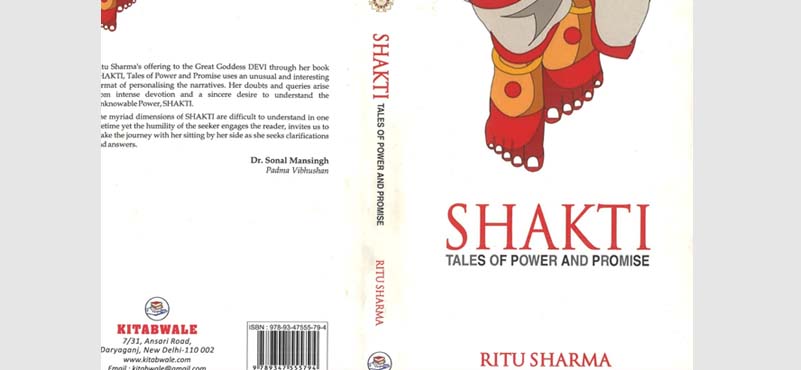
Shakti: Tales of Power and Promise by Ritu Sharma. Published by Kitabwale. 2026. Hardcover. Pages 224. Price Rs. 950.
Let me start with a disclaimer: I have known Ritu Sharma as a colleague and a friend of my wife, Archana Choudhary, IRS (Retd.), for over ten years. Hence, when I learnt of her captivatingly titled book Shakti, I was intrigued and immediately picked up a copy. I must say that my expectations of the book were fully met.
Ritu Sharma is an ace IRS officer of the 2005 batch and has distinguished herself across various verticals of the Department. What makes her special is that, apart from being part of the coveted Civil Services, she is also an author, a poet, a British Chevening Fellow for Leadership and Excellence, and the Director of the National Gallery of Modern Arts, New Delhi.
This eclectic mix of Civil Services and Academics, Fine Arts and Spirituality, provides her with a key differentiator, which sets her apart in the Civil Services and consolidates her position in academia. This unusual, if not unique, blend makes her eminently suitable to write this book.
This book is contextually significant because there has been a resurgence of Indian philosophical thought and religion, aspects that, after centuries, are once again acquiring their place in the Sun. This is reminiscent of Victorian poet and critic Matthew Arnold’s concept of “the man and the moment”, effectively articulated in his work “The Function of Criticism at the Present Time” in the National Review (published in 1864) – the woman here is Ritu Sharma, and the moment is India in the third millennium.
The book’s central focus is on Shakti — the divine feminine energy, source of creation, wisdom, courage, and transformation. When viewed through a proper historical and comparative lens, Shakti emerges as the foundation and core of Indian religious thought and philosophy.
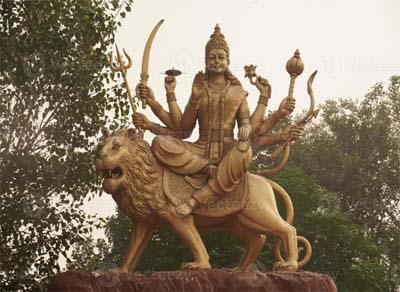
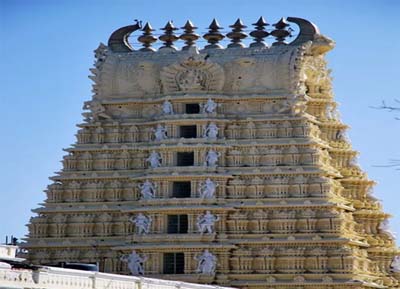
Accordingly, the author explores and examines Shakti in all its forms and manifestations. An incisive examination of Shakti moves seamlessly across the Shaktipeeths (dedicated to Goddess Shakti). This close examination of truth lived, not spoken, is done in a manner which carefully looks at the big picture without being oblivious to granular realities – from Ma Vaishnodevi in the North to Chamundeshwari in the South, to Kamakhya Devi in the Northeast to Sarada in the South. An exploration of these and related dimensions, including those of Shruti and Smriti, allows her to shed light on the Indian tradition of learning and research—a tradition that continues to endure and resonate today, despite centuries of upheaval and the challenges of transition.
In this overarching context of religion, mythology and philosophy, Ritu Sharma’s offering to the Great Goddess Devi in her insightful book is marked by a deep, rare closeness in voice and emotion. She does not present mythology as a distant scripture or a fixed doctrine. She personalises the narratives, transforming them into living conversations between seeker and Divine. Her questions, hesitations, doubts, and moments of wonder stem not from scepticism, but from an intense devotion and a sincere attempt to comprehend the immeasurable force of Shakti. This innovative question-and-answer approach to seeking enlightenment places the book in a rare and distinctive genre—one that remains largely unexplored in the fields of religion and philosophy.
The book is organised into nine neatly structured Chapters, which examine the form and substance of Shakti. There is also a list of References, which will be of interest to a serious reader.
The book derives its strength from this deeply human approach. In spiritual literature, the most enduring journeys are often those rooted in inquiry, and Sharma embraces that ancient tradition of the seeker who approaches the sacred not with certainty, but with humility. Her writing connects ancient myths with everyday life, helping readers see Devi not just as a goddess to worship, but as a source of strength, memory, courage, and hope in human life. Shakti is at once nurturing mother and fierce protector, cosmic intelligence and a basic, unstoppable power, silence and storm. Sharma does not gloss over these contradictions; instead, she invites the reader into contemplation. This is the main message and emotional core of the book.
Sitting beside the author in the manner of a fireside chat, the reader becomes a fellow traveller and an immersive participant in a sacred inquiry — listening, reflecting, questioning, and gradually recognising fragments of the Goddess Energy within the self and the world. This makes it necessary for us “To strive, to seek, to find, and not to yield” (Lord Alfred Tennyson, Ulysses, 1833).
Raised in a conservative Hindu family and having studied Sanskrit through Class XII, I have been devoted to Shakti. And I can say with conviction that this timeless shloka from the Devi Mahatmyam resonates deeply with most of us:
“या देवी सर्वभूतेषु शक्तिरूपेण संस्थिता ।
नमस्तस्यै नमस्तस्यै नमस्तस्यै नमो नमः ॥”
English translation:
Salutations again and again to the Divine Goddess who resides in all beings in the form of power (Śhakti).
I have long examined issues in philosophy, literature and religion. But this refreshingly candid yet kaleidoscopic perspective on Shakti opened new vistas for me. The book’s true strength lies in its seamless integration of sacred myth with psychological depth. Rather than presenting these narratives as static, inherited folklore, the author reframes them as living roadmaps for psychological and spiritual awakening. Through them, Sharma explores timeless themes of courage, surrender, feminine power, trauma, healing, justice, compassion, and spiritual awakening. In doing so, she situates Devi not only within temples and scriptures but also within the struggles and aspirations of contemporary life. This lends the text an immediacy that resonates strongly with modern readers, particularly those seeking meaning beyond rites de passage. Sharma’s conversational engagement with Devi echoes the venerable bhakti tradition (“the bhakti marg,” reflected in the personas of Meera Bai, Andal, Sant Kabir, Sant Tukaram, Akka Mahadevi, and Goswami Tulsidas), in which intimacy with the Divine transcends formal theology. Her writing reflects devotion beyond discourse – the enduring Indian philosophical understanding that the sacred is not distant or inaccessible; it reveals itself through inquiry, devotion, emotional honesty, and inner awakening. This book, about faith beyond rhetoric, becomes more than a catalogue or even a retelling of mythological episodes.
The book shows us that seeking the divine power of Shakti is a journey to discover our own inner strength and wisdom. With honesty, sensitivity, and a desire to learn, Ritu Sharma writes a book that respects Devi while also trying to understand Her many forms. This is a difficult task, but the author accomplishes it well.
The language of the book is clear and effective, and the narration flows smoothly, much like the Holy Ganga River, without any jarring note.
Let me here refer to the words of wisdom and maturity of William Styron. Styron wrote, “A great book should leave you with many experiences, and slightly exhausted at the end. You live several lives while reading.” This is precisely what this book does. I, therefore, strongly recommend this book to all those interested in the Indian religion, philosophy and mythology and the common man interested in the evolution of India down through the ages- “The Wonder That Was India” as A.L. Basham skilfully demonstrated in 1954.
ABOUT THE AUTHOR
 Dr. Manoranjan Sharma is Chief Economist, Infomerics, India. With a brilliant academic record, he has over 250 publications and six books. His views have been cited in the Associated Press, New York; Dow Jones, New York; International Herald Tribune, New York; Wall Street Journal, New York.