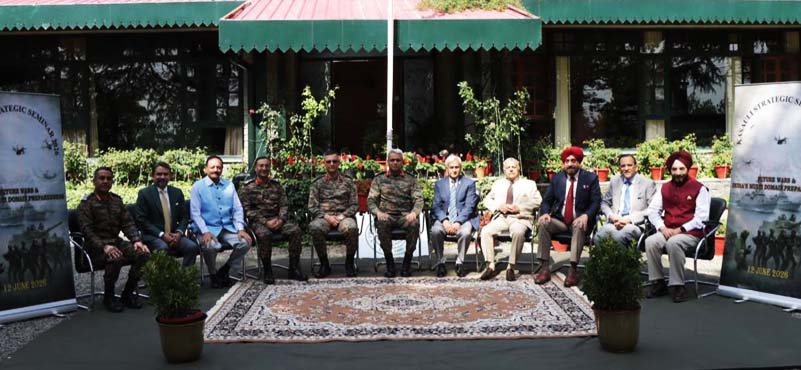
Present on the occasion, apart from the distinguished speakers, were the GOC-in-C Central Command, Gen Sengupta; GOC Uttar Bharat, Gen Mishra; GOC 14 Inf Div Gen Gunjan, and Chairman, Kasauli Club, Brig Sandeep Madan.
On behalf of the Strategic Studies Cell, Lt. General Kamal Davar, said for him as a veteran and an old member of this institution it is an invigorating experience each year to be part of this venture, and since some years, Kasauli too is undisputedly on the security discussions map of India, thanks to 95 Inf Bde. For him personally, he said in his opening remarks, it has been a labour of love.
General Davar noted, that the world, since the last 3 years in particular, namely after the end of the catastrophic COVID pandemic, has been at war with itself, its geopolitics getting fractured by the day; the world today suffers the West Asian War which is now in its 4th month, creating an unprecedented energy crisis globally, bringing the world perhaps on the cusp of another world war.
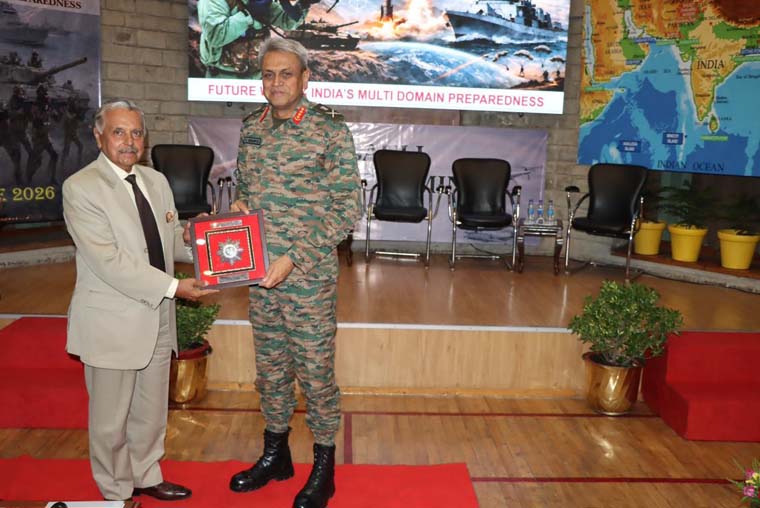
Ambassador Ajai Bisaria, was our last HC to Pakistan before our diplomatic channels with Pakistan were downgraded in Aug 2019. How in today’s global uncertainties what are India’s diplomatic options. How do we manage the emerging challenges as a result of the geopolitical churning taking place. He touched upon the deteriorating relations between our so-called strategic ally, the US and India and whether we are getting bullied by them, like purchasing oil from Russia or not purchasing from Iran since a couple of years and being persuaded to buy it from Venezuela and their inordinate increases in tariffs. Maintenance of strategic autonomy, much that it is desirable is not simple to achieve. The outcome of the recent not so successful visit of the US President to China and China’s long term ambitions for themselves in shaping the world order has also to be factored in by us. How does India build an India Friendly World Order? How are we shaping in restoring harmony and thus prosperity in our immediate neighbour-hood especially with three new governments in place, is also of vital concern to us.
Ambassador Bisaria was unambiguous in his overall assessment that the Indian engagement had been more than positive. In this multi polar global new order, there would be hits and misses, and the India’s hits have been more than adequate. He did think India needed a two-track policy with Pakistan, one area where he felt we had missed out, as some dialogue needs to be continuous with them, too. An elaborate presentation that took a global eye view and how India should be prepared to remain nimble, though equally sure footed.
The former Naval Chief, Admiral Sunil Lanba talked on the Efficacy of Maritime Power in Multi Domain Warfare in the Indian context. What is lurking in the depths of the oceans around us, that is, the threats, both military and economic to our dominance in our choppy waters is of vital concern to India’s well-being. The blockading of waterways through which pass our absolutely critical energy supplies has been amply highlighted in the ongoing West Asian War; we have to think ahead of similar criticalities emerging and ways to surmount such eventualities.
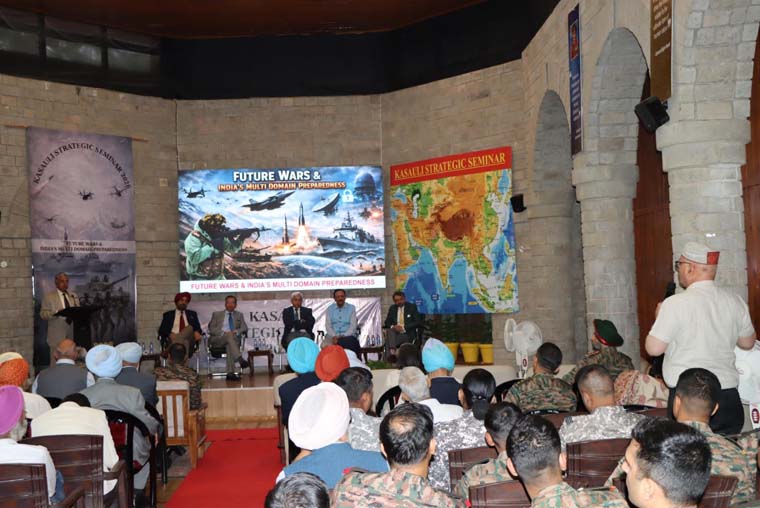
Admiral Lanba touched upon the utility of huge aircraft carriers in today’s increasingly threatening non-contact warfare tactics with large stand-off capabilities emerging. Engagement at sea was ongoing and the seas, in many ways, remained critical in more ways that was often realized. For instance, while our three oil refineries were deep on mainland, the crude they refined was offloaded from overseas in Kutch, Gujarat, which remained central to India’s defence security. He also pointed out how while Quad may remain in abeyance, the Malabar Exercises were taking place regularly. Separately, Indian Navy regularly conducted exercises, one on one, with Japan and Australian navies. Military preparedness on the seas was already effectively underway.
Lt Gen Pannu shared his thoughts on a subject whose significance is ascending by leaps and bounds by each day – namely – Mosaic Warfare and the role of AI in Multi Domain Operations. AI applications, as you all know is truly sweeping the world in an unprecedented manner; never has anything been so revolutionary in recent times. In the military use of AI, it integrates machines learning algorithms to revolutionise command and control, intelligence gathering, combat operations, and logistics. Militaries are deploying AI to process vast battlefield data in seconds, coordinate autonomous drones and automated threat detection among many other applications. Future war fares, he said, could be conducted with gadgets in your hand, with the least human intervention.
In the aerospace domain, Air Marshal Anil Chopra shared his thoughts on understanding Air and Space Conflicts in the Indian context. The ongoing US and Israel combine’s war against Iran has produced many a vital lesson in utilisation of air power including for us. Stealth operations, Electronic Warfare, Drone economics, layered missile defence, directed energy weapons, network centric warfare and strategic autonomy are all vital lessons to be analysed in great detail and adapted in the Indian context.
How relatively cheap but reasonably effective drones are spoiling the Air Force party? Are we spending too much money on acquiring 4.5 gen fighters when the Chinese are going in for gen 6 fighters? He made some excellent pointers. Like, if drones had become the answer, what happened to the thousands that Pakistan had launched upon us? What happened to them? All were effectively neutralized. In another context, given the high costs, was a few squadrons of 4.5 generation more useful than just one or two of 6th generation. He lamented that the ‘real’ cost spend on military upgrades did not match the requirements for a Viksit Bharat that we all are a part of. Fortunately for us, he said, we have not witnessed only the performance of newer weapons and technologies in the West Asian War, but from our own experiences from Operation Sindoor.
Shaping the military narrative often termed narrative warfare or strategic communication is the deliberate process to influence perceptions, secure domestic support and importantly win global legitimacy. NATO has folded public information and information ops into a single Allied Joint Doctrine 2023. The Chinese are highly adept at Information Warfare. Controlling the story is as vital to victory as controlling the physical battlefield. I think we need far more synergy not only among the three services but also with the civil institutions to sharpen our IW capabilities. The young but eminent editor in chief of News X, Rishabh Gulati shared his views on how to shape the narrative. We in India do get overly impressed with Washington Post, New York Times and the BBC who do churn out wrong news, often motivated, about India.
Overall, the impression was of a huge challenge. One that needed more coming together of the three arms of our armed forces, with greater use of high technology and innovation. We need more budgets for this. It was also not about one arm mattering less than the other; all three – land, air and sea – are equally important. Inter disciplinary contests needed to be put aside. As we had entered an era where multi polar engagements was the ongoing new reality, threats could be expected as well from all sides. Security demanded a 24/7 alert, 365 days a year.