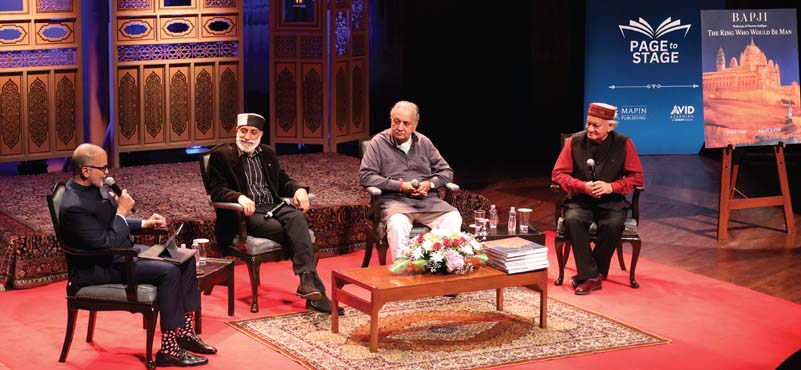
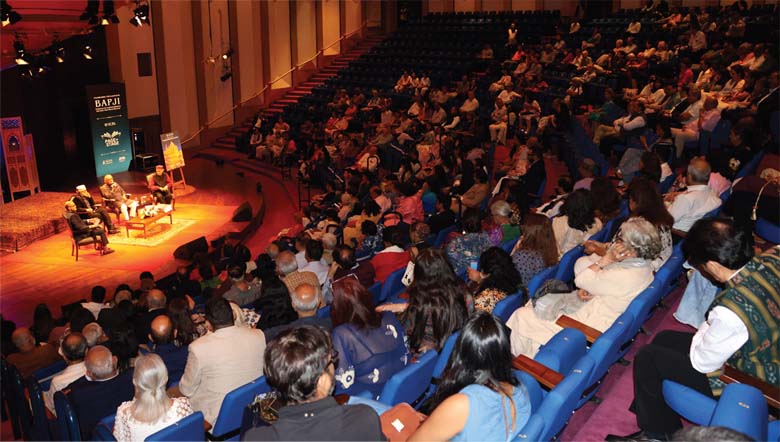
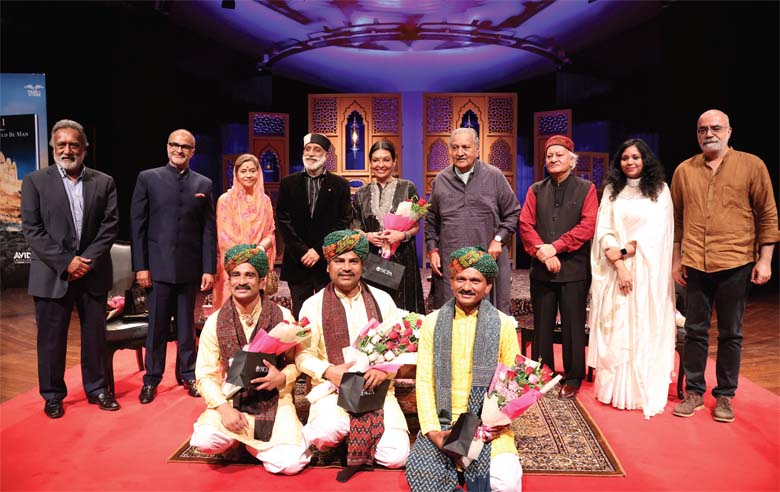
Aman Nath and Yogi Vaid, two friends since childhood, sharing values and budhi alike, have co-authored a biography of Maharaja Gajsingh ji, tracing his lineage, his strong sense of his 39 generations before him, and what he hopes to leave behind as his personal contribution to this legacy. The conversation, marking an official release of the book, ‘The King Who Would be Man’, published by Mapin, was held at the NCPA in Mumbai. Following are excerpts from a much longer conversation, with photographs courtesy Avid Learning.
Opening Remarks
Welcome here. It seems most fitting to have this discussion at the NCPA as part of our Page to Stage initiative, which gives literature a stage and a forum for such discussions.
Founded on a dream over 55 years ago to promote, propagate, and preserve the arts, the NCPA hosts performances across music, dance, and theater. It also boasts of a photo gallery, two libraries, with a rare collection of records and books, as well as a rich archive with priceless treasures, interestingly, including a great collection of books and recordings on the folk music of Rajasthan. In addition to this, NCPA hosts education and outreach programs, ensuring accessibility to the arts. In short, it plays the role of a nationwide ecosystem that sustains artistic expression and cultural continuity.
You see the parallel. The royalty and the arts have always shared a strong relationship. Despite changing times, Maharaja Gajsinghji II has continued to strengthen his patronage to the arts and the culture of Rajasthan. A founder of the Mehrangarh Museum Trust and a chief patron for events like Jodhpur RIFF and the World Sacred Spirit Festival, he promotes Marwar music, arts and festivals playing a significant role in the propagation and preservation of the arts, similar to the NCPA. A keeper of culture including built heritage, intangible heritage, water conservation, environmental efforts and numerous social causes, he plays more than the role of cultural conscience keeper.

Asad Lalljee (Moderator): Tonight, we are in the presence of a book and the people behind it that refuses both. The King Who Would Be Man is not a celebration of monarchy. It is not a eulogy of the lost world. It is something more compelling. It is the story of a man who was handed an identity at the age of four, long before he could understand it, and who then spent the next seven decades forging a legacy. Not just the palaces, titles, or traditions, but responsibility. The weight of being someone an entire people look towards. At the heart of the story, many choose retreat, a quieter life behind high walls, letting the world move on without them. Maharaja Ghat Singh II of Mahabharat Jodhpur did not. He stepped into democracy, into diplomacy, into institution building, tourism, and the fight for a language spoken by millions, yet without an official recognition. He did not choose irrelevance, he chose responsibility. And to his people, he remains simply Bapji.
 You know, I’d like to pause on the word which carries affection and reverence, Bapji, revered father. You were four years old when your father, Maharaja Hanuman Singh, passed away. The Rathors called you bapji, the same name your father carried so you would grow into it, not just inherit it. Seven decades later, you’ve carried it with such grace and trust. What does being Bapji mean to you today?
Bapji: I remember having a nickname, Mukul. But my maternal uncle, Maharaja of Dharamgadra, was very adamant, told my mother, I don’t want him stuck with a nickname, like many of his fellow princes. And so, he said, Bapji is the appropriate word. Bapji itself is a very familiar, honorific and term of endearment used in Rajasthan. So especially in feudal families, the male members of the families are known as Babji. Like in my family, my father was known as Bada Babji. And my uncle was known by so-and-so Bapji, Azur Bapji, Bijla Bapji, by their name Bapji. Since I was the only one, my mother started calling me Bapji. And as a result, everybody else called me Bapji as well. So, it was both an honorific which carried with it a responsibility and a term of endearment for me and that’s how I look at it.
Asad Laljee: And seven decades later? And seven decades later?
Bapji: Seven decades later, well, Aman has got it to stick now in a big way. So I’m known as Bapji by all of Jodhpur, all my friends in India and abroad. And I treat it with honor and with affection. And I hope that I can live up to the expectations
Aman Nath: I think that, you know, words like this which become generic, when we say Bapu, there’s only one Bapu for India. When we say Gurudev, we mean Tagore. And I think that this book will play a certain role in making you the generic Bapji, yes.
 Asad Laljee: But talking about this book, you know, Jodhpur Umaid Bhavan, the Maharaja of Palaces, published in 2008, also by Aman, do share the chance encounter that became the impetus of this book? And why publish this book now? I mean, you know, there was no landmark occasion, like an 80th or a 100th celebration. And how was it working with Aman on this book versus the previous edition?
Bapji: Well, over a period, many people have always told me, write your biography or get somebody else to write it. And since I’m no writer myself, I didn’t take it seriously. But at the same time, what actually happened was Aman’s biography was being written by Yogi. And Yogi was introduced to me because he wanted Yogi to talk to me about him and our friendship. So we met. And that’s how this whole thing evolved. And of course, I’ve known Aman and Francis before that for a long time. And they’ve always had a love affair with Jodhpur, hence the Maharaja book of palaces. And he’s always had in mind to do another book on Jodhpur. He’s a master in these large format books. He told me to call it large format book, not a coffee table book. And the Jaipur book, they’re all legendary, and the one in Delhi, the Tata book, these are all very important books. So we got talking and they said, why not do it?
Asad Laljee: Bill Gates told you?
Bapji: You know, Bill Gates once came with his son, with his father and his sisters, and they were having drinks and he looked at the book, the Maharaja book, and he lingered across it for a long time and he said that this needs to be followed up and that stayed in my mind.
Asad Laljee: Kipling wrote The Man Who Would Be King, about a common man’s hunger to rise above and become royalty. Your book flips it entirely, a king choosing to walk among his people, earning his place not through power, but through presence.What made this reversal the heart of the story?
Aman Nath: Well, Bapji and I began our journey many years ago, disco dancing at the Tabela at The Oberoi.
We say that in the book too. No, but they haven’t read it yet. So, we actually go up and down all of society, as does Bapji. He’s in a village without water one day and he’s with the topmost people the next. So, the whole idea was that in the 60s and 70s, the Maharaja became a sort of mascot because India used it as a mascot. It was not with any ridicule, it was done because it was something that India had to offer, that the world was interested in. And I think that moment passed. So, the moment when, if you now had a picture of Bapji, and there are several, wearing all his jewels, I’m not sure that it would evoke the same sentiment that this book does. I do believe that India is a very wise nation and evolved people and their, I think, majority of the audience could be included in that, understand that nothing belongs to us. That we are custodians of whatever we hold. So, when you talk about 32 forts and palaces, of course none of those belong to me because they’re going to outlive me. So, I think, I believe that if you touch something in your life and improve it, then you have the right to inherit it. Otherwise, you don’t. You could sell it off. So, Bapji is an exemplary example of that. Because one chapter in the book says, inheriting white elephants. So, I know, you know, when you look at Umed Bhawan as one of the best hotels in the world and so on, when it was inherited, it was not so. It was dark, dingy, how much staff do you need, and the privy purses had gone.m
Asad Laljee: But Yogi, we’re gonna go to you.
Yogi Vaid: About time, thank you.
Asad Laljee: Yeah, I mean, with Aman, you would have to, I mean, you all know each other for 68 years, right? So you wrote a deeply personal book about your friend Aman Nath, titled A Remarkable Friendship. That’s when you met Bapji, and now the two of you have turned around and written this book together. While many significant biographies are published posthumously to provide a complete overview of a person’s life, here you are two authors working together to interpret the life of a third person who is a public figure and a close personal acquaintance. So how did this process of shaping a singular narrative voice of this book unfold and what were some of the creative and intellectual challenges?
Yogi Vaid: Well, you know, the process of unification germinated 68 years ago. That’s going back a long time. And Asad, you remember the chicken and egg riddle, right? But unlike that riddle, Aman and I both came first in kindergarten and we got the academic prize in school. So I feel that if our buddhi, our intellect brought us together, it was our bhagya, our destiny, that for next six decades we criss-crossed each other’s paths. And you know we come from similar backgrounds, we have the same family values, we’ve grown up with the same education. So, all that was used as an advantage in bringing out this very human story, and then you know the subject very well, you interact with the family and you know them. And these are the nuances which archival documents seldom throw up. So, you know, the challenge was really never there. We just enjoyed it, it was a cakewalk, I think, you know, and it was teamwork, but the mantra is to keep the ego out. So, Aman and I know our strengths.
Now Aman’s strength is a generosity of spirit, which so many people have benefited from, and an incredible discipline, focus, strength. Now Aman, later on you can trumpet some of mine.
So that was the genesis of the book. So there was no disagreement, so hence the unified narrative. You know there’s a joke in the family that Aman and I have never had a disagreement. I mean leave alone an argument.
Asad Laljee: Bapji, I’m going to go back to you. In 1970, you returned after 14 years in England, Oxford educated, worldly, shaped completely by a different world. And then there were millions of people waiting alongside to greet you. You changed out of your Western clothes. Now, Aman has told me that you looked like Elvis Presley, though I did not find that in the book, into your Rajasthani dress, and you said, to quote, “’The train journey was that momentous one “’that changed the tracks of my life.’ “You abandoned your plans to go and study architecture in the US. So, when did you realize without doubt that this is where you belonged?
BAPJI: Well in all the years, 14 years, I call it my 14 years of exile. I was in England and I enjoyed it. I had to come and go and it was a game I used to play of being Englishman when I was there and being an Indian when I was here. But coming back was another experience. And when I came back, my mother had asked the Palace organization to make a small reception for me. But that snowballed out of control, and it was taken over by the citizens of Jodhpur. So, when I returned to Delhi, I got a call from my mother. She said, you have to stay back in Delhi for a couple of days because they’re not ready for you. So, I asked, what do you mean they’re not ready for me? She said, they’re organizing a reception for you and you have to come by train, not by plane. And I’m sending the saloon. In those days we had the privilege of our own private saloon. It had still not been de-recognized in 1970, which we could attach to the regular train. And I’m sending the saloon for you, and you will come in that. So I came, and the moment we entered the territory of Marwar at 5 o’clock in the morning, it was winter, in November, quite cold, small crowd started assembling, and it grew and grew and grew until I reached the station of Jodhpur at 12 o’clock exactly.
 And there wasn’t a place to walk. You’ll see the photograph in the book. And it took me to, from there, to go to the temple through the old city, which they decided I had to go through, and to my grandmother’s home, and back to Umaid Bhawan, where my mother was, 12 hours. And that really shook me in many ways. It was awe-inspiring. It was, in a way, frightening, because I realized that there’s a lot of expectation. At the same time, I realized that there’s a lot of love and affection. And I also realized that they don’t know me. It’s something that, beyond that, it is my ancestors, my father, grandfather. The respect I’m getting is because of that. And that is when I really, and I also, it was on the eve of de-recognition, when the rest of the country was downgrading and at least the political tendency was to downgrade and look down on the Indian princes. Here was a whole population that had actually come out and it gave me a lot of courage and a lot of strength.
And that is when I realized that this is my calling. And, of course, I’d always known that since the beginning, but I realized that this is – I have to be here, I have to remain here, I have to connect.
Asad Laljee: And I believe that journey normally takes about 15 minutes, this one stretched to 12 hours. So that was a symbolic kind of awakening. The title suggests the king who would be man, that becoming fully human is greater ambition than being king. In post-independence India, royalty is often caricatured as hostile to democracy. Why was it important for you to tell a story that dignifies a Maharaja without romanticizing the institution?
Aman Nath: When you become a democracy, and the titles have been made redundant for whatever reason, for populist reasons and so on, we cannot live time backwards. I think we just have to look ahead. And I think the good thing about Bapji was that he understood that. He understood that. And I didn’t finish the last time, that if you were today playing the Maharaja, and some do actually, it’s good pictures for magazines, but it’s not connected with reality. And India is a very wise country. So I think that kind of wisdom, perhaps because Bapji had been away, and when you look at yourself from a distance, you get a new perspective, which he certainly got. And having got that, there’s been pictures of him in every magazine in the world, wearing those jewels in the 60s, 70s. It was fashionable. There were books like that. And Cartier did exhibitions and vintage cars and rallies and all that. But it becomes out of sync. Today, when people talk of, I mean, we are in hotels, luxury is important. But for India, experiential tourism is also very important because when you actually set up luxury and get Miss India to sit in a jacuzzi with rose petals and make a photograph and say, you know, come to this luxury hotel, the reality is so different because by the time you can afford to pay seven lakhs for your suite, or is it more than that, you know? Yes. You know, you become 60 and if you have a mirrored bathroom and you take off all your clothes, I think you want to drown yourself.
Asad Laljee: I think we need to keep this PG-13, and all India Flower Association will object to you. But you know, when I first met, one of the first meetings with Aman, I met him at JLF, when people mistook him to be Hamid Karzai. And he sat and complained to me. I mean, we barely knew each other at that time. And then when I was talking to him the other day, he said, now people mistake him as a Maharaja because of the number of palaces he has in his portfolio. So, am I correct?
Aman Nath: Not entirely, you know, I mean, I’m also on the same trail, you know, I keep saying I’m a fakir and they say, you know, that’s not how it is, but Bapji is a fakir, you know, he plays that role.
Asad Laljee: Yeah. Bapji, you know, you fought both in Parliament and outside for Rajasthani to be included in the eighth schedule of the Constitution. Why does linguistic inclusion matter so much to you?
BAPJI: You see, it’s the root of culture. And we, today in Rajasthan, we pride ourselves on our culture and we talk about cultural events like we saw today, our music, that is also Rajasthani. And there are different forms of Rajasthani. And we do all that, at the same time, we don’t recognize the language. With the language comes everything. Language becomes culture, values, the way you present yourself. And all the fineries that Rajasthan has, comes from the language, refinement. And it’s a very rich language. There are 12 volumes of a dictionary written by one gentleman. And it’s much richer than Hindi or any other language. It’s recognized by the society academy long before, as the mother of the desert languages, is known as Maru Bhaja, mother of present-day Rajasthani, Gujarati, Sindhi, all come from that. So, it is our root and it’s what makes Rajasthan strong, what we believe in. And it’s very sad that it hasn’t happened because what happens now are the parents want their children to learn Hindi and English and they stop speaking the local language at home.
Asad Laljee: I think that’s happening in many parts of India. But Yogi mentioned the Pancharanga flag has five colors representing the five communities, the five faiths and the five ways of belonging under one roof and you’ve often said the king has no caste. And, in today’s India, where identity and caste are increasingly used to divide, how do you actively hold the five-colour promise together in Marwar?
BAPJI: In Marwar, definitely, and in Jodhpur city, of course, all over, there is a great sense of binding, a great sense of oneness, of belonging to the Marwar culture, and the apnapan, they call it, apnayat. And so people in Jodhpur love each other wherever they are, and they are spread all over the world, and they will welcome each other with open arms, regardless of who you are, whether you’re a king or a pauper. If you go abroad and you find a rich Rajasthani, he will welcome you into his home. And that is the strength of the culture, and again, that is the language. One finds that recognition comes from the language. So we have a very strong communal harmony. We have a society, we have a group, that actively looks into this. So there have been very few communal incidents in Jodhpur. And particularly during the time of partition, my father and grandfather saw to it that Indians – Muslims and Hindus – crossed over the border safely. And we had the Jodhpur Railway at that time. Jodhpur Railway had a line going into Hyderabad Sindh. That was the safest crossing in those days. Even though my grandfather appealed to the people saying that Hindus and Muslims are like my two eyes, don’t leave, you’ll be safe here. But some people left, and they retained that connection. There are people in Karachi who still call themselves Marwar Muslim Society, and they’re in touch with me, and they bring out a calendar. They wanted photographs of my grandfather, they wanted photographs of the fort, me, and they bring out a calendar. They wanted photographs of my grandfather, they wanted photographs of the fort, which they bring out. So that’s the strength.
Asad Laljee: Thank you for that. You know, I’m just going to go into this whole area of heritage and tourism. In 1978, before leaving for Trinidad, you made the decision that would change the landscape of Indian heritage tourism. You signed a professional hotel management company to run Umaid Bhawan. At the time, very few royals thought that way. Was this a pragmatic survival decision or did you already have a sense that heritage handled well can become its own form of legacy? I mean, he has briefly mentioned the white elephants,
Bapji: No, it’s a combination of factors. Firstly, Aman already mentioned the experience of being in Europe and looking from outside inwards. One saw things in a different way. And I realized that there is so much culture and there’s so much history, architecture that needs to be preserved the way they’ve done in Europe. They are modern democratic countries. They’re not backward. Like we were made out to be here, but yet they were able to protect their heritage in a practical way. So that was one. Secondly, as you rightly say, there was a need for the hour. Because as Arvind said, everything was basically under dust sheets. And we had to look after our staff. We had to look after buildings. The other assets, the land had been taken away, the taxation was very heavy, but there was no liquidity, but we had these white elephants. So, it seemed like the obvious thing to do.
Yogi Vaid: Yeah, and I must add, the first time I met him (Bapji), for writing for my book on Aman, we are sitting in Umaid Bhavan, and he says, will you believe when I tell you that we have seen poverty? And I’m sitting in this opulent 347 room palace with portraits, and I said, my God, has he lost this? This man has lost it. He’s saying he’s poor. But he just explained what they went through. That was tough.
Bapji: So people like us represent that in a very wise way, not, it’s not me, it’s something that we are carrying through, and that is what heritage is about.
Asad Laljee: To just continue on that thread, you and Bapji were the founding members of INTACH? But in this rapidly, moving to today because we’re looking forward, in a rapidly urbanizing country like India, how can organizations like INTACH balance heritage conservation with the pressures of economic development without turning culture into a tourist asset?
Aman Nath: You know, this happens to institutions, this happens to royals, people set up a plan, but things don’t work to plan. So I say that if three generations keep their head on their shoulder, which is difficult, an empire can be made, and if five generations can keep their head on their shoulder, a dynasty can be made. But if you look at the Hindu trinity, which understands this whole business of life in a very wise way, because we are truly a wise country, if you look at Brahma, Vishnu, Mahesh, there’s the creator, the preserver. Because if one generation creates an extraordinary amount of wealth, to the second generation, it’s not just an asset. It’s also a liability. If you had 100 trillion rupees or dollars or whatever, then you get into the trappings of all that. And the third generation then has to be decadent and for them to keep that agility of the hunter to go out to the forest and hunt, you know, is lost. So that is nature’s plan, in a way fortunately, because otherwise one family would go on rising.
But I forgot your question though. Sorry. No, no, INTACH, yeah. So the problem with setting up institutions is that they’re very well intended but it doesn’t work out like that. And I think the best example you can take, is that of the Taj Mahal. So I studied medieval Indian history. So Shah Jahan, with the foresight of whatever he’d built, he’d emptied his whole treasury, built this extraordinary thing, and whatever money was left, he made a basra chadar for the grave. So he says, how is this going to be looked after? So, he writes 250 villages, you know, in a farman, to say they are part of the Taj Mahal, and revenues from that we look after. But it doesn’t work, even for an emperor of that size, et cetera. So, a few generations later, the British are there. They’re having dance parties, and they go with hammers and chisels, and they’re pulling out the semi-precious stones. So, where is Shah Jahan, and where is anything? So it’s very difficult to get continuity, which is the reason that this book explains the complexity of the task ahead. And in fact, I don’t know what you would say about it. It’s set up with this grand plan, but then people start sitting over elections, people start campaigning.
Asad Laljee: You know, your family, unfortunately, has endured a lot of tragedies across generations, from the untimely loss of your grandfather, your father, the accident for your son. So, when you look back at these adverse moments, what beliefs and values have helped your family endure these trials and maintain the strength and resilience through these difficult times?
Bapji: Well, I certainly believe that there is a legacy and I was fortunate to be born into that legacy and that gives us a strength of continuity. We have a responsibility to that legacy and hence we have to carry it on, whatever the circumstances. And that helps us to regroup and take life further. And in the case of my son, we had the prayers of all the people of Jodhpur and around the world, and it put my son on his feet again. He got married, we have a grandson and a granddaughter and the legacy continues.
Asad Laljee: The granddaughter is written in the book also. You know, speaking about legacy, the book’s dedication says legacy is not what you inherit but what you leave behind. You inherited 39 generations of history; you have added your own golden chapter to it. So, when you look back at what you have built, what are you most proud of?
Bapji: I think I’m most proud of the fact that people today recognize me and they appreciate what I’m trying to put across. And in fact, they also have grasped the importance of their own heritage, their own culture, and their own history.
Aman Nath: I think that whatever you do in your lifetime, I’m talking now about this book, should be something that nobody can better in their life. So when I do books, when I did the Tata Centenary book, Ratan Tata said that he gives it out to people. It’s considered the best corporate book in the world. It’s good to hear that. And this will be, I think, the most extraordinary biography because it’s completely unputdownable.