
It’s not about the Moon, about romance or just landings. It is serious leanings and learnings for the next century. India has made a quiet but determined start. ISRO has set for itself the right targets and understood the importance of testing and collaborations. India cannot do all this on her own, finding the right partners in equally critical. India’s private sector must become a serious player in the business. This is the next frontier.
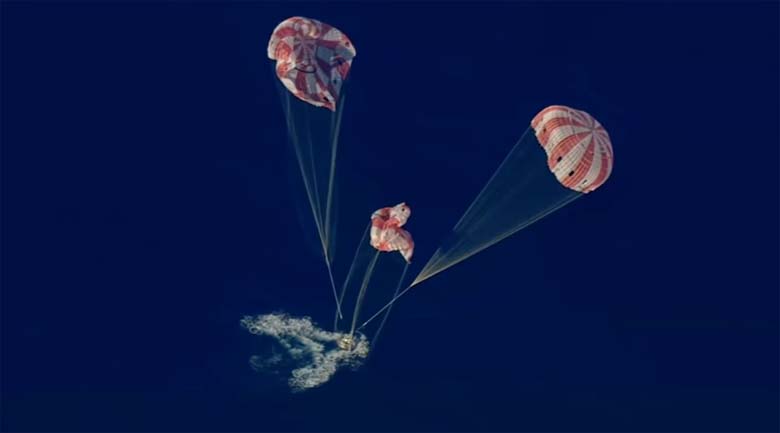
 There is something almost quietly remarkable about the fact that the most powerful rocket ever built carried no human being when it finally left the launchpad. Artemis 1, which lifted off on the 16 Nov 2022 from Kennedy Space Centre in Florida, was an uncrewed test flight. The Orion spacecraft, riding atop the Space Launch System, flew around the Moon and back over 25 days, covering 2.25 million kilometres and splashing down in the Pacific Ocean on the 11 Dec 2022. That splashdown date, almost poetically, fell exactly fifty years to the day after the Apollo 17 crew, the last humans to visit the Moon, returned to Earth. The symmetry was deliberate and pointed. Half a century had passed, and humanity was only now sending an empty spacecraft to test whether it had remembered how.
The mission was never about discovery in the traditional sense. It was an engineering audit. NASA needed to know, above all else, whether the Orion capsule’s heat shield could survive a lunar return trajectory. When a spacecraft comes home from the Moon, it enters Earth’s atmosphere at roughly 40,000 km/hr, far faster than a return from the International Space Station, generating temperatures at the heat shield face that exceed 2,700 degrees Celsius. No human rated deep space capsule had been put through those conditions since Apollo. The heat shield is made of ablative material called Avcoat and some of it is supposed to burn off during re-entry, but what NASA found after Artemis 1 was that the material had eroded in unexpected ways, more than the models had predicted. That discovery forced engineers back to the drawing board on heat shield permeability and delayed the next mission by over a year.
Beyond the heat shield, Artemis 1 tested Orion’s navigation systems across nearly half a million kilometres of deep space, its power generation in the high radiation environment beyond low Earth orbit, its communication links and its splashdown and recovery procedures. The spacecraft carried mannequins fitted with radiation sensors to measure what a human body would experience. Artemis 1 set a distance record for a crew rated spacecraft, travelling more than 2.3 million kilometres on its path around the Moon. The data gathered was irreplaceable. There is no laboratory capable of simulating the Van Allen belts or the unshielded cosmic ray bombardment of interplanetary space. You can only learn those things by going.
So why did it take 50 years to try again? The Apollo programme ended not because the Moon became less interesting but because political will collapsed. Lunar exploration was Cold War theatre and once America had planted its flag and the Soviets had quietly conceded the race, congressional funding dried up. What followed was five decades of orbital stations, Mars rovers, and commercial satellite work, but no human being ever ventured beyond low Earth orbit again. The gap was not technological. It was political.
The SLS rocket, the vehicle that finally flew Artemis 1, was conceived in 2011 and was supposed to fly by 2016. It did not fly until 2022, a 6-year delay that cost billions and reflected a deeper tension in American space policy between the old cost-plus contracting model and the disruptive ambitions of private players like SpaceX. Every year the SLS sat in development, Elon Musk’s engineers were building reusable rockets that routinely landed themselves and flew again. The contrast was impossible to ignore.
The role of private companies in Artemis is, in fact, the most important structural shift in how spacefaring nations think about exploration. Artemis is not a NASA programme the way Apollo was. NASA owns the Orion spacecraft, built by Lockheed Martin and the SLS, assembled by Boeing and Northrop Grumman. But for the actual lunar landing, NASA contracted SpaceX to provide the Human Landing System, a modified version of the Starship vehicle, to ferry astronauts from lunar orbit down to the lunar surface and back. The government agency responsible for putting men on the Moon is now dependent on a private company’s next generation rocket to complete the mission. That is either a brilliant leveraging of commercial innovation or a worrying concentration of capability in a single entrepreneurial venture, depending on how you look at it. Probably both.
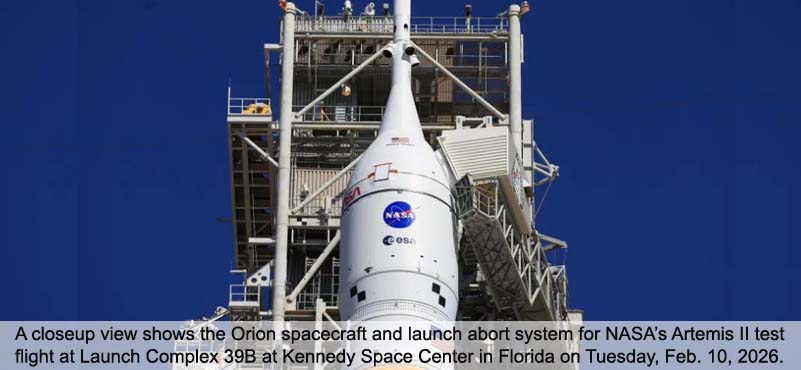
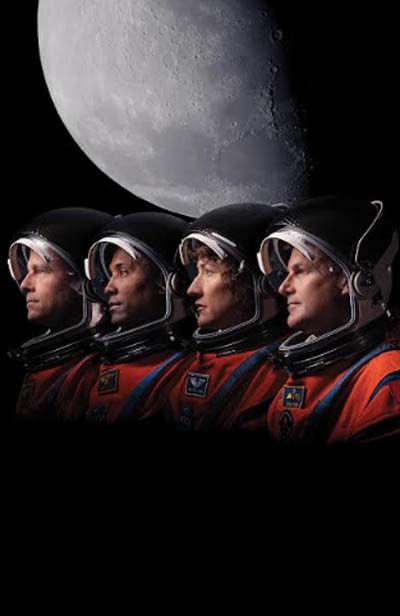
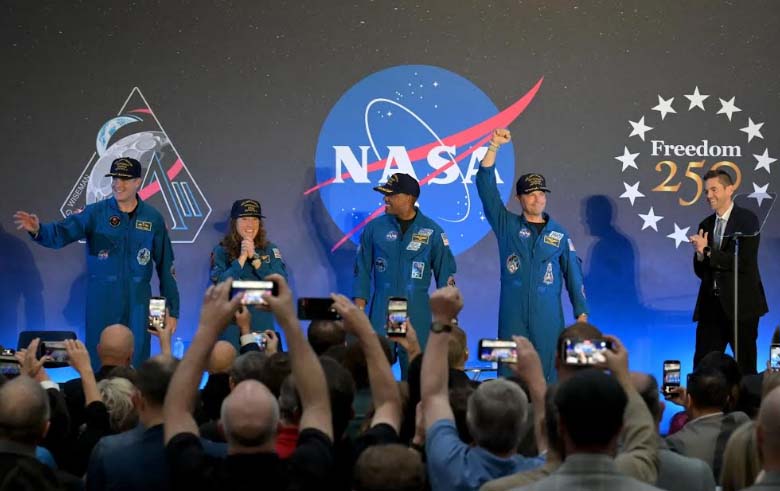
Now for where things stand today. Artemis 2 launched on the 1st of April 2026 and carried four astronauts, commander Reid Wiseman, Victor Glover, Christina Koch from NASA, and Jeremy Hansen from the Canadian Space Agency, on a 9-day lunar flyby. It was the first time, humans had travelled beyond low Earth orbit since Apollo 17 in 1972. The mission did not attempt a landing. It was a crewed shakedown of the Orion system with humans aboard for the first time, testing life support, communications and the new more conservative re-entry trajectory designed in response to the heat shield findings from Artemis 1.
Artemis 3, now scheduled for mid-2027, has itself been restructured. Rather than a lunar landing as originally planned, it will test the SpaceX Starship Human Landing System in Earth orbit, with the first actual crewed lunar landing now pushed to Artemis 4, targeted for 2028. The Lunar Gateway orbital station, once a centrepiece of the programme’s long-term architecture, was cancelled in March 2026, with NASA pivoting instead to building infrastructure directly on the lunar surface. The plan now is annual lunar landings from Artemis 5 onward, building toward a permanent base near the south pole, where water ice locked in permanently shadowed craters represents the most strategically valuable resource in the inner solar system. Water ice means oxygen, drinking water, and hydrogen for rocket fuel. It is the petrol station that makes the rest of the solar system reachable.
Europe is not watching from the sidelines. The European Space Agency has been building toward its own lunar presence through a strategy called Terrae Novae, which translates roughly as new worlds. ESA’s stated goals include sending the first European astronaut to the Moon’s surface by 2030 and participating in the first human mission to Mars. The main vehicle for European lunar ambition is the Argonaut programme, a heavy cargo lander designed to deliver up to 1,500 kg of supplies to the lunar surface, with the first mission planned by 2030 using the Ariane 6 rocket. Europe is also building Moonlight, a dedicated satellite constellation for telecommunication and navigation services around the Moon, with initial operations targeted by 2028 and full capability by 2030. This is the GPS of the lunar economy, and whoever builds it first shapes how every subsequent actor operates. ESA has been supplying the European Service Module for Orion throughout the Artemis programme, which gives it a seat at the table without having to fund the entire launch architecture independently.
China represents the most serious geopolitical challenge to American dominance in space. Beijing’s Chang’e programme has already achieved things that once seemed improbable for a latecomer, a soft landing on the far side of the Moon in 2019, a sample return mission in 2020, and the first ever samples returned from the lunar far side in 2024. China’s stated plan is to land two astronauts on the Moon by 2030 using the Mengzhou crewed spacecraft and the Lanyue lunar lander. China hopes to build a basic version of a crewed scientific base near the lunar south pole by 2035, partnering with Russia on the project, called the International Lunar Research Station. A second expanded phase is planned for the late 2030s to 2040s, adding a moon orbiting station as a central hub. China’s Chang 7 is expected to launch around 2026 to probe the lunar south pole for water ice and Chang 8 around 2028 to begin experiments on using lunar resources in situ. China never describes this as a race. It does not need to. The trajectory is unmistakable.
Which brings us to India. The lessons of Artemis 1 and its aftermath are directly applicable to where ISRO now stands, and where it needs to go. Shubhanshu Shukla launched to the International Space Station on the 25 Jun 2025 as mission pilot on Axiom Mission 4, the commercial spaceflight operated by Axiom Space on a SpaceX Falcon 9, becoming the second Indian to travel to space after Rakesh Sharma in 1984 and the first Indian ever to visit the ISS. He spent 18 days aboard the station, travelled nearly 12 million kilometres, orbited Earth around 280 times and completed seven Indian science experiments focused on muscle repair, algae growth, seed behaviour, and neurological responses to spaceflight. The mission cost approximately 600 crore rupees, and ISRO officials have defended every paisa of it.
They are right to do so. The Ax-4 mission was not a prestige exercise. It was a training investment. ISRO teams stationed in the United States gained crucial experience working alongside NASA and Axiom flight controllers, directly strengthening readiness for Gaganyaan. The Gaganyaan programme now plans three uncrewed test flights before the first crewed mission in 2027, with the first uncrewed flight carrying Vyommitra, ISRO’s humanoid robot is planned for 2026. India would become only the fourth nation to independently launch humans to space.
The lessons from Artemis 1 for Gaganyaan are not subtle.
- First, test everything before trusting anything. NASA spent years and billions validating Orion before putting a single human aboard, and still found unexpected heat shield erosion that set back the entire programme. ISRO’s philosophy of exhaustive testing before crewed flight is correct and must not be sacrificed to political pressure or anniversary deadlines.
- Second, the Ax-4 mission demonstrated the value of the commercial model. A government space agency getting its astronaut to orbit on a private rocket, trained at a private company’s facility, in partnership with another nation’s space agency, is not a concession of sovereignty. It is sophisticated statecraft. India needs to deepen this approach, building a domestic ecosystem where private companies like Skyroot, Agnikul and others become genuine capability partners.
- Third, and most pressingly, India needs a strategic destination beyond Gaganyaan itself. ISRO’s Chandrayaan 3 landing near the lunar south pole in August 2023 was an extraordinary achievement that placed India precisely where the geopolitical action is. The question now is what India plans to do with that positioning. A lunar mission by 2040, a collaboration with NASA or independent partners, a role in the emerging lunar economy, these are decisions that need to be taken now, not after the first Gaganyaan crewed flight lands safely.
The Moon is no longer a romantic destination. It is the logistics hub of the next century of space exploration. Artemis 1 was an empty test flight, but everything that flows from it, the crewed flybys, the landings, the bases, the resource extraction, the Mars missions beyond, is remaking the geopolitics of space in real time. Every nation that participates shapes the rules and every nation that waits finds the rules are already written.
ABOUT THE AUTHOR
 Air Marshal (Dr) Sanjeev Kapoor (Retd) a pilot, with over 8000 hrs of flying. He is a flying instructor and a pioneer in aerial refuelling in IAF. He commanded the air-to-air refuelling squadron, a large operational base, Air Force Academy and National Defence Academy. He holds an Airline Pilot License and is part of various think tanks, boards and studies.