Introduction
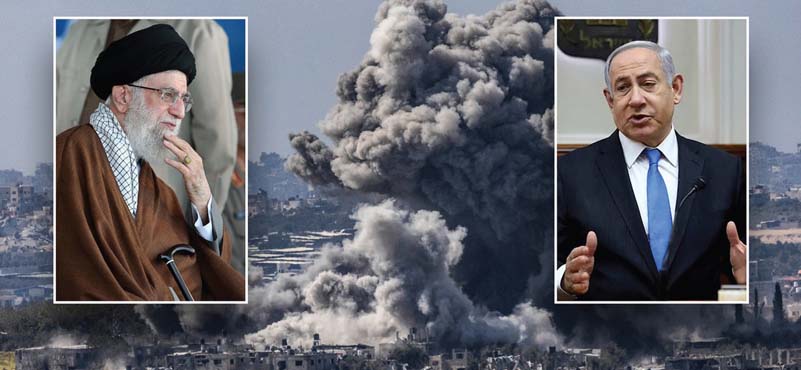
The death of Ayatollah Ali Khamenei, Iran’s Supreme Leader on 01 March by a US and Israeli air strike marks a turning point not only for Iran but for the wider West Asian region.
His assassination removes a figure who for more than three decades stood at the apex of Iran’s political, military, and religious order. While Iran has an elected President Masoud Pezeshkian, the real power has rested with its Supreme Leader who has the final say over all matters of state.
As Supreme Leader, he exercised ultimate authority over foreign policy, the Armed Forces, and the direction of the revolution. As Marjai Taqleed, a source of emulation in Shia jurisprudence, he embodied religious legitimacy that extended beyond Iran’s borders. His passing, therefore, creates a vacuum. Yet those expecting the immediate collapse of the Iranian system may be misreading both its structure and its history.
Iran’s system is not built around one man alone. The Islamic Republic rests on multiple pillars, including the clerical establishment, security services, the bureaucracy, and an ideological base shaped by the doctrine of Velayat e Faqih. Unlike personality-driven autocracies, it therefore has institutional depth.
Ayatollah Khamenei lived under the tightest security, and his relatively infrequent public appearances were never announced in advance or broadcast live. As Supreme Leader he never set foot outside the country, a precedent set by Ayatollah Khomeini following his return to Tehran from France in 1979.His last known foreign trip was an official visit to North Korea in 1989 as President, where he met Kim II Sung.
Khamenei worked with six elected Presidents, including more moderate figures, such as Mohammad Khatami, who were allowed to make attempts at cautious reform and rapprochement with the West. But in the end, Khamenei always came down on the side of hardliners. As a result, Israel has long seen him as a destabilising force in the region, citing his alleged backing for a network of militant allies.
Choosing A Successor
Under Iran’s constitution, an interim council comprising President Masoud Pezeshkian, the Judiciary Chief Gholamhossein Mohseni Ejei and a cleric from the Guardian Council will step in and temporarily assume all the duties of leadership until the Assembly of Experts appoints a successor.
Though the Leadership Council will govern in the interim, an 88-member panel called the Assembly of Experts “must, as soon as possible” pick a new Supreme Leader from senior Shia clerics under Iranian law. Clerical deliberations about succession take place away from the public eye, making it hard to gauge who may be a top contender. The contours of the succession process are complex.
Names circulating in Tehran include Sadeq Larijani, the former Judiciary Chief, and a close aide to Khamenei; Alireza Arafi, who oversees Iran’s seminaries; Mohsen Araki, a longtime member of the Assembly; Mohsen Qomi, an adviser within the Supreme Leader’s office; Hassan Khomeini, the grandson of the Islamic Republic’s founder, Ruhollah Khomeini and one of Khamenei’s sons, Mojtaba, a 56-year-old Shiite cleric.
 The late President Ebrahim Raisi had been seen as a frontrunner before his own death in an air crash. Reports that Ayatollah Khamenei had identified three potential successors during earlier crises suggest that contingency planning was already underway, though the names remain undisclosed.
That, however, does not mean friction is impossible. Rivalries could surface as factions manoeuvre for influence over the next Supreme Leader. A hardline successor would enforce ideological orthodoxy. Even if a relatively moderate cleric is chosen, immediate flexibility toward the West appears unlikely, as regimes, in moments of perceived siege, tend to project strength, not compromise.
Iran’s Response
Iran has faced moments far more perilous and yet endured. During the Iran-Iraq War, when the revolution was still young, Iran confronted invasion, diplomatic isolation, and crippling arms embargoes.
During that period, the Hafte Tir bombing, carried out by the militant Mujahedin-e Khalq (MEK) in June 1981 eliminated 74 senior officials in one stroke, among them Chief Justice Mohammad Beheshti and several cabinet members.
It was a decapitation attempt targeting the heart of the nascent revolution. Yet the system did not unravel. Vacancies were filled with speed, institutions closed ranks, and the doctrine of Velayat e Faqih was consolidated rather than diluted.
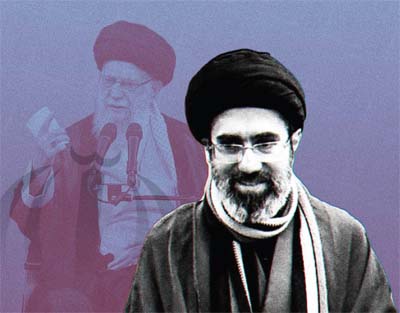 The external consequences are already visible. Iran has responded to aggression with missile and drone strikes against Israel and US facilities in the Gulf. Its network of regional allies and proxies, often described as the Axis of Resistance, including Hezbollah in Lebanon and the Houthis in Yemen, are expected to intensify asymmetrical attacks.
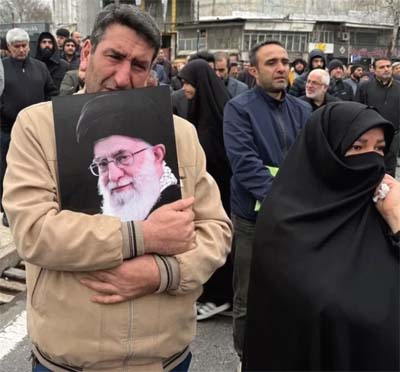
Ayatollah Khamenei’s death will be framed as martyrdom, a narrative that resonates deeply within Shia political theology and could mobilise supporters from Iraq to Bahrain and in Lebanon. There have already been protests in Pakistan outside the US Consulate in Karachi as well as in the Gilgit-Baltistan where protesters attacked the offices of the UN Military Observer Group and the UNDP.
In a televised address Iran’s Parliamentary Speaker, Mohammad Bagher Ghalibaf said “You have crossed our red line and must pay the price.” “We will deliver such devastating blows that you yourselves will be driven to beg.” While an Iranian TV presenter stated “With the martyrdom of the Supreme Leader, his path and mission neither will be lost nor will be forgotten, on the other hand, they will be pursued with greater vigour, and zeal.”
Khamenei’s death could result in the regime and its security forces closing ranks in order to survive, or it could be the opposite; the sinking of a regime. The key question now is whether leadership cohesion in Tehran remains intact. If the upper tier fractures, the strikes may succeed and the war could compress. If cohesion holds, the confrontation would shift into sustained conflict in which escalation control becomes more fragile with each passing day.
For Israel, the operation may have removed a principal adversary, but it also introduces new unpredictability. Khamenei, calibrated escalation. A leadership in transition may be less restrained. Multi-front confrontations stretching from the Gulf to the Levant become more conceivable.
The issues now uppermost on most analysts’ minds are; How long will the war last? Will it grow? What will the conflict and the death of Ayatollah Ali Khamenei mean to the region and global security overall? These are the questions that are echoing across the Middle East and the globe presently for which there are no easy answers.
A War of Choice
How would history look back at this moment is also important. It may view this not as a war of necessity but as a war of choice. Apparently only days ago, discussions under Omani mediation were progressing and technical talks involving the International Atomic Energy Agency were scheduled for 02 March.
Oman’s Foreign Minister, Badr Al Busaidi, had publicly spoken of near agreement on Iran not producing nuclear weapons, reducing existing stockpiles, not stockpiling in future and IAEA inspection and verification mechanism. He said; “A peace deal is within our reach … if we just allow diplomacy the space it needs to get there.” “If the ultimate objective is to ensure forever that Iran cannot have a nuclear bomb, I think we have cracked that problem through these negotiations by agreeing [on] a very important breakthrough that has never been achieved any time before,” is what he said in an interview with CBS News in Washington.

There was no imminent threat of Iran acquiring nuclear weapons or launching attacks on the US and its allies in West Asia. But probably both the US and Israel saw an opportunity to exploit the weakness of one of their worst adversaries. The fact is that Iran was weakened as a result of Operation Rising Lion and Midnight Hammer last June, its regional proxies were decimated, and it was facing an uprising.
 Yet in his State of the Union address on 24 February President Donald Trump framed Iran’s nuclear activities as a renewed threat that the United States had previously crushed but may need to confront again. “We wiped it out, and they want to start all over again,” Trump stated regarding Iran’s nuclear programme, accusing Tehran of “again pursuing their sinister ambitions.”
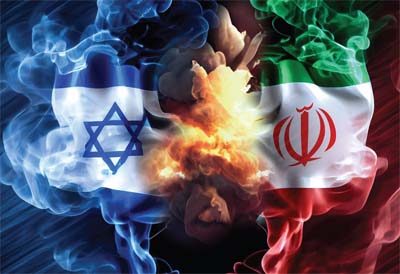
But what unfolded since 28 February has signified a shift in objective, in tactics, in timing and in political framing of this long-running conflict between the US and Israel, and Iran since the last twelve-day confrontation. The US-Israel war against Iran has, moved from deterrence management to regime change and this transformation will determine the direction of this confrontation.
President Trump also has a personal stake here. In January, on at least nine occasions, he drew firm redlines, insisting that if Iran killed protesters the US would come to their aid. People were incited to the streets during those protests, telling them to go seize state institutions and that help was “on the way.” For President Trump, the greatest motivating factor seems to be his own credibility, more than any imminent threat to the US.
Conclusion
President Donald Trump said on social media that Khamenei was dead, calling it “the single greatest chance for the Iranian people to take back their country.”
Yet history offers caution. Air power alone seldom topples entrenched systems in the absence of ground intervention or a coherent internal uprising. Instead, external attack often consolidates ruling elites and blunts domestic dissent, at least in the short term.
Khamenei’s assassination has closed one chapter in Iran’s history, but it does not automatically open another aligned with the ambitions of those who ordered the strike. Instead, it ushered in a period of uncertainty. Regime eviction seems easy but replacement by a stable regime is more difficult.
In Syria there was Ahmed Hussein al-Sharaa in the shadows, while in Venezuela Delcy Rodríguez, the Vice President stepped in. In Iran the candidate favoured by the West seems to be Prince Reza Pahlavi, the son of the last Shah of Iran.
The strategic gamble is therefore immense. As retaliation expands to target US assets across West Asia, the US could find itself drawn deeper into a conflict without a clear political end state. Moreover, with the erosion of deterrence, cycles of strike and counterstrike may escalate into a wider war.
Presently three trajectories seem possible; rapid containment with mediation resuming after calibrated exchanges; extended but controlled confrontation involving sustained strikes and avoiding full energy infrastructure destruction; or a regional war, where proxies expand the theatre and maritime disruption intensifies.
Unfortunately, continuing conflict in this combustible region has wide global implications due to its oil reserves and strategic location. Crude could react strongly to fears surrounding the Strait of Hormuz, through which roughly a fifth of global oil flows. Killing the Supreme Leader is one thing ousting the regime will be another. The fact is that removing a man is far easier than reshaping the order he helped build without the guarantee that the attendant fallout brings in stability and prosperity.
ABOUT THE AUTHOR
 Maj Gen VK Singh, VSM was commissioned into The Scinde Horse in Dec 1983. The officer has commanded an Independent Recce Sqn in the desert sector, and has the distinction of being the first Armoured Corps Officer to command an Assam Rifles Battalion in Counter Insurgency Operations in Manipur and Nagaland, as well as the first General Cadre Officer to command a Strategic Forces Brigade. He then commanded 12 Infantry Division (RAPID) in Western Sector. The General is a fourth generation army officer.
 Major General Jagatbir Singh was commissioned into 18 Cavalry in December 1981. During his 38 years of service in the Army he has held various command, staff and instructional appointments and served in varied terrains in the country. He has served in a United Nations Peace Keeping Mission as a Military Observer in Iraq and Kuwait. He has been an instructor to Indian Military Academy and the Defence Services Staff College, Wellington. He is a prolific writer in defence & national security and adept at public speaking.