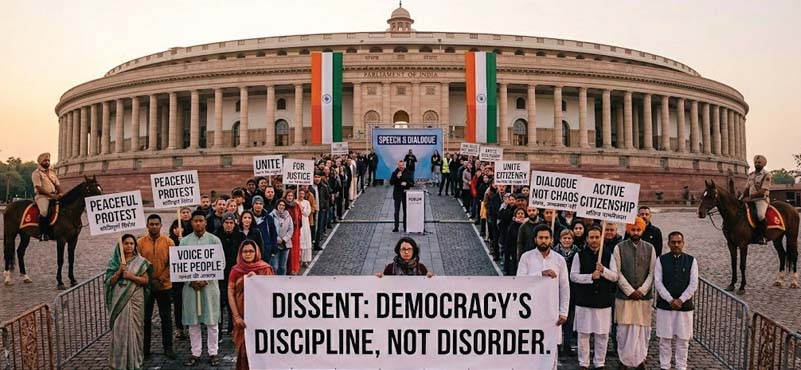
In a democracy, dissent is not disorder; it is discipline applied to power. In India, the world’s largest and most plural republic, criticism has repeatedly corrected excess, sharpened policy, and strengthened institutions. Indian political history demonstrates that constructive dissent has often prevented drift and redirected governance toward constitutional balance. Tolerance of dissent is not sentimental liberalism; it is the mechanism through which power remains accountable. The strength of a democracy lies not in unquestioned authority but in its ability to absorb criticism, correct course, and move forward with steadiness.
Forged in the Fire of Freedom
India’s independence was secured not by acquiescence but by organised, sustained dissent against colonial authority. Newspapers such as Kesari, which was started by Bal Gangadhar Tilak, and Young India led by Mahatma Gandhi never held back; they exposed colonial injustice, mobilised public opinion, and transformed nationalist sentiment into political force. Tilak’s declaration, “Swaraj is my birthright,” was not merely rhetoric; it was political mobilisation in distilled form.
This was a legacy that took root in our Constitution. Article 19 enshrined freedom of speech as a foundational guarantee, reflecting the framers’ lived experience of censorship under colonial rule. The framers understood that suppressing debate weakens institutions; they designed a system that privileges deliberation over silence. Early post-independence years experienced strong criticisms by socialists and communists in Parliament, which compelled the Government in power to make amendments in land reforms and economic planning. Criticism was not obstruction; it was institutional correction at work.
 Dark Shadow of Intolerance
History stands testimony to the dangers of dictatorial rule in a democracy. India’s most profound lesson is the Emergency of 1975. Civil liberties were suspended, opposition leaders imprisoned, and the press subjected to pre-publication censorship. What started as a reaction to political instability ended up being 21 months of dictatorial governance, whereby even uttering words against the regime was punishable by arrest. The electorate responded decisively in 1977. The Government was defeated in 1977 in a landslide by voters, and a new government was elected, which had to restore rights and put amendments on the Constitution to prevent abuse in the future. The episode institutionalised a crucial democratic reflex: concentrated power invites resistance, and resistance, when constitutional, restores equilibrium.
Judiciary Facing the Mirror
The judiciary has often been the arena where the limits of dissent are tested. Take Kedar Nath Singh in 1962. In fiery speeches, he sharply criticised local political leadership, calling them thieves. Charged under Section 124A for sedition, he faced prosecution; yet the Court held that only speech inciting violence or public disorder could justify a conviction. Yet the ruling significantly narrowed the scope of sedition law, limiting its application to incitement of violence.
In February 2026 alone, the Supreme Court was faced with intense scrutiny over the Class 8 social science textbook of the NCERT. One of the chapters has also been direct in listing corruption at different levels of the judiciary and backlogs and shortage of judges, therefore presenting it as systemic vices. The Court’s intervention, citing concerns over institutional credibility, triggered debate over whether critical examination of judicial shortcomings undermines or ultimately strengthens public trust. Institutional dignity and public scrutiny are not mutually exclusive; in mature democracies, they reinforce one another.
The CBI excise policy case acquittal of Arvind Kejriwal and Manish Sisodia on February 27, 2026, in a Delhi court is an example of the important role played by the judiciary. It put the system in check by insisting on evidence in a flawed probe that lacked evidence. Irrespective of the outcome, the message is clear that an independent judiciary is a crucial pillar of democracy.
Policy Wins from Dissent
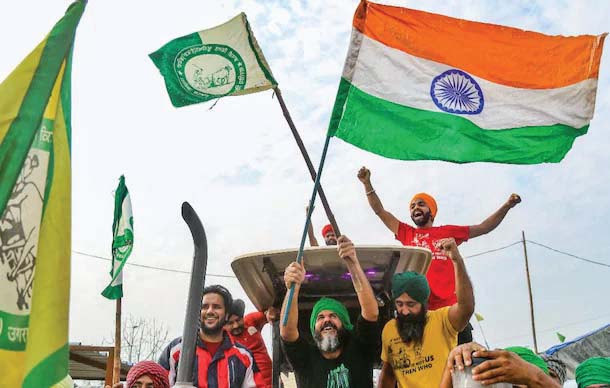
Criticism improves governance by exposing flawed assumptions and unintended consequences. Farmer protests that lasted one year were the result of the three farm laws of 2020; Punjab voices to Delhi raised the alarm of corporate takeover. Under constant pressure, the government repealed them in 2021, a rare instance of executive retreat in response to sustained civic mobilisation. Equally, land acquisition amendments in 2015 that disregard consent provisions were defeated at the hands of opposition fire, reversed to save the smallholders.
The shift from NPS to UPS reflected sustained political pressure at the state level. Even the Digital Personal Data Protection Bill was refined following the parliamentary debates, which revealed loopholes in privacy. These reversals were not signs of weakness; they were demonstrations of democratic elasticity.
Contemporary Tests of Tolerance
The 2026 debate over higher education equity, the University Grants Commission (Promotion of Equity in Higher Education Institutions ) Regulations, illustrates another tension. Policies framed with corrective intent can generate fresh grievances if definitions are narrow or consultation is inadequate. Judicial pause in such instances reflects not obstruction but constitutional caution.
This tumult tests us now, in 2026. The rebirth of sedition is against satirists, yet the spectre of Kedar Nath smothers excessiveness. In February 2026, the Supreme Court again stated that free speech is not a license to defame but to criticise institutions, reinforcing the boundary between criticism and defamation. The scale and speed of digital communication amplify both scrutiny and misinformation, making institutional tolerance even more necessary.
Way Ahead to a Vibrant India
The Indian Republic has endured because it has corrected itself. From the editorials of the freedom movement to contemporary civic mobilisation, dissent has functioned as democratic feedback rather than disruption.
The durability of India’s democracy will not be determined by the absence of criticism but by the maturity with which institutions absorb it. Governments must reduce the criminalisation of non-violent speech and practise transparent regulation. The opposition must critique responsibly. The judiciary must protect liberty without conflating dissent with defiance.
Democracies do not decay because they are criticised. They decay when criticism is feared.