Analysing a War that has Affected the Whole World: The Choices It Leaves for India
Fourteen months after the first bombs fell on Iran’s nuclear sites in June 2025, the West Asia war has settled into an uncomfortable morass: intense flare-ups, brittle ceasefires, shifting alliances and a widening map of fronts, but no decisive politico military end state. What began as a narrowly targeted campaign by US-Israel combine against Iran’s nuclear programme has, by August 2026, expanded geographically into much of West Asia including critical maritime trade routes, drawn in the Houthis and surreptitiously involving Russia and China. The honest answer to the question of who is winning, is that no one has won, and everyone has paid a price. What follows is an attempt to analyse the war in three distinct escalations, take stock of where the balance of advantage currently lies, examine Pakistan’s contested role as mediator, and set out the choices before India.
Three Distinct Interventions
- June 2025 — The Twelve-Day War
The first round opened in June 2025 with a joint US-Israeli air campaign against Iran’s nuclear infrastructure. Israel struck first and the United States followed with Operation Midnight Hammer with B-2 Spirit bombers dropping GBU-57 massive ordnance penetrators on the deeply buried enrichment facilities at Fordow, alongside strikes on Natanz and Isfahan. Washington’s claim at the time was that Iran’s nuclear assets had been set back by years, if not obliterated outright, though independent damage assessments were always more cautious than the political messaging. The strikes also killed a number of Iran’s senior military and scientific leadership, including the IRGC commander-in-chief and the armed forces’ chief of staff, along with several nuclear scientists; a decapitation of the operational chain of command. Iran’s response was decidedly restrained. A choreographed and consultative missile strike on the US Al Udeid airbase in Qatar, timed to avoid American casualties. The irony was not lost on the region. Qatar, was at that very moment, one of the principal channels quietly working the Iran-US back-channel. The strike caused minimal damage, tempers cooled, and negotiations over a longer-term settlement resumed through 2025, even as an undercurrent of unresolved issues including differences over enrichment rights, sanctions and verification, Iran’s proxies and ballistic missiles stockpile persisted beneath the uneasy calm.
- 28 February 2026 — The Decapitation Strike and the Islamabad Peace Process
The uneasy calm collapsed on 28 February 2026 amidst the talks, when Israel, working off American intelligence, struck Ayatollah Ali Khamenei’s compound in Tehran and killed Iran’s Supreme Leader, an 86-year-old who had held the office since 1989 — along with several members of his inner circle. President Trump framed the campaign’s aims expansively: to destroy Iran’s ballistic missile capability, eliminate its navy, foreclose any path to a nuclear weapon, sever support to its proxy network, and explicitly encourage regime change, inviting Iranians to “take back their country,” in language reminiscent of the playbook used against Venezuela’s Maduro. The strikes killed a number of the theocratic and military leadership alongside Khamenei, and were accompanied by heavy civilian casualties, including a strike on a girls’ school in Southern Iran that killed over 140; an episode that was exploited by Iran to gain moral high ground in the run up to subsequent negotiations. This time Iran did not absorb the blow quietly. It launched retaliatory missile and drone strikes against American bases and interests across Bahrain, Kuwait, the UAE, Qatar and Saudi Arabia, and against energy infrastructure in response to American strikes on its own oil facilities. Most significantly, Iran moved to assert control over the Strait of Hormuz in coordination with Oman on the southern shore, disrupting a route that carries roughly a fifth of global oil trade and over half of India’s crude imports. What followed was less a swift American victory than a demonstration of the limits of air power: Washington calibrated its upward escalation through March and April including the blockade of Iranian ports on 12 April and launching Project Freedom to restore freedom of navigation through the strait of Hormuz. The US however visibly hesitated to commit to a ground offensive despite the build-up of marines, wary of casualties, the absence of a credible exit strategy, and the risk of a protracted entanglement reminiscent of Afghanistan and Iraq. Global oil prices spiked, and with American munitions stocks and Gulf-based air-defence assets under strain, the US moved toward negotiations. Pakistan and Qatar mediated an interim ceasefire in April 2026, which after many back and forth produced the Memorandum of Understanding by mid-June; a fourteen-point framework digitally signed by US and Iranian representatives on 17 June. Its terms amounted to concessions to Iran that would have been unthinkable in June 2025; reopening of the Strait for sixty days without transit charges, an end to the US naval blockade of Iranian ports, discussion of sanctions relief and the release of up to twenty-five billion dollars in frozen Iranian assets, a US $300 billion reconstruction and economic development plan, a ceasefire extending across the wider Middle East including southern Lebanon, and tellingly, the relegation of Iran’s nuclear programme to a secondary, later-stage agenda item rather than a precondition. Iran had rarely, if ever, been offered terms of this generosity.
- The Fragile Peace Collapses and Conflict Resumes
The MOU turned out to be a contested interpretation. The Strait of Hormuz remained the sticking point from the outset. Its language obliged Iran only to use “best efforts” for safe passage, with the door left open to future service fees and Tehran read this as tacit acceptance of its unrestricted control. Within days of the digital signing, an Iranian drone struck a vessel in the Strait and the US construed it as a violation and responded with calibrated strikes. By mid-July the fragile truce had broken down completely after the IRGC attacked tankers attempting to transit Hormuz, the United States launched thirteen consecutive nights of air strikes on Iran beginning 11 July. Both sides declared the June agreement dead, accusing each other of violating the terms of MOU with Washington charging Iran refusing to open Hormuz and Tehran charging Washington with reneging on the MOU’s sanctions, naval blockade and reconstruction commitments and threatening further attacks. The third phase widened the war’s geography rather than its intensity. After a nine-month pause, the Houthis re-entered the fray in July, declaring a naval blockade of Saudi Arabia and striking Saudi oil tankers and export facilities on the Red Sea in retaliation for Riyadh’s targeting of Sanna airfield as the Iranian plane carrying Yemeni delegation connected to the funeral of the slain Supreme Leader was to land. A US owned floating storage and regasification unit at Egypt’s Damietta port was hit by suspected Iranian drones, and Houthi missiles were also fired at Israel, opening yet another front. Reports though contested, pointed to Iranian strikes on key American airbases in Jordan and possibly Egypt, and to Russian intelligence and upgraded Shahed drone support helping Iran target US positions in the Gulf, alongside Chinese supply of air-defence systems to Tehran. Saudi Arabia, for its part, joined US operations against Iran-aligned militias in Iraq. By early August, the fighting had again subsided to intermittent strikes — Houthi attacks on southern Saudi border region and tankers continued even as Washington voiced hope that Hormuz would reopen “soon”. Washington’s pullback from full-scale escalation in late July appears to have been driven less by any Iranian capitulation than by a convergence of Gulf pressure — Saudi Arabia, the UAE, Qatar, Kuwait and Bahrain all appealing to Washington to stand down — alongside the diminishing military returns of further strikes, the drawdown of precision guided munitions including Tomahawk and Patriot stocks, rising war-fatigue in American domestic opinion, and a visible dent in President Trump’s approval ratings.
Where Does This Leave the Negotiations?
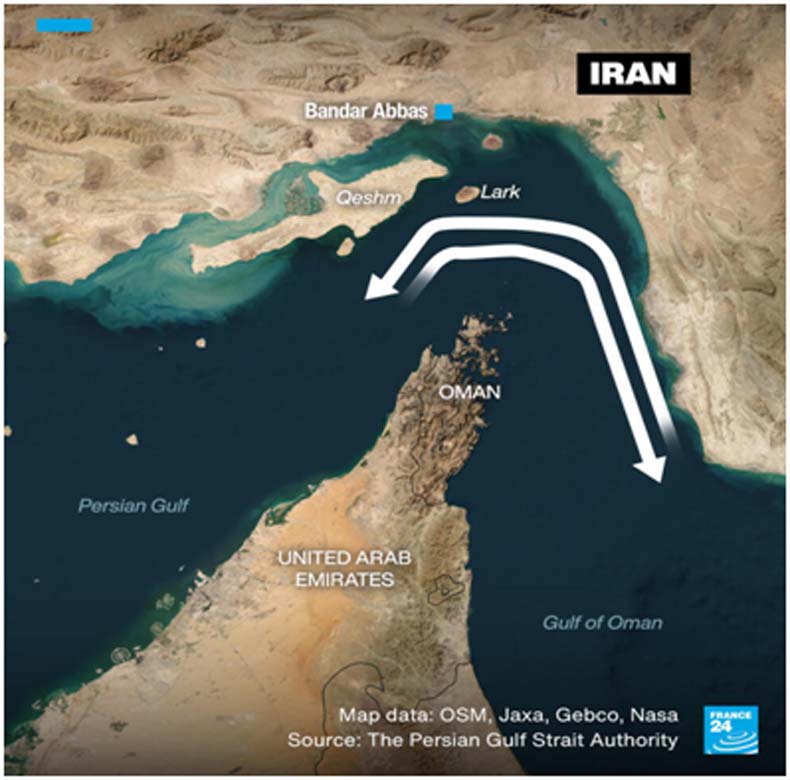
The present pause is more of an understanding between Iran and Oman ( albeit with American blessings) rather than between Iran and the US to manage the shipping corridor through Hormuz. Iran controls the northern shipping lane, Oman coordinates the southern lane under coordination with Iran. Whether reversion to the fourteen-point MoU can still serve as the basis for a durable settlement is doubtful. Iran’s negotiating posture has progressively hardened from June 2025 to August 2026. The current Supreme Leader, reportedly more hardline than his predecessor, with several relatives among the dead from the 28 February strike has less personal or political incentive towards accommodation. Iran demonstrated ability to penetrate layered American and Israeli air defences with its missile and drone strikes and withstand repeated American attacks through its “mosaic defence” doctrine, and inflict real costs on US bases and gulf infrastructure. It has given Tehran a confidence in its capacity to absorb and outlast further Western pressure that it did not possess in June 2025.
The Balance Sheet — How the Conflict Has Actually Panned Out
- A strategic dead end and humiliating quagmire for Washington
The United States has reached the point of diminishing returns on further kinetic action in the absence of commensurate politico-military dividend. It has demonstrated, repeatedly, that it can devastate Iranian infrastructure and decapitate its leadership but with attendant Iranian retaliation. It has failed to compel Iranian compliance, let alone regime change. Every escalatory cycle has ended not in capitulation but in a fresh round of mediated talks on terms progressively less favourable to Washington. There have been reports of the United States weighing a relocation of Fifth Fleet and CENTCOM assets out of range of Iranian ballistic missiles, and toward Israel, a tacit admission of the threat Iran’s missile force now poses to fixed American infrastructure in the Gulf.
- The Cost of Depletion
Sustained expenditure of precision munitions, air-defence interceptors and naval assets in the Gulf incurs costs in the Indo-Pacific, in continued support to Ukraine, Japan, South Korea and in the Western Hemisphere, including contingencies around Cuba ( notwithstanding the Cuba Task Force). It has triggered differences within Whitehouse as regards ammunition reserves. Domestically, elevated fuel and living costs, war fatigue, and eroding Trump approval ratings constrain Washington’s freedom of manoeuvre and, by extension, its governing legitimacy.
- Allied Reluctance
The European Union and other traditional allies have declined to join the campaign in any operational sense, resisting even purely defensive taskings such as escorting shipping through Hormuz in the absence of a comprehensive ceasefire. This has left Washington managing an open-ended commitment with a thin coalition and no visible exit strategy without consequent political costs.
- Iran’s Paradoxical Strengthening
Counter-intuitively, Iran may emerge from this cycle more resilient than before. Its proxy network — Hezbollah, the Houthis, and Iraqi militias, and potentially remnants of influence in Syria — has shown it can still be activated and coordinated even as Tehran’s own leadership has been decimated. There is, moreover, no guarantee that Iran’s nuclear ambitions have been permanently rolled back or that IAEA safeguards which looked achievable after the June 2025 round remain a realistic near-term prospect now that the nuclear file has been pushed to a secondary priority. The West Asia appears set to be even more turbulent, volatile and militarised in the foreseeable future.
- China and Russia as Quiet Beneficiaries
Both powers have incentives, economic and geopolitical, to keep Iran standing and the United States strategically overstretched, diminishing Washington’s global reach and the primacy of the petrodollar. China has reportedly cut its own oil demand by roughly five million barrels a day through strategic reserves, renewable energy and EV adoption, insulating itself from Hormuz-linked price shocks while retaining leverage over Iran to deploy in its own trade and Taiwan-related bargaining with Washington. Russia, accelerating its strikes in Ukraine amid deepening NATO involvement and Ukrainian strikes reaching further from the front, has an interest in using its Iran leverage to draw the US back towards the kind of settlement contemplated at the Alaska talks.
- Gulf States Hedge their Bets
Washington’s inability to guarantee either the safety of Gulf states or free passage through Hormuz has visibly accelerated hedging. Saudi Arabia and Pakistan moved into a formal mutual defence pact in September 2025. This extended into the Saudi-Türkiye-Pakistan defence pact on 07 August 26. Saudi Arabia announced a 14 member coalition to protect shipping through Red Sea and Bab-El Mandeb. These have fascinating contradictions. The UAE’s decision to exit OPEC after nearly six decades of membership signals a broader Gulf recalibration, and reports suggest an emerging Türkiye-Pakistan-Egypt- Saudi Arabia (R4) consultative grouping taking shape alongside it. At the same time, wary of Gulf states diversifying away from US Treasuries, Washington has dangled civil nuclear cooperation, technology transfer, and expanded military and intelligence sharing at Riyadh and Abu Dhabi — though Saudi Arabia continues to tie any Abraham Accords normalisation to a credible pathway toward Palestinian statehood.
- Global Maritime Trade
The unresolved question of what happens to other global chokepoints — Malacca, Panama, Gibraltar — if the precedent of a littoral power asserting control over Hormuz is allowed to stand, remains largely undiscussed but consequential.
- Israel’s Overreach
Israel may have misjudged both its own capacity and Washington’s appetite when it pushed for regime change and the destruction of Iran’s nuclear programme in one stroke. Frictions between Washington and Tel Aviv have grown visible over the conduct of the wider war, including in Lebanon and Gaza, suggesting a ceiling to unconditional American backing for an expansive Israeli campaign.
The Pakistan Factor
Pakistan’s self-cast role as lead mediator has, on closer inspection, meandered toward a dead end, and its conduct has raised as many questions than it has answered.
- Its neutrality has been repeatedly called into question: CBS News reported, citing US officials, that Pakistan allowed Iranian military aircraft including a reconnaissance plane to shelter at Nur Khan airbase near Rawalpindi during the ceasefire window, an account Islamabad has denied as misleading, insisting the aircraft movements were tied only to facilitating the talks. Reports of cross-border oil trade with Iran skirting sanctions, and of nuclear-technology cooperation, have compounded doubts about its impartiality.
- As a Muslim-majority state, Pakistan has struggled to reconcile its posture toward Iran with American pressure to join an expanded Abraham Accords framework alongside Saudi Arabia, Qatar, Turkey and Egypt — normalising relations with a state many in Pakistan regard as a sworn adversary.
- Institutional fragility at home — active insurgent and separatist pressure in Pakistan-occupied Jammu & Kashmir, Balochistan, and Khyber Pakhtunkhwa sits awkwardly with its externally projected image as a stabilising regional broker.
- Pakistan’s mediating role looks, in good part, like tactical opportunism seized upon by Washington because of its geography astride Iran, China and Afghanistan, rather than a reflection of any independent diplomatic weight.
- Despite the 2025 mutual defence pact with Riyadh, it remains untested whether Pakistan would commit forces to Saudi Arabia’s defence against the Houthi campaign in the Red Sea and Yemen.
- A severe domestic economic crisis — including recurring recourse to IMF support — sits uneasily with the image of a confident international mediator; a country perennially seeking external financial support is not naturally positioned to broker peace.
How Must India Navigate Through the Crisis
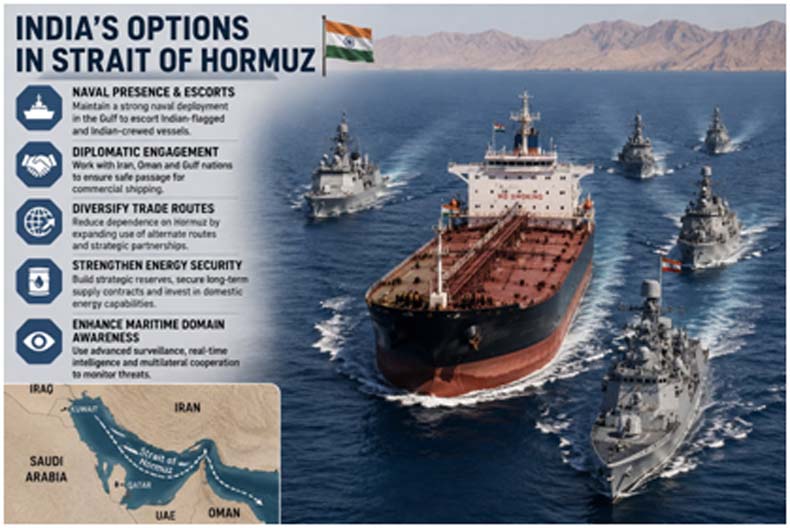
India has, on balance, managed this conflict adroitly. It has held a deliberately balanced posture — avoiding entanglement on either side — even while absorbing collateral costs. Indian seafarers have been caught in multiple attacks attributed to both Iran and the US, although they were not the intended targets.
- New Delhi has diversified crude sourcing from roughly 27 countries to over 40, drawing on the United States, Guyana, Brazil and West Africa, while continuing to source discounted Russian crude despite Western sanctions.
- It has moved to expand strategic reserves — including a 1.5 MMT expansion at Mangaluru (total around 5.33 MMT) and to grow refining capacity toward becoming a global refining hub, even as current reserve cover remains well short of the ninety-day IEA benchmark.
- Despite a war now well into its second year on India’s energy lifeline, there has been no major disruption to domestic energy supply or economic activity — a genuine policy achievement.
- The structural case for reducing dependence on seaborne trade through chokepoints remains strong. The India-Middle East-Europe Economic Corridor (IMEC) offers a partial alternative, though its own routing, financing and geopolitical complications including dependence on a stable Gulf and Israeli sector means it cannot yet be counted on as a reliable substitute.
- The defence pacts, Pakistan-Saudi Arabia and Pakistan-Saudi Arabia-Turkite while not India oriented, poses challenges that India has to navigate through relationships across competing camps.
- A bruised and depleted America in West Asia has progressively less latent capacity to intervene meaningfully in any India-China contingency, a structural shift India’s own planning should account for, independent of how the West Asia war eventually resolves.
India should watch developments in Pakistan’s dwindling West Asia role with steady nerves rather than anxiety attacks. A country wrestling with an economic crisis at home, an insurgency on three fronts, and a credibility deficit as a mediator abroad is at best diverting attention from its domestic troubles. India is an independent, ambitious and increasingly self-assured power charting a path shaped by its own interests rather than by the choices of others. A resurgent, righteous and prosperous India — peaceful in temperament, confident in capability, and passionate in purpose — has the standing to let this war play out and to keep building its own strength for the road to Viksit Bharat 2047, through economic and strategic resilience.
ABOUT THE AUTHOR
 Major General SC Mohanty, AVSM (Retd), was commissioned in June 1983. The officer commanded a Mechanised Infantry Battalion, a Mechanised Brigade and an Infantry Division (RAPID Strike) in the Western Sector. As a Brigade Major, he took active part in the Kargil Operations while located at Drass. As part of Military Operations Directorate, he headed the Information Warfare, Cyber and Electronic Warfare branches. Post retirement, he was the Security Advisor to Government of Arunachal Pradesh from July 2020 to May 2023.