Where Going Home Has Become an Expedition
Gurugram has finally achieved what it has been aspiring to for decades: it has become a truly world-class city. Glass towers, global corporations, luxury apartments, golf courses, expressways, malls, traffic jams of international standards and connected to Delhi by 29 km long Dwarka Expressway affectionately called Golden Road laboriously built at a cost of Rs 252 Crore per Km—we have them all. And now, after a few hours of good monsoon rain, Gurugram has acquired its most spectacular infrastructure project yet: waterways.
Welcome to Gurugram: The New Venice.
There is, of course, one small difference. Venice has gondolas. Gurugram has SUVs.
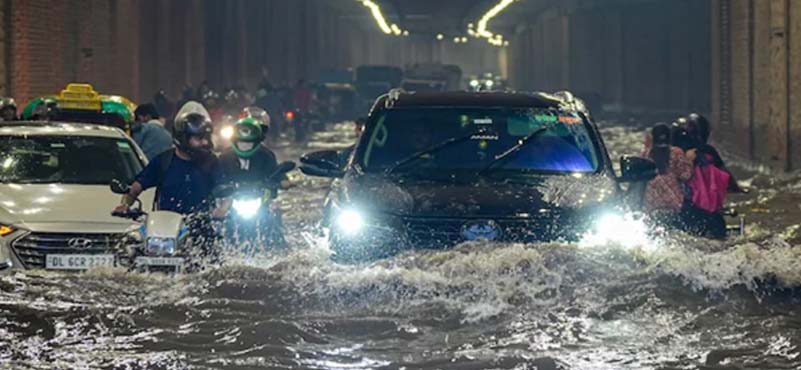
The monsoon has once again performed its annual magic. Roads have disappeared under several feet of water, cars have been stranded, motorcycles have become partially submerged objects of archaeological interest, and commuters have discovered that the shortest route home may now involve taking off their shoes and wading through the nearest lake.
The city’s famous roads have acquired a new purpose. They are no longer merely meant for transportation. They are reservoirs with lane markings.
The real transformation begins around office-closing time. A few years ago, the question at six in the evening was simple: “Are you leaving office?” Today, it is more likely to be: “Are you planning to go home?”
The distinction is important.
Going home is no longer a routine commute. It has become an expedition requiring planning, reconnaissance, weather intelligence, vehicle selection and, preferably, a small boat. People are actually beginning to consider staying back at their workplaces until the water recedes.
And why not? The modern corporate office already has almost everything required for survival—air-conditioning, Wi-Fi, coffee machines, charging points, comfortable chairs and, most importantly, a boss who has no objection to you working late.
All that is missing is a bed. That is where Gurugram’s hotels may soon discover an entirely new market. Forget business travellers and tourists. The next big category could be “monsoon refugees.”
A weary professional may walk into a hotel reception at nine at night and ask, “Do you have a room?”
“For how many nights, sir?”
“Don’t know.”
“Till when?”
“Till Gurugram dries.”
Hotels may soon advertise “lake-view rooms”, not because the hotel overlooks an actual lake, but because the road outside has temporarily become one. Real-estate developers, too, may have to rethink their vocabulary. “Premium apartment with exclusive access to a seasonal water body” sounds considerably more attractive than “flat opposite a waterlogged road.”
The monsoon has also produced a fascinating change in Gurugram’s social hierarchy. For years, the luxury SUV was regarded primarily as a symbol of wealth and status. Today, it is beginning to look like a sensible investment in urban survival.
The man driving a modest hatchback looks at the owner of a large SUV with newfound respect. The SUV owner looks back with the quiet confidence of a man who has invested wisely. The sedan is nervous, the hatchback is praying, while the SUV is simply thinking, “Bring it on.”
Somewhere at the top of this new hierarchy sits the tractor—the ultimate Gurugram vehicle. Perhaps automobile companies should stop advertising horsepower and start advertising water-depth capability.
Google Maps, meanwhile, needs an urgent monsoon upgrade. Until yesterday it would tell us, “Fastest route: 32 minutes.” During the Gurugram monsoon, it should say: “Fastest route: 32 minutes—if you own a boat.”
It might also announce: “Turn left in 200 metres. You will now enter a water body formerly known as Golf Course Road.”
Perhaps the navigation symbols need updating too: road ahead, traffic jam, road closed, deep water, boat recommended—and finally, the most useful of all: Good Luck.
Yet the strangest part of this annual drama is not that it rains. Everybody knows it will rain. The monsoon does not arrive like an unexpected guest. It comes every year, almost on schedule. Preparations are made. Drains are cleaned. Pumps are deployed. Meetings are held. Vulnerable locations are identified. Advisories are issued. Then it rains—and everyone appears surprised.
This year, as in previous monsoons, heavy rain has again left major stretches of Gurugram inundated, stranded vehicles and disrupted traffic, with authorities even advising companies to allow work from home during severe spells.
Which raises a rather philosophical question: if the best way to avoid Gurugram’s roads during rain is to remain at home, and the best way to avoid the journey home after reaching office is to remain at office, where exactly are we supposed to be?
Perhaps the answer is obvious. At a hotel. Until the lake dries. And therein lies the great paradox of Gurugram.
This is one of India’s most prosperous corporate centres, home to global companies, spectacular skyscrapers, sophisticated technology, expensive homes and some of the country’s most ambitious infrastructure. We have become extraordinarily good at building upwards. We have constructed towers that touch the sky.
We have perhaps not yet perfected the much older and simpler science of making water flow downwards.
That is where the laughter acquires a slightly uncomfortable edge. There is something profoundly absurd about a city capable of handling billions of rupees of global business being brought to a standstill by something as ancient, predictable and perfectly natural as rain.
Perhaps the monsoon is not really the problem. Rain is doing what rain has always done. The real question is why a modern city repeatedly has nowhere sensible to put it.
But until that question is answered, perhaps we should simply embrace our new identity. Forget Millennium City. Forget Cyber City. Forget the corporate capital. For a few glorious weeks every monsoon, Gurugram is Venice.
The only problem is that Venice has gondoliers. Gurugram has office-goers carrying their shoes, pushing motorcycles through waist-deep water and wondering whether to attempt the journey home or book a room nearby.
So, if your boss asks why you are not leaving office tonight, don’t panic. Just smile and say, “Sir, I would love to go home. Unfortunately, my home is currently on the other side of the lake.”
And if your family calls to ask when you will return, there is only one honest answer left: “As soon as Gurugram dries.”
Until then, welcome to the New Venice.
Breakfast is complimentary. Check-out is weather-dependent.
ABOUT THE AUTHOR

Lt Gen Rajeev Chaudhry (Retd) is a social observer and writes on contemporary national and international issues, strategic implications of infrastructure development towards national power, geo-moral dimension of international relations and leadership nuances in changing social construct.