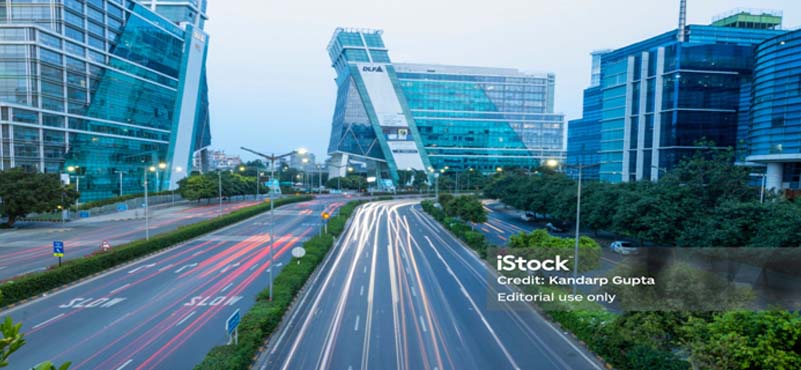
The rapid growth of Gurugram highlights a sharp divergence in India’s urbanisation: soaring real estate valuations alongside failing civic infrastructure. This dynamic raises a fundamental question: how do property rates sustain ₹10,000–₹20,000+ per square foot when routine monsoon rains reliably paralyse arterial roads, halt commercial operations, and disrupt daily mobility?
The pricing disparity is easily explained: real estate values capitalise on location, supply constraints, and long-term potential rather than current civic performance. Gurugram’s economic fundamentals—corporate hubs, airport access, and high-income employment—keep demand strong. However, ignoring public infrastructure creates an “urban-risk discount.” Over time, this hidden penalty erodes value via depressed rental yields, rising operating and commuting costs, and declining corporate retention.
Why Do High Property Prices Persist?
Agglomeration economics offers the simplest explanation: businesses and individuals are willing to pay more to be near one another. Gurugram is far more than a place to live; it has become one of India’s key centers for corporate offices, financial services, technology, consulting, automobiles, aviation, and Global Capability Centres (GCCs). Delhi-NCR recorded 15.3 million sq ft of office leasing in 2025, including 4.5 million sq ft of GCC leasing, underscoring the depth of the region’s corporate ecosystem. This concentration generates a self-reinforcing cycle: jobs attract professionals; professionals create housing demand; housing attracts retail, schools, hospitals and entertainment; and the resulting ecosystem attracts more companies.
The real-estate numbers illustrate the strength of this demand. According to ANAROCK data, average residential prices in Gurugram rose from about ₹6,150 per sq ft in Q1 2020 to ₹11,300 per sq ft in Q1 2025—a whopping 84% increase. NCR’s unsold housing inventory, however, fell by 51%, suggesting that the price escalation was accompanied by substantial absorption rather than being purely speculative.
The transformation of the product mix is revealing. Luxury and ultra-luxury housing increasingly dominates NCR supply, with homes priced above ₹2.5 crore accounting for a much larger share of launches than before the pandemic. In other words, buyers are not simply purchasing a flat. They are purchasing access.
Criticality of Location
I have long maintained in my series of articles on the subject that location is the single most important determinant of real estate value. The adage in property markets— “location, location, location”—captures this enduring truth: proximity to jobs, infrastructure, connectivity, amenities and other sources of economic value can significantly shape property prices. The phrase is commonly attributed to British property tycoon Lord Harold Samuel, although archival research suggests that the exact formulation appeared in print in 1926 in a Chicago Tribune classified advertisement.
Several factors converge to produce the Gurugram premium. Employment access is the most obvious: proximity to corporate headquarters, multinational companies, financial institutions, consulting firms, technology companies and GCCs. Connectivity also matters — the steady expansion of Delhi, IGI Airport, NH-48, the Metro network, Golf Course Road, Southern Peripheral Road and Dwarka Expressway has widened Gurugram’s effective economic catchment well beyond its formal boundaries.
The private infrastructure gated communities have built to compensate for what lies outside their gates — security, power backup, landscaped open spaces, internal roads, water management, recreational facilities, private maintenance. None of it fixes the city beyond the boundary wall, but it buys residents a kind of insulation from it.
There’s also a positional dimension that has little to do with infrastructure at all. Golf Course Road, the DLF enclaves, premium sectors and newer luxury corridors function as brands as much as addresses; owning there is simultaneously a place to live, an investment, and a marker of status. And finally, property markets look forward, not backwards, which is why anticipated infrastructure, roads, metro links and drainage systems that don’t yet exist can already be showing up in today’s valuations. Dwarka Expressway is a particularly good illustration of how expectations about connectivity can alter market perceptions and valuations. ANAROCK’s Q2 2025 data, for example, put average quoted rates on the Dwarka Expressway at ₹12,850 per sq ft, with prices still rising.
Employment does not automatically solve the infrastructure problem because economic growth and civic capacity operate on different timelines. A multinational company can lease an office, install sophisticated internal systems and begin operations relatively quickly. A developer can construct a residential tower within a few years. But a metropolitan drainage system requires land acquisition, hydrological planning, interconnected stormwater channels, outfalls, maintenance and coordination among several agencies.
Gurugram’s governance structure compounds the problem. GMDA, MCG, HSVP, HSIIDC, NHAI, municipal bodies and other agencies have overlapping or interconnected responsibilities. The fact that authorities have repeatedly called for closer coordination and mapping of internal drains, sewer lines and outfalls illustrates the institutional challenge.
NHAI has earlier advocated designating a single agency to manage drainage along the Delhi–Gurugram Expressway, noting that overlapping institutional responsibilities were hindering coordination. This is more than an administrative issue: fragmented accountability imposes tangible economic costs.
August 2026 Warning
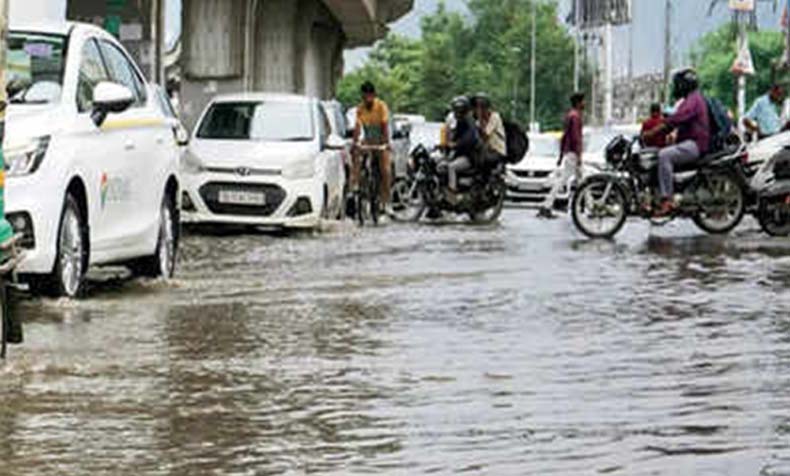
The disruptions of August 24–25, 2026, clearly exposed the severity of this disconnect. Heavy rainfall caused widespread waterlogging across Golf Course Road, Sohna Road, Sector 46, Sikanderpur, Vatika Chowk and other important locations. Even the vicinity of DLF Magnolias, where some apartments command prices of ₹50 crore or more, experienced severe water accumulation -not a pretty picture, is it?
The administration subsequently advised offices to consider work from home, and educational institutions were closed amid concerns over waterlogging and traffic disruption. The symbolism is powerful: a city capable of creating billion-rupee corporate campuses and ₹50-crore apartments can still be brought to a standstill by rainfall. This is not simply an engineering failure; it has grim portents about the sustainability of the urban model.
Spending Without Resilience Paradox
The problem is not a complete lack of effort or funding. Substantial public resources have been directed toward drainage upgrades, desilting, and targeted remedial projects at critical waterlogging sites. In June 2026, the Haryana government reported that corrective measures were completed at 158 vulnerable locations.
GMDA also reported completing desilting of three primary master drains, while MCG had completed work at 70 of 155 identified waterlogging hotspots by June. Yet recurrent flooding continues. This is symptomatic of a deeper distinction between spending on infrastructure and creating infrastructure resilience. Desilting a drain before the monsoon is necessary; it is not necessarily sufficient. If catchment areas have been excessively concretised, natural drainage channels encroached upon, green spaces reduced, drains disconnected or outfalls inadequate, the system can remain structurally vulnerable despite annual maintenance expenditure. Viewed thereof, GMDA’s decision in 2026 to lower certain green belts and develop them as bioswales—effectively “green drains”—recognises that the solution must move beyond conventional concrete drainage.
Hidden Economic Cost
Consequently, the core issue extends beyond property valuations to the full cost of living and conducting business amid recurring infrastructure breakdowns. Take a professional earning ₹30 lakh a year. If flooding repeatedly adds two hours to commuting, the opportunity cost is substantial. Add vehicle damage, higher fuel consumption, emergency transport, private security, backup power, water arrangements, maintenance charges and insurance-related costs, and the nominal property price becomes only one component of the real cost of urban living. For companies, the costs can be even higher: employee absenteeism, delayed meetings, disrupted logistics, business continuity arrangements and lower productivity. These are negative externalities—costs generated by inadequate public infrastructure but borne privately by households and firms.
An Urban-Risk Discount
Gurugram’s economic advantages outweigh these costs. But that does not mean they are irrelevant. Property markets are fundamentally differential. Buyers increasingly distinguish between a well-drained, elevated, professionally managed enclave and a poorly connected, flood-prone neighbourhood. Consequently, the likely outcome is not a sudden citywide collapse in property values but greater spatial differentiation.
Resilient micro-markets may continue to command extraordinary premiums. Locations with chronic flooding, poor access roads or unreliable civic services may experience slower appreciation, higher vacancy, longer selling periods and greater negotiation discounts. This is how an urban-risk discount gets capitalised. The discount may first appear in rents rather than capital values. Tenants can move more easily than homeowners. Corporate occupiers can relocate offices. Families can choose another micro-market. Over time, those revealed preferences can influence capital values.
Private Enclaves Cannot Substitute Indefinitely for Public Goods
Gurugram’s gated communities have been remarkably successful at creating islands of high-quality private infrastructure. But cities are networks, not collections of islands. A luxury apartment cannot prevent a flooded arterial road from blocking access to the office. A corporate campus cannot control the drainage system outside its boundary. A private generator cannot solve metropolitan power resilience. A gated community cannot build an independent public transport system. This creates a fundamental policy lesson: private excellence cannot permanently compensate for public inadequacy. Indeed, the more expensive and sophisticated the private enclave becomes, the more visible the contrast with surrounding public infrastructure.
Change Agenda
Stormwater drainage deserves the same status as roads and electricity: critical economic infrastructure, not an afterthought to be patched after each monsoon. Getting there will require a unified metropolitan drainage authority — or at least, one clearly designated agency with end-to-end accountability, rather than the current patchwork of overlapping mandates. Real-estate approvals also need to change: every major development should be judged not just on its internal systems, but on whether the surrounding drainage, roads, water and mobility networks can absorb it.
Leaning far more heavily on blue-green infrastructure — restored natural channels, wetlands, permeable surfaces, rain gardens, bioswales, retention ponds, groundwater-recharge zones — rather than concrete alone is necessary. Spending, too, must be judged differently – not by the spend on emergency pumping and announcements, but whether a given location still functions after a specified intensity of rainfall -a paradigm shift from outlay to outcome. A publicly accessible urban resilience dashboard — tracking rainfall, flood depth, drainage capacity, road closures and response times — would make that kind of accountability possible; GMDA’s existing OneMap platform is a reasonable starting point. And underlying all of this, Gurugram needs a stronger fiscal compact: a city generating this much in real-estate value, commercial activity and property-tax revenue must be willing to fund public infrastructure at a matching scale.
No Conundrum—But A Growing Contradiction
Gurugram’s elevated property values and deficient civic infrastructure are not contradictory; they reflect the same underlying development trajectory. The market has effectively priced in the city’s concentration of jobs, investment and economic opportunity, while public institutions have lagged in converting that prosperity into reliable urban services and infrastructure. This divergence explains why real-estate prices can continue to appreciate even as recurring flooding disrupts roads and daily life.
But it also explains why the present equilibrium is not sustainable – no way! Gurugram’s competitive advantage rests on the quality of its agglomeration—jobs, connectivity, talent, corporate networks and liveability. If recurring infrastructure failures increasingly erode liveability and productivity, the economic premium itself can eventually come under pressure. The real danger, therefore, is not that Gurugram’s property market will collapse. It is more subtle: the city could become increasingly expensive without becoming correspondingly better. That would widen inequality, raise the private cost of urban living and gradually weaken the very agglomeration advantages that made Gurugram successful.
The real task now is converting private prosperity into public resilience. Gurugram has already proven that India can build a world-class corporate and residential ecosystem at extraordinary speed — that part of the experiment has succeeded. What remains unproven is whether it can build the public infrastructure, institutions and metropolitan governance for enduring prosperity. Fail at that, and the paradox only gets sharper: a city where a home’s price can outrun the capacity of its drains to carry away the rain.
As I have repeatedly demonstrated, India’s next real estate growth cycle will depend less on short-term demand fluctuations and more on robust infrastructure, institutional investment, and effective project execution. Markets that integrate strong connectivity, employment opportunities, and sustainable urban development will become the sector’s enduring growth hubs. This thesis has an important policy-prescriptive lesson for Gurgaon.
ABOUT THE AUTHOR
 Dr. Manoranjan Sharma is Chief Economist, Infomerics, India. With a brilliant academic record, he has over 250 publications and six books. His views have been cited in the Associated Press, New York; Dow Jones, New York; International Herald Tribune, New York; Wall Street Journal, New York.