
From Pothole Detection to Digital Road Governance
When Pothole Became an Evidence
A Bengaluru engineer got tired of potholes damaging his car. Instead of merely cursing them, he decided to track them.
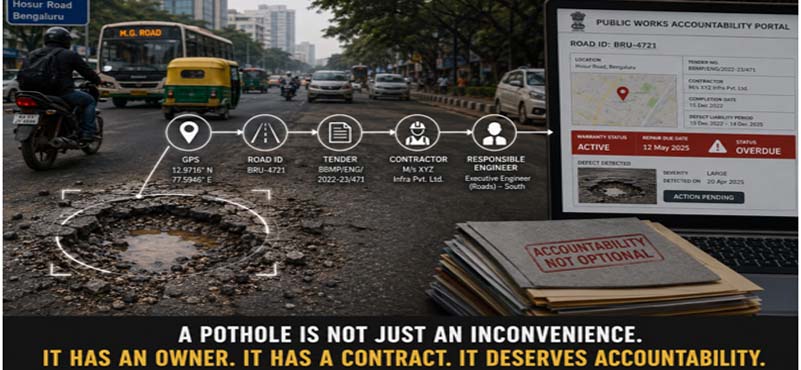
He fitted his vehicle with a dash-cam, GPS and an accelerometer and built an application using AI. As he drove, the system detected potholes, classified them by severity and recorded their precise location. Then came the ingenious part: it searched government contracts to establish which road had been built under which tender, who the contractor was and which official was responsible. The reported system could generate a complaint containing the photograph, geo-location, tender number and responsible authority. On one drive, it reportedly detected 12 potholes and produced 12 complaint-ready cases.
The significance of this experiment goes far beyond potholes. It exposes the missing link in India’s infrastructure governance.
The pothole is visible. The accountability behind it is not.
Government knows who built a road. It knows what it costs. It knows when it was completed. It knows the contractual obligations and, in many cases, the period during which the contractor remains liable for defects. BBMP tender documents, for instance, provide for defect-liability and maintenance periods. Yet the citizen driving over the broken road normally knows none of this.
The Bengaluru experiment offers a radical possibility:
What if technology could connect the physical failure of infrastructure with the contractual and administrative responsibility behind it? Then the pothole would cease to be merely a nuisance. It would become evidence.
India’s Road Problem is Not Just About Roads
For millions of Indians, the condition of a road is a daily measure of the quality of governance.
A pothole damages a suspension, but it can do much more. It can throw a two-wheeler rider off balance, delay an ambulance, increase travel time, damage goods, increase fuel consumption and turn an ordinary journey into a hazard. India’s road problem is therefore not cosmetic. It is an economic, safety and governance problem.
Yet the institutional structure governing urban roads is notoriously fragmented. One agency builds a road, another lays a water line, another digs it for cables, another fills the trench and another is expected to maintain the surface. Responsibility is divided until accountability becomes almost invisible.
The deeper problem is contractual.
Roads are often treated as completed when they are built, rather than as assets whose performance must be monitored throughout their life. Defect-liability provisions exist precisely because construction defects may emerge after completion. The CAG has documented cases in which defective road works, poor enforcement of contractual provisions and weak supervision resulted in avoidable expenditure.
There have even been instances where pothole-filling bills themselves raised audit concerns, including inadequate documentation and failure to invoke quality-control and defect-liability provisions.
This creates a perverse cycle: Bad road. Fresh repair. Fresh expenditure. Fresh contract. Same problem.
The citizen pays twice—once through taxes and again through the cost of a failing road. Technology cannot cure bad engineering or corruption by itself. But it can make something that has traditionally been elusive far more difficult to evade: visible accountability.
Pothole Detection to Infrastructure Accountability
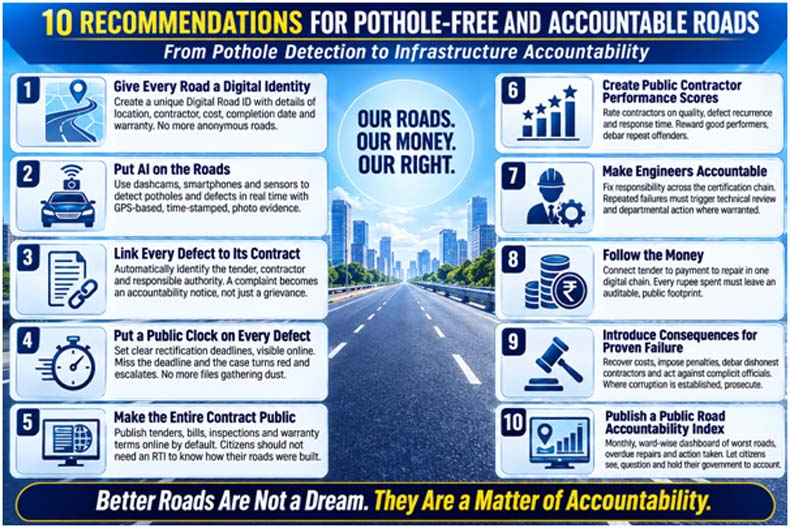
1. Give Every Road a Digital Identity. Every urban road should have a unique Digital Road ID, displayed on a public map. Its record should show the contractor, tender number, sanctioned and actual cost, date of completion, design specifications, defect-liability period, supervising engineer and maintenance responsibility. The citizen should be able to scan or click a road and know its complete public history. If public money built the road, the road should have a public identity. No more anonymous infrastructure and no more searching through files to discover who owns the problem.
2. Put Artificial Intelligence on the Roads. Municipal vehicles, buses, taxis, delivery fleets and citizen vehicles can become a distributed road-monitoring network. Dash-cams, smartphones, GPS and vehicle sensors can detect potholes, cracks, rutting, waterlogging and surface deterioration. AI should convert these observations into geo-tagged, time-stamped evidence and assign a severity rating. Bengaluru is already seeing dash-cam based road surveys, while Indian firms have demonstrated large-scale sensor and AI-based road assessment. The city should know the condition of its roads continuously, not only after citizens start shouting.
3. Link Every Defect to Its Contract. A pothole report should automatically travel backwards through the infrastructure chain: defect → road → project → tender → contractor → warranty → responsible authority. If the road remains within its defect-liability period, the system should say so explicitly. The complaint should therefore not merely read, “There is a pothole here.” It should state: “This defect has occurred on a road constructed under Tender X, within its contractual liability period; Contractor Y is responsible for rectification.” A complaint becomes an accountability notice.
4. Put a Public Clock on Every Defect. Every verified defect should receive a deadline based on its severity. The dashboard should show when it was reported, when it was verified, who was assigned responsibility and when rectification is due. Until the defect is closed and independently verified, the clock should remain visible along the road. Miss the deadline and the case automatically turns red and escalates to the next level. No complaint should disappear into a file. A public clock transforms administration from a system of reminders into a system of measurable commitments.
5. Make the Entire Contract Public. Every road contract should have a citizen-readable digital file containing the tender, work order, contractor, sanctioned amount, variations, measurements, completion certificate, payments, inspection reports, photographs and warranty conditions. Sensitive information genuinely protected by law can remain restricted, but routine public-works information should be open by default. Citizens should not require an RTI application to discover how much was paid to build the road outside their homes. Transparency must move from disclosure on demand to disclosure by design.
6. Create Public Contractor Performance Scores. Every contractor should have a continuously updated performance record. It should capture premature failures, number of defects, response time, repeated repairs, penalties, quality-control observations and proven contractual violations. Procurement authorities should see this history before awarding another project. A contractor who repeatedly produces defective infrastructure should not receive a perpetual fresh start with every new tender. The past performance of a contractor must follow the contractor into the next contract. Lowest price cannot remain the only meaningful measure of public procurement.
7. Make Engineers Accountable for Certification. Contractor accountability alone is insufficient. Every project should identify the executing engineer, supervising engineer, quality-control authority and certifying officer. A premature failure should automatically trigger a technical review of the work and the certification chain. This does not mean punishing an engineer merely because a road deteriorated; roads can fail for legitimate technical reasons. But repeated failures under the same certification regime must trigger scrutiny. Authority without accountability is dangerous; certification without consequence is meaningless.
8. Follow the Money from Tender to Repair. The digital architecture should connect the entire financial lifecycle: tender → work order → measurement → bill → payment → completion certificate → warranty → defect → repair → penalty. This would allow auditors and citizens to see whether public money has been spent once, twice or repeatedly on the same road. The CAG’s findings in Karnataka show why such linkage matters: weaknesses in execution, documentation and enforcement can result in avoidable expenditure. Every rupee spent on a road should leave an auditable digital footprint.
9. Introduce Consequences for Proven Failure. Dashboards without consequences are merely sophisticated notice boards. Once a defect is verified and contractual responsibility established, failure to rectify it should trigger the remedies already available under the contract—recovery where applicable, security adjustments, penalties, performance-rating reductions and, for serious or repeated breaches, debarment under due process. Where an official deliberately ignores contractual obligations, departmental action should follow. Where investigation establishes fraud, collusion or corruption, criminal law must apply. The objective is not arbitrary punishment; it is to make proven failure costly.
10. Create a Public Road Accountability Index. Every city should publish a monthly Road Accountability Index. It should show the worst-performing roads, unresolved defects, overdue cases, contractors with the highest failure rates, departments with the longest delays, repair expenditure and penalties recovered. The information should be searchable by ward, road, contractor and department. Local representatives should have to answer questions based on the same public data. Imagine asking not, “Why is my road bad?” but “Why has Road ID 472 remained defective for 37 days despite a valid warranty?” That is how technology becomes democratic accountability.
The Roadblock Is Not the Pothole
The Bengaluru engineer’s real achievement was not detecting twelve potholes. It was discovering the invisible chain behind them.
A road is not simply asphalt laid on earth. It is a contract, a budget, an engineering decision, a certification, a warranty and a public promise. When the road fails, every link in that chain should become visible.
India does not lack technology. It does not lack engineers, contracts, laws or data. What it lacks is a system that connects them—and places the result before the citizen. The answer is therefore not another annual pothole-filling campaign.
It is an infrastructure accountability architecture in which every road has an identity, every contractor has a record, every engineer has a responsibility, every defect has a deadline, every rupee is traceable and every proven failure has a consequence.
We should not be afraid of naming responsibility. We should be afraid of a system in which nobody can be held responsible.
Some contractors may have to lose contracts. Some officials may have to face disciplinary action. Where corruption is established, some people may have to face prosecution. That is not vengeance. It is deterrence. Because citizens do not need governments merely to build roads. They need governments to ensure that roads remain roads. The geek in Bengaluru has shown us how to find the pothole.
The next revolution must find what lies behind it: the contract, the contractor, the engineer, the babu, the accountability—and, when necessary, the consequence.
ABOUT THE AUTHOR

Lt Gen Rajeev Chaudhry (Retd) is a social observer and writes on contemporary national and international issues, strategic implications of infrastructure development towards national power, geo-moral dimension of international relations and leadership nuances in changing social construct.