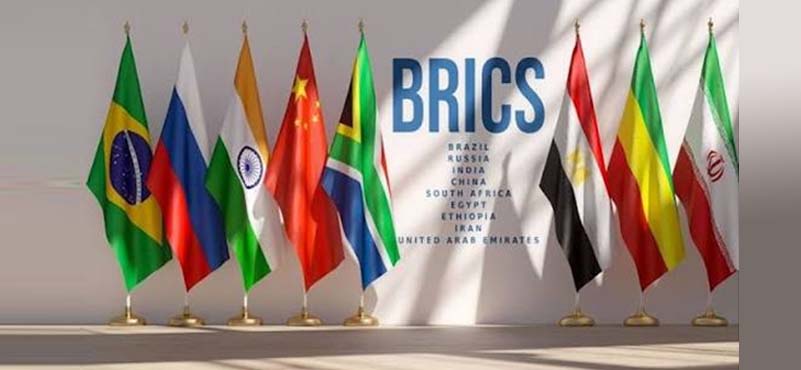
India assumed the rotating chairmanship of BRICS on January 1, 2026, marking its fourth turn at the helm since the grouping’s first summit in 2009. The Eighteenth BRICS Summit will convene in New Delhi on September 12 and 13, under the theme “Building for Resilience, Innovation, Cooperation and Sustainability.” It arrives at a moment when the international order the grouping was assembled to contest is fraying openly, and when the burden of proving that BRICS still means something has fallen, more than at any point in its history, on India alone.
That burden is not incidental. It is structural. BRICS today accounts for close to forty-one percent of global output measured in purchasing power terms and just under half the world’s population, spread across ten full members and ten partner states admitted through 2025. Such numbers ought to translate into influence. Instead, the grouping enters its New Delhi summit weakened by a diplomatic failure few had predicted. At the foreign ministers’ meeting in the capital on May 14 and 15, BRICS could not agree on a joint statement, the first such breakdown in years. The cause was not economic policy but the Middle East, where an open clash between Iran’s foreign ministry and the United Arab Emirates exposed a fault line that no chair’s language could paper over. India, holding the gavel, had to settle for issuing its own chair’s statement rather than a consensus text. That episode is the clearest signal yet of what New Delhi is managing this year: not a bloc with shared strategic instincts, but a coalition of convenience held together by grievance against a Western-centred order.
The expectations placed on India, both from within the grouping and from capitals watching from outside, are correspondingly high and often incompatible. The Global South wants India to use its chairmanship to press hard for reform of the United Nations Security Council, the International Monetary Fund and the World Bank, institutions whose voting weights still reflect the world of 1945 rather than 2026. Moscow and Beijing want New Delhi to advance the architecture of monetary de-risking, including the BRICS Pay framework meant to link national payment systems such as India’s UPI, Russia’s SPFS and China’s CIPS for local-currency settlement outside the dollar clearing system. Smaller members and partner states, several of them added in a rapid expansion round in 2025 that brought in Belarus, Kazakhstan, Nigeria, Vietnam and others as partner countries, want assurance that a larger table still produces decisions rather than paralysis. And Washington, watching all of this with open hostility, wants India to prove it is not part of any of it.
That last pressure is the sharpest contradiction India must navigate, and it deserves to be stated plainly rather than diplomatically. The United States has already demonstrated, through the trade and tariff confrontation that began in August 2025, that it is willing to impose real economic costs on India for its BRICS participation and continued purchases of Russian energy. Tariffs on Indian exports peaked at fifty per cent, among the highest imposed on any American trading partner, and were justified in part by Washington’s irritation with New Delhi’s presence in a grouping it has labelled anti-American. The threat has not receded with the change of BRICS chair.
Washington has continued to warn of an additional 10 per cent tariff on any country seen as aligning with the bloc’s de-dollarisation ambitions, a warning aimed squarely at the summit India is now hosting. New Delhi’s answer so far has been careful and, on balance, correct: it has drawn a firm distinction between promoting trade settlement in local currencies, which is a matter of transaction efficiency and reserve diversification, and any project to displace the dollar as the anchor of the international monetary system, which India has repeatedly said it does not support and will not lead. That distinction needs to survive intact in the New Delhi declaration. Blurring it to satisfy Moscow’s rhetorical preferences would hand Washington exactly the pretext it is looking for, at a cost that India’s own exporters would bear first.
A second contradiction sits closer to home. Over the past two years, India has opened an increasing number of anti-dumping and countervailing duty investigations against goods from fellow BRICS members, particularly China. A chair that wants to build what its own briefing documents describe as a genuine BRICS market cannot simultaneously be the bloc’s most frequent user of trade defence instruments against its partners. Credibility in economic cooperation will require India to be seen as tightening, not merely preaching, its own market access commitments, even as it continues to protect sectors genuinely vulnerable to underpriced Chinese output.
A third contradiction concerns expansion itself. The rapid addition of partner states through 2025, welcome as a gesture of inclusiveness, has made consensus mathematically harder at exactly the moment the grouping most needs to demonstrate it can still produce one. Saudi Arabia remains in an ambiguous position, invited to full membership in 2023 but never having formally accepted it. Pakistan has separately applied for access to the New Development Bank, a request that places India, as both chair and the NDB’s largest founding shareholder alongside China, in an uncomfortable position it cannot simply ignore. The declaration due in September needs a clear statement on future admission criteria, not because expansion should stop, but because a grouping without an agreed threshold for entry will keep importing new bilateral quarrels, as the Iran-UAE episode has already shown.
Given all this, what should the New Delhi declaration contain to be judged a success rather than a face-saving compromise?
Five elements matter most.
First, a reaffirmed, specific position on multilateral reform, going beyond generic language on Security Council expansion to name concrete steps for IMF quota realignment that BRICS states can jointly push at the Bretton Woods institutions this year.
Second, a payments and trade settlement text that operationalises BRICS Pay and UPI-linked cross-border settlement while explicitly and repeatedly disclaiming any common BRICS currency, closing the gap that Washington keeps probing.
Third, a Middle East formulation that both Iran and the UAE can sign, built around de-escalation and freedom of navigation rather than attribution of blame, learning directly from May’s failure.
Fourth, a Global South development package anchored in the New Development Bank, covering debt-relief mechanisms and climate-finance commitments that give smaller partner states a tangible reason to stay invested in the grouping’s success.
Fifth, a section on digital public infrastructure and ethical artificial intelligence governance, an area where India’s own UPI and Aadhaar experience gives it genuine, non-rhetorical authority to lead rather than merely chair.
There is also a domestic dimension to this chairmanship that deserves more attention than it usually receives in commentary focused on New Delhi’s external balancing act. India enters this presidency carrying the credibility earned through its own G20 chairmanship, which placed African Union membership and Global South concerns at the centre of the agenda in a way that outlasted the summit itself. That precedent is an asset, but it is also a standard by which India will be measured. A BRICS declaration that reads as a watered-down compromise, stripped of anything that could offend Washington or unsettle Moscow, will be read across the Global South as India choosing caution over leadership at the one moment its turn at the gavel gave it room to do otherwise. Domestic economic performance, with high growth running even through the tariff shock of 2025, gives India a stronger hand to negotiate from than in previous chairmanships. That strength should translate into a declaration with genuine substance, not merely careful phrasing designed to avoid controversy.
The way ahead for India is narrower than its diplomats will publicly admit. New Delhi cannot afford a repeat of May’s breakdown in September, on its own soil, under its own gavel, without lasting damage to the credibility it has spent two decades building as a serious, non-aligned power. Nor can it afford to let BRICS drift into a vehicle for confrontation with Washington that India’s own economic interests cannot sustain. The realistic outcome, and the one India should be working toward, is a declaration that is more modest in ambition than the bloc’s founding rhetoric yet genuinely implementable: reform pressed through existing institutions rather than parallel ones, monetary cooperation kept short of monetary rebellion, and a Middle East text that survives contact with its signatories. That would be a modest achievement by the standards of BRICS communiques past. In the climate of 2026, it would also be the most credible one on offer, and precisely the kind of outcome only India, positioned as it is between the Global South, Moscow, Beijing and Washington, is placed to deliver.
ABOUT THE AUTHOR
 Lieutenant General A B Shivane, is the former Strike Corps Commander and Director General of Mechanised Forces. As a scholar warrior, he has authored over 200 publications on national security and matters defence, besides four books and is an internationally renowned keynote speaker. The General was a Consultant to the Ministry of Defence (Ordnance Factory Board) post-superannuation. He was the Distinguished Fellow and held COAS Chair of Excellence at the Centre for Land Warfare Studies 2021 2022. He is also the Senior Advisor Board Member to several organisations and Think Tanks.