
The Battlefield is Moving
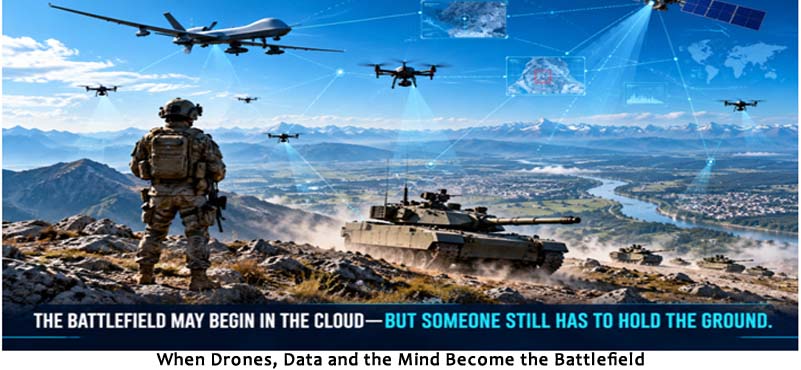
A soldier on tomorrow’s battlefield may never see the enemy he defeats. A drone may identify a vehicle, a satellite confirm its position, an algorithm nominate the target, electronic warfare suppress communications, and a loitering munition complete the engagement. Distance, once a defining barrier, is collapsing. The battlefield is becoming transparent and lethal without massed formations exposing themselves.
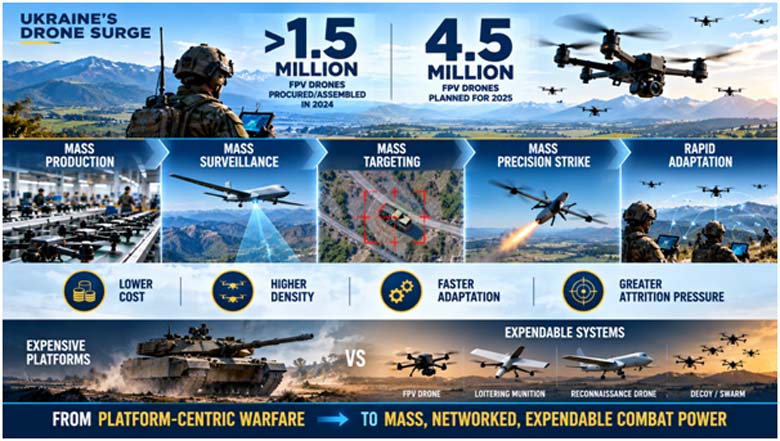
Ukraine has provided the clearest laboratory. In 2024, Ukrainian authorities said more than 1.5 million FPV drones were produced or assembled, while 96.2 percent of UAVs supplied to its Defence Forces were domestically made. Its Defence Ministry planned procurement of 4.5 million FPV drones in 2025. These represent industrial-scale warfare built around cheap, replaceable machines.
The question is whether the traditional hierarchy of combat power must be rearranged around machines, networks and cognition. If future wars seek to coerce rather than conquer, perhaps decisive terrain will be information, infrastructure, perception and decision-making. Yet territory may still matter decisively, physically and politically.
From Physical Destruction to Cognitive Dominance
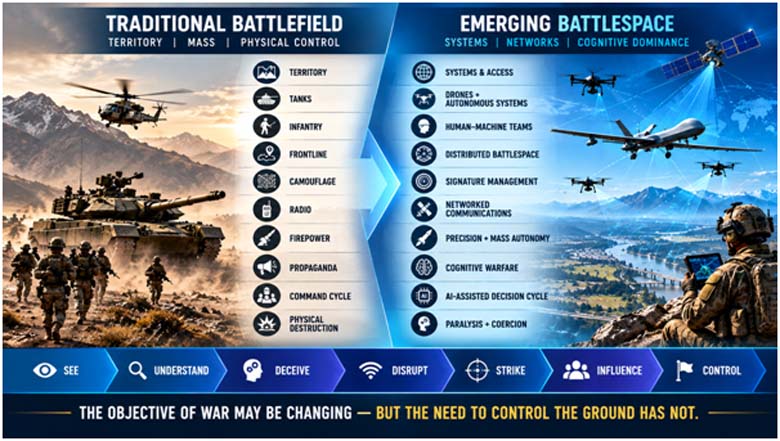
War has always been a contest of wills, but technology now allows states to attack the enemy’s decision cycle directly. The classic sequence was find, fix, strike and destroy. The emerging sequence is broader: sense, fuse, predict, deceive, disrupt, strike and influence. The target need not be the soldier; it can be his command network, logistics architecture, electromagnetic spectrum, political confidence or public narrative.
This is why cognitive warfare is more than sophisticated propaganda. NATO describes it as a struggle for cognitive superiority, using military and non-military activities to gain, maintain and protect cognitive advantage. The human brain becomes a battlespace alongside land, sea, air, space, cyber and information.
Artificial intelligence accelerates the contest by compressing time. It can sift sensor feeds, detect patterns, identify anomalies and support commanders facing information overload. Deep-fakes and synthetic content add another weapon: uncertainty. A fabricated image or false order need not be believed by everyone; it only needs to slow a decision, fracture trust or trigger overreaction.
The strategic prize is decision superiority: seeing first, understanding faster, deciding confidently and adapting sooner.
The Drone Revolution: The Tank’s New Nemesis?
The economics are stark. RUSI has noted that a battlefield drone costing roughly $2,000 could, under favourable circumstances, produce effects comparable to a much more expensive anti-tank missile. Ukraine’s Defence Ministry said it had procured over 1.5 million drones in 2024 and planned 4.5 million FPV drones for 2025. The United Kingdom reported in 2025 that FPV and bomb-dropping drones were responsible for an estimated 60–70 percent of damage then being caused to Russian equipment.
The operational effect is profound. A tank once concealed itself behind terrain, smoke and movement. Today it may be detected by a cheap drone, tracked through sensors, attacked from above and observed again for battle-damage assessment. Armour has become more vulnerable because the battlefield is observable.
Yet declaring the tank obsolete would be premature. RUSI reported that between 1 and 24 August 2025 Ukrainian ISR detected only 23 Russian tanks operating within 70 kilometres of the frontline, compared with 470 tanks on the Southern axis in May 2023. But the same study noted that Ukrainian commanders still valued armour for concentrated firepower, protected mobility and drawing enemy fire away from infantry. The tank is changing from a mass manoeuvre instrument into a protected, networked combat system.
The Mind as the New Battlefield
The most consequential shift may occur beyond the physical battlefield. Every connected society carries a cognitive attack surface. Mobile phones, social media, financial networks, digital identities and continuous news cycles allow an adversary to reach millions without crossing a border.
The objective can be modest: create confusion about what happened, uncertainty about whom to trust, fear about what comes next, and disagreement about what should be done. NATO’s work on cognitive warfare highlights attempts to influence beliefs and behaviour, erode trust and exploit vulnerabilities in hyper-connected societies.
This creates a new form of strategic pressure. A military can lose freedom of action because its networks are jammed. A government can lose room for manoeuvre because markets panic. A population can lose cohesion because contradictory narratives proliferate faster than verified information. Commanders can hesitate because every report may contain deception.
The future contest will also include a battle over attention. Sensors collect information; AI processes it; algorithms distribute it; humans interpret it. Vulnerability exists at every transition. Whoever protects those transitions while corrupting the opponent’s, can generate effects out of proportion to the physical force employed.
Ukraine and the Return of the Physical Battlefield
Ukraine delivers the critical warning against technological triumphalism. Despite the spectacular rise of drones, the war remains brutally geographical. Trenches, rivers, roads, urban centres, defensive belts and logistics corridors continue to determine what can be held and what can be taken.
RUSI’s 2025 assessment described Ukraine’s expanding “wall of drones” and an attrition belt reaching roughly 30 kilometres around parts of the frontline. Yet the same analysis concluded that seizing a contested sector still requires surveying, isolating, degrading, fixing, suppressing, closing with the enemy and consolidating control. The drone can support every stage; it cannot substitute for the final physical act of controlling ground.
This distinction matters. Destroying a headquarters is not equivalent to controlling its district. Collapsing a bridge does not secure the crossing. Precision strike can win an engagement; political objectives require sustained control, legitimacy and endurance.
Ukraine is not showing the death of conventional warfare; it is showing its fusion with uncrewed systems and rapid adaptation. The decisive question is becoming less “How many platforms do we possess?” and more “How effectively can humans and machines combine them?”
Why Boots Will Survive the Algorithm
Some functions remain irreducibly physical. Borders have coordinates. Roads have to be secured. Ports, airfields, tunnels, bridges and mountain passes must be protected. Populations need reassurance, governance requires presence, and disputed claims ultimately become meaningful when political authority can exercise control.
A drone can observe a village continuously, but it cannot provide a durable security presence. An autonomous vehicle can deliver ammunition, but someone must protect the logistics network on which it depends. An algorithm can recommend a target, but human authorities remain responsible for purpose, law and consequences.
The more transparent the battlefield becomes, the more valuable concealment, dispersion, deception, mobility and resilience become. Boots may become fewer, but they may also become more highly trained, better protected and more heavily supported by autonomous systems.
The future soldier is unlikely to disappear. Instead, the ratio between humans and machines will change. One soldier may command, coordinate or exploit systems that multiply his reach several times over.
The Indian Battlefield: What Must Change?
India should resist a false choice between tanks and drones. The requirement is a force designed around combined effects: tanks, infantry, drones, artillery, satellites, cyber, electronic warfare, air defence and AI operating as one combat ecosystem.
Operation Sindoor offered an Indian illustration. The Government reported that Pakistani drone and missile attacks on 7–8 May 2025 were met by an integrated counter-UAS and air-defence grid, while the Chief of Defence Staff subsequently stressed the operational value of indigenous UAV and counter-UAS capabilities. The lesson is simple: the side connecting sensors, decision-makers and effectors faster gains disproportionate advantage.
India is already moving in this direction. The Defence Ministry’s 2026–27 allocation was Rs 7.85 lakh crore, including Rs 2.19 lakh crore under the capital head. In July 2026, the Defence Acquisition Council approved proposals including Army anti-UAV electronic warfare, active protection systems for tanks and jet-based kamikaze drones. The IAF’s Dronathon 2026 also focused on autonomous operations, swarm technologies and electronic warfare.
The next step must be doctrinal. Every fighting formation needs organic drone and counter-drone capabilities; battlefield networks must remain functional under jamming; AI must fuse feeds across domains; autonomous logistics must operate in contested environments; and training must assume continuous surveillance. India also needs a cognitive-security architecture protecting public trust, decision-making and national resilience.
The future Indian force should not be “tank-heavy” or “drone-heavy”. It should be decision-heavy: able to sense faster, understand better, strike selectively, recover quickly and retain human control.
The War After Territory
The future of warfare is not a clean transition from territory to technology. It is a progression in which the contest increasingly runs through information, networks, perception and decisions before culminating, where necessary, in physical control.
The battlefield may begin in the cloud, move through the electromagnetic spectrum, enter the human mind and arrive at the ground only at the decisive moment. That changes the meaning of military power. Mass will matter differently. Platforms will become more expendable. Data will become ammunition. Resilience will become combat power. Cognitive superiority will increasingly shape the space in which commanders can act.
Yet geography will not surrender its claim. A state can be deceived without losing territory; it can be disrupted without being occupied. But lasting political outcomes still require control of people, places and infrastructure. The revolution is not replacement of the soldier by the machine. It is the soldier-machine team becoming the basic unit of future combat power.
The wars of tomorrow may begin in the cloud, be fought in the mind and decided by machines. But when the flag finally has to be planted, someone will still have to stand on the ground.
ABOUT THE AUTHOR

Lt Gen Rajeev Chaudhry (Retd) is a social observer and writes on contemporary national and international issues, strategic implications of infrastructure development towards national power, geo-moral dimension of international relations and leadership nuances in changing social construct.