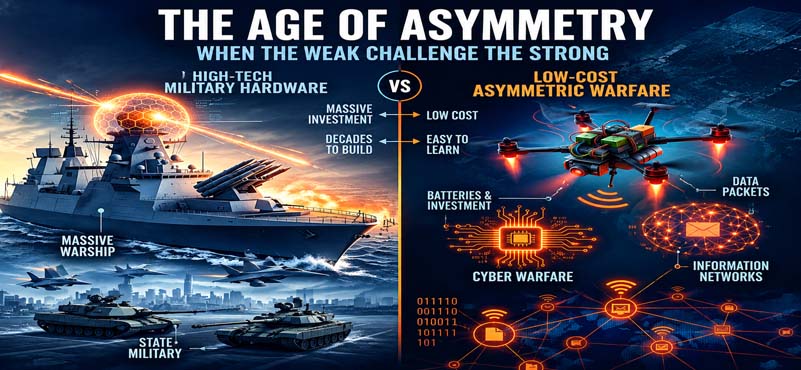
A cheap drone powered by a few batteries can rattle an air defence system that took decades and billions of dollars to build. In November 2008, ten men with rifles and mobile phones held India’s financial capital hostage for three days, dominating the world’s screens as they did so. None of them needed to match the strength of the state they were confronting. They only needed to find where that strength was weakest.
This asymmetry is older than the drone. What has changed is reach. The barriers that once kept small states and non-state actors out of strategic affairs have fallen, and the tools that produce outsized effects are now cheap and easy to learn.
Vulnerability Is The New Currency
For centuries, the first question in strategic assessment was who is stronger. The better question now is harder: where is the stronger side most vulnerable, and what will it cost to protect that point? A weaker side does not need parity. It needs leverage, a point where a small investment forces the other side to incur a large and permanent expense.
There is an uncomfortable paradox beneath. The very things that make a modern state powerful also leave it exposed. Connectivity builds strength and creates dependency. Precision builds capability and creates fragility. The task is no longer only to grow stronger. It is to ensure the strengths a nation relies on do not become the openings an adversary exploits.
What Recent Wars Taught
America’s wars show a pattern. In Vietnam, Hanoi countered American firepower with endurance and political will. In Afghanistan, the coalition toppled the Taliban within weeks. The Taliban avoided decisive battles, used the terrain and waited, while the political cost of staying at home kept rising. When the last American troops left in August 2021, the Taliban were back in Kabul. In Iraq, Baghdad fell within three weeks, yet what followed was an insurgency, a sectarian civil war and the rise of the Islamic State. Battlefield dominance never translated into political success.
Iran adds the resilience dimension to the story. Squeezed by sanctions, currency collapse and military strikes, it has kept the state running. The lesson is plain. Military superiority remains necessary, but it is no longer enough. The ability to impose costs must be matched by the ability to absorb them.
A Battlefield Without Borders
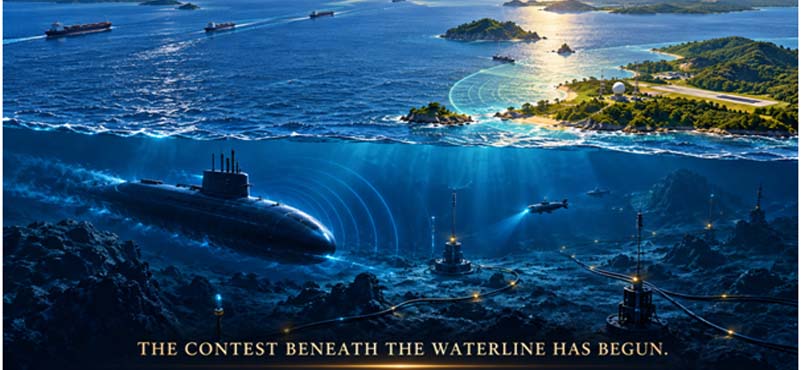
Geography no longer sets the limits of the contest. A data centre in Bengaluru, an undersea cable in the Indian Ocean, a satellite in orbit and a stock exchange in Mumbai can all be part of the same strategic contest.
The aim has shifted too. Disinformation often does not try to sell a particular story. It works by creating enough confusion that people stop trusting official sources and, over time, their own judgement. Public confidence and social cohesion have become national security concerns.
India Has Lived This For Centuries
For India, none of this is new. Kautilya wrote two thousand years ago about statecraft that blends diplomacy, intelligence, economic leverage, and deception. Since 1989, Pakistan has sustained cross-border terrorism in Jammu and Kashmir, a textbook asymmetric calculation: if conventional parity is out of reach, impose costs by other means.
The pattern of recent years is consistent. Mumbai in 2008 was intended to cause psychological shock, not for territorial gain. Uri in 2016 prompted cross-border surgical strikes. Pulwama in 2019 prompted airstrikes at Balakot. Pahalgam in April 2025 prompted Operation Sindoor. Each episode moved India one rung up the escalation ladder while stopping short of full-scale war.
Strong states practise asymmetry too. Washington uses the dollar to shut adversaries out of global finance. India’s own squeeze on trade and fuel to Nepal in 2015 and 2016 showed the limits of such tools, as it hardened opinion and pushed Kathmandu towards China.
What India Must Do
As India rises, the stakes of its vulnerabilities rise with it. It cannot protect everything equally, so it has to decide what is truly critical. Three priorities follow. First, a standing national framework for information warfare and narrative management that operates continuously, rather than being assembled after a crisis. Second, power grids, financial systems and undersea cables must be treated as part of the national security matrix, not as matters of regulatory oversight. Third, economic and industrial resilience, especially in defence production and critical technologies, needs deliberate strengthening so that sustained pressure cannot lead to strategic paralysis.
The final test may matter most: can the leadership remain purposeful when costs rise? Resilience cannot be assumed. It has to be built.
The future will not automatically belong to the strongest. It will belong to those who convert strength into resilience, resilience into endurance, and endurance into advantage. The real measure of power is not merely the capacity to wage war. It is the capacity to remain purposeful when war, in whatever form it takes, refuses to end.
ABOUT THE AUTHOR
 Lieutenant General A B Shivane, is the former Strike Corps Commander and Director General of Mechanised Forces. As a scholar warrior, he has authored over 200 publications on national security and matters defence, besides four books and is an internationally renowned keynote speaker. The General was a Consultant to the Ministry of Defence (Ordnance Factory Board) post-superannuation. He was the Distinguished Fellow and held COAS Chair of Excellence at the Centre for Land Warfare Studies 2021 2022. He is also the Senior Advisor Board Member to several organisations and Think Tanks.