
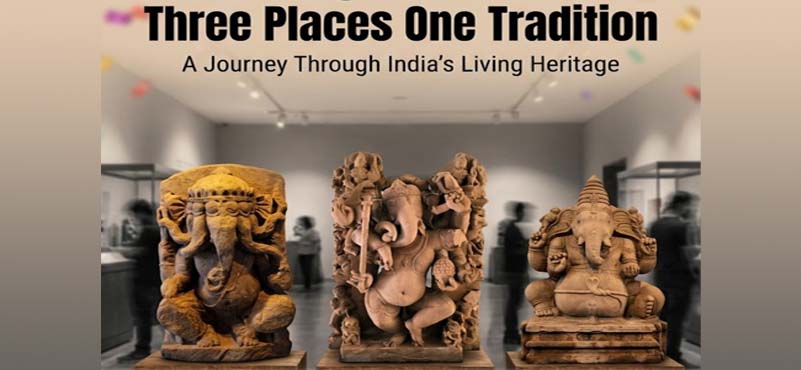
Follow Ganesha across Khajuraho, Bhopal and Hampi, where art, storytelling and ancient landscapes transform travel into an immersive journey beyond monuments.
As Ganesh Chaturthi approaches, the festival recalling the rebirth of Ganesha, the elephant-headed Hindu deity, India pulses with anticipation: clay images appear on pushcarts and in neighbourhood markets, while music carries his name through the streets, for travellers seeking more than festival spectacle, travelling with Ganesha opens another way of seeing India, through pauses, detours and stories that deepen the journey.
To encounter Ganesha, the living symbol of new beginnings, of learning and thresholds. He is a figure through whom a sculpture, a story, a ritual and a heritage site acquire fresh meaning. From Khajuraho to Bhopal and Hampi, the journey moves across three distinct landscapes, revealing one enduring tradition and inviting visitors beyond the hurried checklist of monuments.
The Journey Begins at the Doorway
The festival of Ganesh Chaturthi, held in August or September, symbolises the season of fresh starts: new ventures, study, journeys and obstacles set aside. In Maharashtra, neighbourhood pavilions, swelling processions and the final immersion of clay images turn the festival into a vivid public tide. Yet Ganesha’s presence flows across India, in countless local forms and rhythms.
His gaatha, or living circle of stories, travels through regional retellings, texts, and oral performing traditions: music, dance, ritual, and meditation. In one enduring tale, Parvati, wife of the Hindu god Shiva, shapes a boy to guard her private chamber. Shiva, barred by the child he does not know, beheads him in anger. At Parvati’s command, the boy is restored with an elephant’s head and received as a son.
The tale gives Ganesha multiple dimensions: he first stands as a guardian at the threshold, becomes Vighnaharta, the remover of obstacles, asking travellers to pause before crossing into the unknown. Each aspect of his form takes on new meaning: his broad head, elephant face, keen ears, rounded belly, and tiny mouse companion evoke intelligence without arrogance, abundance without excess, gentle strength, and the art of finding a path where larger beings cannot pass.
The Fruit of Knowledge
Another beloved story places Ganesha beside his brother Kartikeya, the youthful warrior often shown riding a peacock. Challenged to race around the world for a fruit of wisdom, Kartikeya races swiftly around the world. Ganesha, whose vehicle is a mouse, chooses a quieter course, circling his parents Shiva and Parvati, declaring that they are the whole world.
Ganesha wins through proportion. Kartikeya seeks truth on the far horizon; Ganesha finds its immeasurable worth close at hand.
For the heritage traveller, the myth gently unsettles modern tourism’s habits: distance mistaken for depth, destinations accumulated, panoramas consumed and movement confused with discovery. Ganesha suggests another discipline: arrive, linger, circle and look again. A journey need not shrink in ambition.
Ganesh Chaturthi offers a fitting moment to travel India anew. Beyond its familiar festival imagery lies a trail of sculpture, museum collections, sacred landscapes and archaeological sites where the festival’s living energy can lead, in turn, to Ganesha’s older, quieter presences in stone.
Khajuraho: Dance in Stone
At Khajuraho’s UNESCO-listed Hindu and Jain temples, begin with the monumental 10th- and 11th-century architecture, then take a quieter detour to the Archaeological Survey of India Museum, allowing attention to narrow around a yellow-sandstone dancing Ganesha, once placed in the 9th-century Chausath Yogini precinct, an open shrine to sixty-four powerful female divinities and among the site’s oldest temples.
Standing before the sculpture, resisting reading the label, the visitor’s eye follows the rounded belly as it seems to sway, the limbs as they hold a remembered beat, and the small attendant or drummer who heightens the rhythm, noticing stone holding creation, dissolution, renewal and the current shifting between stillness and energy.
The visitor’s imagination then moves from museum light to the open Yogini sanctuary: beneath sun and sky, amid ritual movement, recitation, and the unseen presence of the goddesses. The isolated museum masterpiece begins to return to its sacred spatial conversation.
The visitor looks first, then feels the rhythm, then reads the label, and the encounter begins with the traveller’s own stillness before another body made permanent in stone.
Bhopal: The Many-Faced Gaze
In Bhopal, the city’s museum life opens into Central India’s layered past: towards the Buddhist monuments of Sanchi, the prehistoric rock shelters of Bhimbetka and the sculpture-filled galleries of the State Museum on Shyamla Hills. Amid this continuum of memory stands the Panchmukhi Ganesha, the five-faced elephant-headed deity, drawing the traveller into a different kind of looking.
The gaze of the traveller does not settle at once. It moves across one face, then another, as the familiar form gradually exceeds itself. No single face contains the whole presence. Together, the five suggest a divinity turned in every direction: perception and protection widening beyond a single human viewpoint. They may recall the five elements, earth, water, fire, air and space, and the five sheaths of the self: nourishment, vital breath, mind, intellect and bliss.
Furthermore, under the museum’s soft light, the sculpture gathers these ideas without demanding explanation. Its faces seem to hold several worlds in stillness. Looking becomes lingering; lingering becomes a small inward journey, where art opens briefly onto cosmic imagination.
Hampi: When the Landscape Becomes Ganesha
After Khajuraho’s dance in stone and Bhopal’s many-sided gaze, Hampi opens into scale: ancient granite boulders, the Tungabhadra River, towering temples, ghostly lines of bazaars and ceremonial spaces. Once the capital of the 14th- to 16th-century Vijayanagara Empire, this UNESCO World Heritage landscape holds two monumental Ganeshas, as though released from the rock itself.
The Kadalekalu, or chickpea Ganesha, rises about 4.5 metres beneath a pillared canopy, its affectionate name recalling the god’s rounded belly. Columns frame the massive body; light and shadow drift across granite; scale slowly gathers around the traveller. The image is both seen and felt, its stone retaining warmth, touch and the accumulated hush of devotion.
Nearby stands Sasivekalu, or mustard-seed Ganesha, whose intimate name contrasts with its imposing form. In an open pavilion, the elephant-headed deity meets hill and sky. From the front comes familiar grandeur; from behind emerges the quieter revelation of mother Parvati, suggesting Ganesha seated in her lap, inseparable from maternal presence and nurturing energy.
Here, meaning arrives through movement. Granite becomes landscape, landscape becomes deity, and the ancient rock holds an entire biography of encounter.
Travel as Darshan
To travel with Ganesha is a pilgrimage, a journey that enlarges the self through India’s living landscapes of memory. Darshan is the concept of sacred seeing, where looking becomes more than observation; it opens into reciprocity, reflection, and inner discovery as the image is seen and the one looking is ‘seen’ by the sacred image.
At Bhopal, five faces emerge and recede beneath museum light. At Khajuraho, Ganesha’s dancing body seems to gather rhythm from stone. At Hampi, the deity rises from granite to meet river, hill, heat and sky. No encounter repeats itself. Pale morning, fierce noon, rain-shadowed evening, silence, architecture, other presences and the traveller’s own changing mind all enter the act of seeing.
A museum label against the sculptural image names dynasties, centuries, material and provenance, yet an image’s meanings exceed its label. At Khajuraho, Bhopal and Hampi, each Ganesha is both an artwork and a surviving presence from a larger sacred world. The journey deepens not by adding more destinations, but by letting each place reveal another way of seeing.
What begins as a search for the remover of obstacles becomes a passage through pauses and thresholds. In Ganesha’s company, travel sheds the urgency to arrive. Stone, river, shadow and memory become teachers of renewal. The road does not merely lead elsewhere; it returns the traveller to life with a clearer gaze, a lighter step and the courage to begin again.
ABOUT THE AUTHOR
 Navina Jafa is a renowned curator and scholar on Cultural Heritage & Tourism, and a most accomplished classical dancer. She is a prolific writer and regular contributor to art discussions.