Introduction
Xi Jinping, declared his rule to be a ‘New Era’ in The Party’s Third Historical Resolution of 2021, which cemented his place in history and declared his leadership ‘the key to the great rejuvenation of the Chinese nation’. The Party distinguishes the New Era from the two previous eras in the history of the People’s Republic of China (PRC). In the first the Mao Zedong era (1940-78) and second the Deng Xiaoping era (1979-2012).
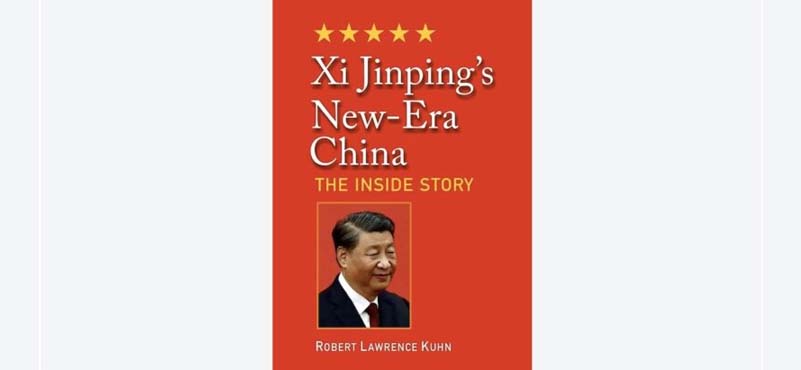
Xi Jingping’s New Era China written by Robert Lawrence Kuhn and published in India by Pentagon Press, covers the extraordinary period of Xi Jinping’s leadership from 2012 to now as the Chinese President emerged as the country’s most powerful leader since Mao Zedong. This book explores his vision and the strategy and the context behind them.
Kuhn is a western Sinologist who has stayed and worked in China since 1988, interacted with thousands of Chinese across the spectrum, written many books and articles on the country’s politics, society and economy including the biography of Jiang Zemin. Considered an insider but while he does not see China as a ruthless authoritarian state, he is also not an uncritical admirer. With a doctorate in ‘brain research ‘ he analyses Xi’s speeches through the ‘eye of a scientist’. The book is thus a balance between objectivity and context and an insider’s perspective.
The Book
In the “Overview”: Kuhn states that “India needs to learn more about China, especially about Xi Jinping himself: how he thinks; his philosophies, policies and plans, domestic and international”.
China impacts ‘every aspect of global economics and geopolitics and President Xi wields unprecedented power over the country while laying down its vision and overseeing its functioning. The books purpose ‘is to tell the inside story’.
The book laid out in fifteen chapters is basically a compilation of 190 essays from 2012 to 2025 on contemporary events. This was the “extraordinary period of Xi’s leadership from around 2012, before the 18th National Congress of the Communist Party of China”. This also covers the later period since 2017 when Xi became China’s senior leader, following the 19 th CPC National Congress, “when Xi became China’s most powerful leader since Mao Zedong”.
Xi Jingping’s political philosophies and ideas encompassed by the word ‘thought’ began immediately after becoming the General Secretary in November 2012. In October 2016 Xi was designated the ‘Core’ of the CPC Central Committee and of the entire Party. According to the Party line ‘not only does he have responsibility for China’s transformation, but he is also accountable for it’.
The author states that in the Chinese political system the Party has absolute control of the country. While the Party is controlled by its ideology. Xi therefore absolutely and perennially controls both the Party and country. Understanding China’s political system requires understanding how the Party implements its leadership through its hierarchical system. Xi and the Party ‘which is the ruling organisation and not a competing political party’ have both been explored in depth in the book and this helps in understanding China.
Kuhn sees Xi’s worldview founded on three philosophical pillars. The first a grand vision for China as an exemplary country with common prosperity for all and a leading world power respected globally for its wisdom and interests. Next is Marxism adapted for China and finally Chinese ancient civilisation its wisdom and traditions, political structure, ethics and morality. He sees himself as a ‘Philosopher King’. The senior most political leader and thinker.
To know China is also to know the Politburo Standing Committee (PSC) members. These seven men are the ones who wield the power in the country. But while its importance remains, one cannot overstate the consequences of Xi’s name ‘written in the Party’s Constitution thus ensuring his pre-eminence in the country’s political life’.
The goals of China are also important from 2020 to 2035 it will realise ‘socialist modernisation’ and from 2035 to 2050 ‘the great rejuvenation of the Chinese nation will be achieved’. China is no longer ‘hiding capacities and bidding time’ but moving to ‘the centre stage’.
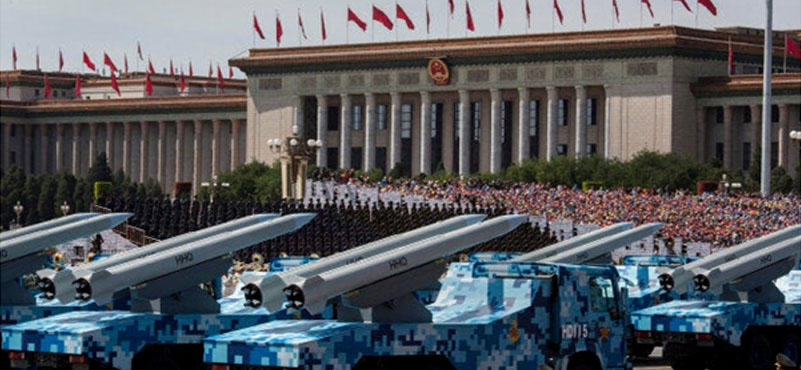
On security he states that ‘security is the prerequisite for development and development is the guarantee of security’. The aim is to build a ‘world class military that ensures national security, guarantees national sovereignty, protects territorial integrity and provides strategic support to realise China’s dream. The principle being ‘maintaining peace through strength’ with the Party maintaining absolute control over the military and the military absolute loyalty to the party’.
His domestic tours and policies have been analysed in detail. Each visit sends out a message while his focus remains on poverty alleviation. For example; Xi visit to Tibet in 2021 focused on ethnic harmony, ecological conservation, high quality economic development, people’s happiness and cultural appreciation’.
While military expansion and economic domination are the hallmarks of China the book brings out that Xi considers poverty reduction to be his most important task. While the author states that programmes to alleviate poverty cannot be taken from one country and imposed on another without adaptation but he feels that both India and China need to share their experiences to fight poverty.
Conclusion
It is said the Mao made China stand up while Deng made China rich. Xi is now making China strong.
India shares a long, disputed border with China along the Line of Actual Control (LAC). The border dispute casts a shadow on relations between both nations as issues of sovereignty and territorial integrity stir patriotic feelings. Hence it is imperative to understand how China thinks and what drives it so as to be able to handle strategic issues between the two countries.
The biggest challenge for India is to get a proper understanding of China and its operating system. Geography and history have decreed that India and China playing increasing roles in global affairs abut each other. In the New World Order the relationship between the two countries will become the most pivotal.
As Kuhn writes ‘like it or not, China is highly relevant for India’s long term international and economic strategy ‘It is therefore books like this that give a ringside view for those dealing with China as well as scholars and students to understand China and President Xi better.
ABOUT THE AUTHOR
 Major General Jagatbir Singh VSM, (Retd), has held various command, staff and instructional appointments and served in varied terrains in the country. He has served in a United Nations Peace Keeping Mission as a Military Observer in Iraq and Kuwait. He has been an instructor to Indian Military Academy and the Defence Services Staff College, Wellington. He has commanded the prestigious 1 Armoured Division. He is a prolific writer in defence& national security and is a Distinguished Fellow at USI.