Language, Migration and the Price of Economic Fragmentation
When Language becomes a Barrier
There is nothing unreasonable about asking an auto-rickshaw or taxi driver working in Maharashtra to learn basic Marathi. A language is not merely a means of communication; it carries the history, culture and personality of a place. Someone who lives and earns in Maharashtra should ideally be encouraged to understand and speak the language of the people around him.
The question, therefore, is not whether Marathi should be promoted. It certainly should. The more important question is what happens when encouragement gradually becomes compulsion, and when knowledge of a language begins to acquire the character of an economic qualification.
The Maharashtra government has now given auto and taxi drivers one year to learn basic Marathi, with no punitive action during that period. The immediate measure may appear limited to one category of workers. But public policy often has consequences beyond its original intention. A rule introduced for one occupation can become a precedent for others; a requirement framed as cultural integration can acquire an exclusionary meaning.
This is why the larger issue deserves a calm examination. India is a federal Union of states, but it is also one enormous economic space in which people have historically moved towards opportunity.
A language should ideally become a bridge to belonging, not a barrier to livelihood.
India is an Economy on the Move
India’s growth story is, in large measure, a story of migration.
The Census recorded more than 41 million inter-State migrant workers, while subsequent estimates have placed India’s broader inter-State migrant population at around 60 million. Behind these numbers are people who leave villages and small towns for factories, farms, construction sites, transport networks, hotels, restaurants, warehouses and millions of other occupations that keep the economy moving.
Migration is often discussed as though it were a social problem requiring management. Economically, however, it is something much more fundamental. It is the mechanism through which labour moves towards demand.
A worker leaves a district where agricultural incomes are limited and travels to an industrial centre. Another leaves a village because a construction project offers a substantially better wage. A young person moves to a city because the services economy offers opportunities unavailable at home. This is not an aberration in India’s economic system. It is the system working.
India’s demographic dividend is therefore not simply the number of young people it possesses. It is the ability to connect those people with the opportunities and productivity that different parts of the country offer.
The migrant worker is not an outsider entering somebody else’s economy. He is an Indian worker moving within his own economy.
The India that Migrants Build
The dependence on migrant labour becomes even clearer when we look at manufacturing and infrastructure.
NITI Aayog estimates that of roughly 60 million people employed in manufacturing, nearly six million—about one in ten—are inter-State migrant workers. The manufacturing ambitions of a rapidly industrialising India will therefore depend substantially on the ability to attract workers to locations where factories are being established.
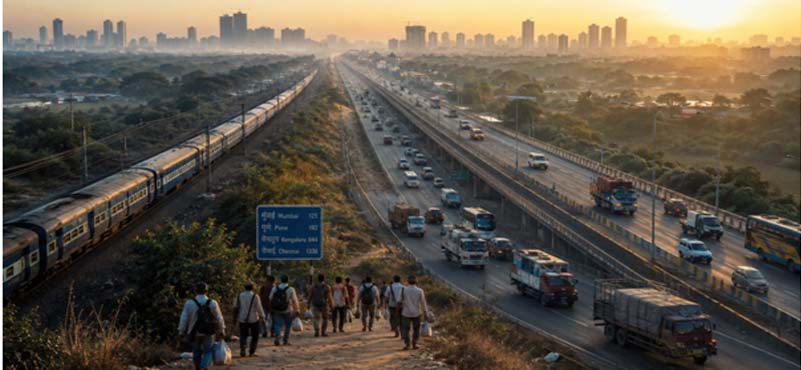
The same story can be found in India’s infrastructure. For decades, workers from Jharkhand, including the Dumka region, have travelled far from their homes to participate in infrastructure projects in some of the country’s most difficult terrains, including projects associated with the Border Roads Organisation. They build roads they may never personally use, often in places separated from their families by hundreds or thousands of kilometres.
Their labour creates an interesting economic circle. A worker travels towards opportunity; the income he earns travels back towards his village; his family spends or invests that income there; the destination gets the labour it needs and the source region receives additional purchasing power. The highway, factory or bridge may stand in one state, but the economic benefits travel across several. This is the largely invisible geography of Indian growth.
India’s infrastructure itself has been built by people who routinely cross its internal boundaries.
India Needs more Mobility, Not Less
There is an even larger structural reason why India should be careful about creating anxieties around migration.
According to PLFS 2023–24 data cited by NITI Aayog, agriculture still employs about 43.5% of India’s workforce while contributing only 14.7% of GVA. Industry employs 24.9% and services 31.6%, while services account for 63.4% of output. This enormous gap tells us where India’s future growth must come from: workers will have to move from lower-productivity occupations towards higher-productivity manufacturing and services.
Earlier NITI Aayog analysis estimated that 84 million agricultural workers would need to move into non-farm employment to bring employment and output structures closer into balance. Such a transition cannot be achieved if people become increasingly reluctant to cross state boundaries. India’s economic transformation will require movement—from farm to factory, from village to city and, increasingly, from one state to another.
The implication is important.
If the next phase of India’s growth requires greater labour mobility, public policy should reduce the friction of migration, not increase it.
A worker should be able to follow opportunity.
Fear Travels Faster than Legislation
The greatest impact of linguistic requirements may not be felt by large corporations or highly skilled professionals. It could be felt by the millions who operate in India’s informal economy.
According to NITI Aayog, more than 70% of non-agricultural workers are informally employed nationally, with informality particularly high in rural areas. These workers include drivers, construction workers, agricultural labourers, helpers, small traders and countless others whose livelihoods depend upon flexibility rather than formal employment structures.
A large company can arrange language classes, documentation, relocation assistance and compliance. A migrant worker arriving for a construction job cannot. More importantly, a worker does not have to be formally prevented from entering a state for a policy to influence his decision. If he begins to believe that his language, identity or lack of familiarity with local rules could create difficulties, he may simply choose another destination.
Fear travels faster than legislation.
Millions of individual decisions can collectively alter the flow of labour. And the consequences would not remain confined to the workers. Construction costs can rise when labour becomes scarce. Manufacturing plants can face recruitment difficulties. Infrastructure projects can encounter delays. Service businesses can find it harder to fill vacancies.
The irony would be profound: a measure intended to strengthen local identity could ultimately make the state’s own economy less competitive.
Migration is an Escalator of Opportunity
There is another dimension that is often missing from the migration debate.
People do not migrate only because they have no choice. They also migrate because migration can improve their economic prospects. NITI Aayog’s analysis found that among migrants who had an income before leaving home, 56.2% reported an increase in income after migration.
Migration is therefore an escalator of economic mobility.
A worker moves to a place where his labour earns more. His family benefits from the additional income. The destination economy gains workers. The source economy gains remittances and consumption. The individual acquires skills and experience that can eventually create further opportunities. The movement is not one-way.
Labour moves towards opportunity, but income flows back towards communities.
This is why making interstate mobility more psychologically or administratively difficult could have consequences well beyond the worker who is asked to learn a language. It could weaken one of the most effective mechanisms through which ordinary Indians improve their economic circumstances.
And the problem becomes even more serious if one state’s approach becomes a template for another.
The Precedent Matters
Maharashtra’s decision must therefore be viewed not merely as a Maharashtra issue.
India’s federal structure gives states considerable space to protect and promote their languages and cultures. That diversity is one of the country’s greatest strengths. But linguistic states were created within the Indian Union; they were not intended to become linguistic nations.
The danger lies in precedent.
If linguistic proficiency increasingly becomes a condition for particular occupations in one state, political actors elsewhere may find it tempting to adopt similar measures. Maharashtra today may be followed by demands elsewhere tomorrow—not necessarily through identical legislation, but through a growing expectation that economic participation should come with linguistic qualifications.
That could gradually create invisible borders inside a country whose greatest economic advantage is its scale. A worker from Bihar considering Maharashtra may hesitate. A worker from Maharashtra considering Karnataka may hesitate. A worker from Odisha considering Tamil Nadu may hesitate.
The question could slowly change from “Where is there work?” to “Will I be welcome there?” That would be a costly transformation.
India’s companies already operate across states. Its supply chains already cross linguistic boundaries. Its infrastructure corridors already connect distant regions. Its digital economy recognises few geographical barriers.
The labour market should not move in the opposite direction.
Many Languages, One Economic Homeland
None of this requires Maharashtra to apologise for Marathi, Karnataka for Kannada, Tamil Nadu for Tamil or any other state for protecting its linguistic heritage.
Quite the opposite. India should encourage its citizens to learn more Indian languages, not fewer. Maharashtra should make Marathi accessible to migrants. Karnataka should make Kannada accessible. Tamil Nadu should make Tamil accessible. Language classes, practical learning programmes and cultural integration are far more powerful instruments than fear.
The ideal message should be simple:
Come to Maharashtra. Work here. Build here. Learn Marathi. But never feel that you have left India to enter Maharashtra.
A migrant who learns Marathi does not become less Indian. A Maharashtrian who learns Kannada does not become less Maharashtrian. A Tamilian working in Pune does not cease to be Tamil. India’s civilisational strength has always been its ability to absorb difference without demanding the erasure of identity.
The India of the future will be more urban, more interconnected and more mobile. Manufacturing corridors will draw workers from distant states. Infrastructure will continue to connect regions. Services will expand beyond traditional linguistic boundaries. India’s demographic dividend will depend increasingly upon the ability of its people to move towards opportunity.
We should therefore be careful about creating psychological borders where the Constitution has created none.
The strongest languages do not need walls around them. They need people willing to learn them.
India’s linguistic diversity should remain a source of pride, not anxiety; a bridge between communities, not a test of belonging. The country cannot afford to become a collection of tightly guarded labour markets. Its growth depends upon the opposite: people, skills, enterprise and opportunity moving freely across its vast internal geography.
India can have many linguistic homes. But it must retain one economic and constitutional homeland.
ABOUT THE AUTHOR

Lt Gen Rajeev Chaudhry (Retd) is a social observer and writes on contemporary national and international issues, strategic implications of infrastructure development towards national power, geo-moral dimension of international relations and leadership nuances in changing social construct.