
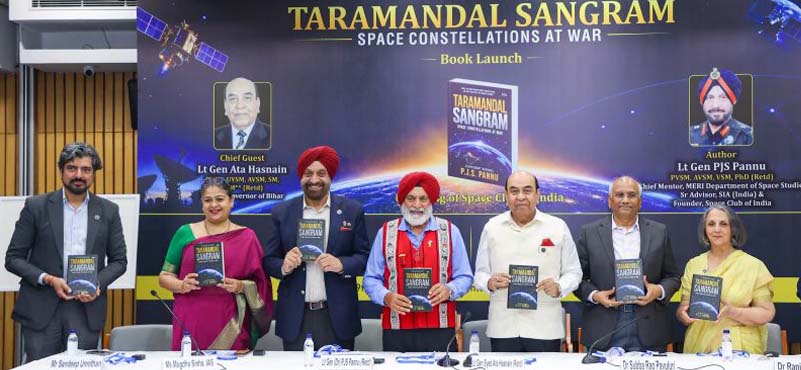
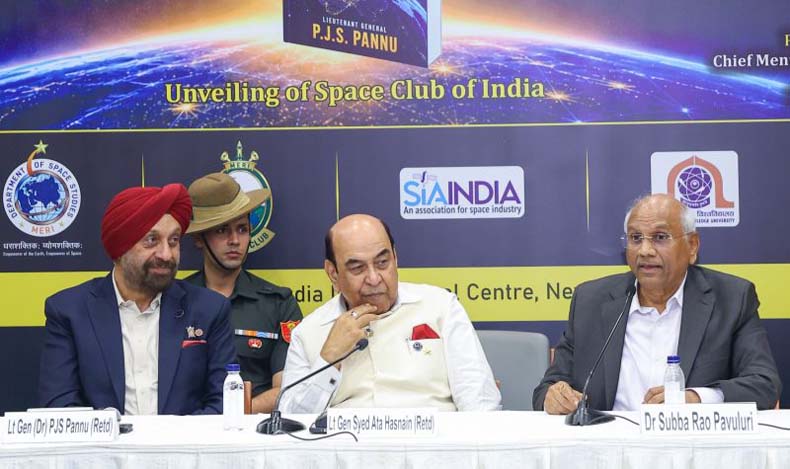
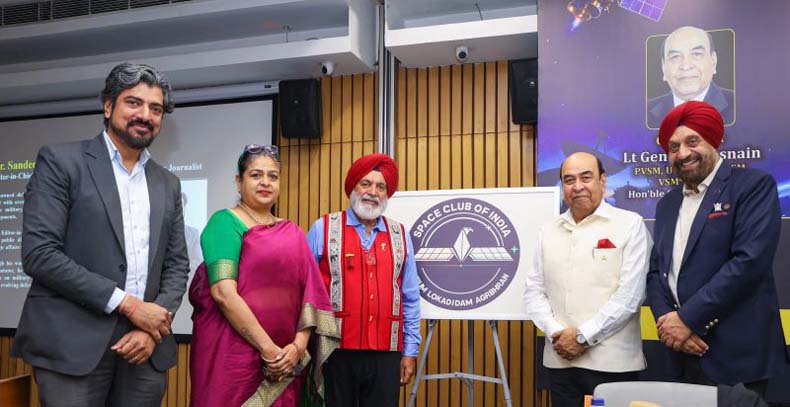
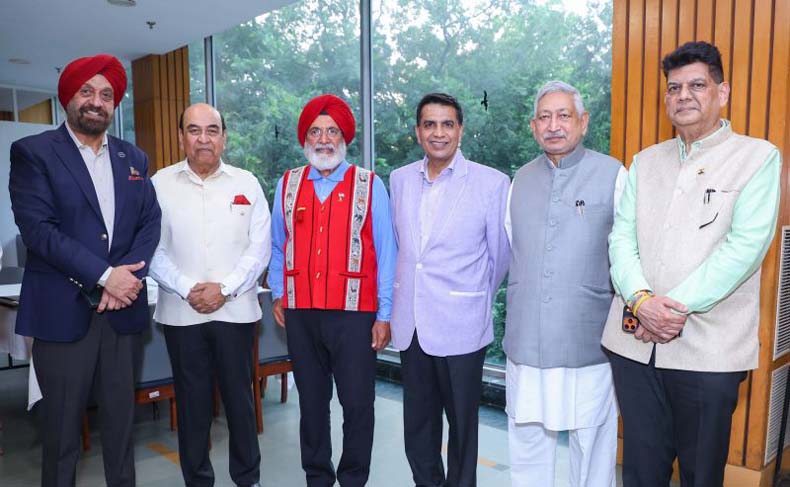
Taramandal Sangram, authored by Lt Gen P. J. S. Pannu, was released at a distinguished gathering at the India International Centre in New Delhi. The event was attended by the Chief Guest, Lt Gen Syed Ata Hasnain, Governor of Bihar; former Chief of the Army Staff General J. J. Singh; senior serving and retired officers; former military chiefs; academics; and experts engaged in research across space technology, national security and related fields.
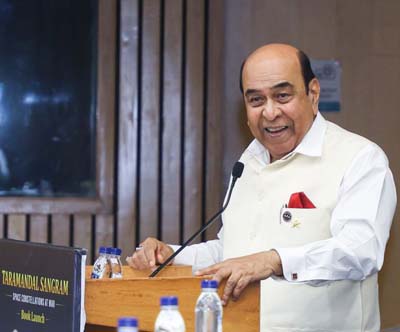 General J. J. Singh recalled his early days as a soldier, when military communications were difficult and often less than basic. Lacing his remarks with humour, he spoke of his association with Lt Gen Pannu and drew upon his own experiences to emphasise the importance of receiving information on time, with accuracy and precision.
The book is a timely wake-up call for the nation. India not only needs to act, but to act quickly, as it is already late in this strategic contest. The book argues that future wars may well be fought in outer space. Space assets may begin by serving as the “eye in the sky”, but could eventually become instruments and targets of warfare in their own right.
For India, therefore, strengthening its capabilities in space is no longer a matter of choice. The vision of a Viksit Bharat must necessarily include a secure and well-defended Bharat. Space preparedness is now as important as conventional preparedness on land, at sea and in the air—if not more so.
Taramandal Sangram traces the remarkable journey of outer space from an object of spiritual fascination to one of the most contested strategic frontiers of the twenty-first century. From the Cold War space race and humanity’s quest to travel beyond Earth, to the development of satellites that now support communication, navigation, commerce and warfare, the book explains how some of humanity’s greatest technological achievements have transformed the nature of power itself.
Nations today depend upon space-based capabilities for economic growth, military effectiveness and technological progress. Yet the same domain that enables global communication and connectivity has also become an arena of rivalry, vulnerability and potential conflict.
Anti-satellite weapons, cyber threats, artificial intelligence, fragile supply chains and the emergence of dedicated space forces are steadily reshaping international security. The struggle for strategic dominance is no longer confined to land, sea and air; it has extended into orbit.
As space becomes increasingly central to economic prosperity, national security and technological advancement, countries face difficult questions. How can space remain a global common while also serving competing national interests? Can international cooperation survive growing geopolitical tensions? What will be the consequences for nations that fail to develop resilient and self-reliant space capabilities?
Accessible to both general readers and those interested in policy and national security, Taramandal Sangram is a timely exploration of why the future of nations—and perhaps of humanity itself—will be shaped not only on Earth, but also among the stars.
From Information to Decision Superiority
In his keynote address, Lt Gen Syed Ata Hasnain recalled incidents from his years in the Army when commanders found themselves at a disadvantage because they lacked an “eye in the sky”.
“If you have an eye in the sky, critical situations cannot be missed,” he said.
He noted that the situation was now changing, even at the tactical level. Drones were providing commanders with a clearer view of the immediate tactical picture, while satellites offered a much wider operational perspective.
“A drone gives you a window. A satellite gives you a canvas,” he said. “Satellites reveal the operational picture to a far greater extent.”
Space technology, he explained, has the potential to transform the confidence with which military decisions are taken. For generations, armed forces have spoken about the “fog of war”—the uncertainty created by incomplete, delayed or inaccurate information. Modern space-based technologies can help reduce that uncertainty.
Commanders must now move beyond merely asking what a satellite shows. They must ask what the complete picture reveals and, more importantly, what is likely to happen next.
“The problem has always been to understand what is opposite us, how it is deployed and what it is likely to do,” he said. “With this technology, we can hopefully see that uncertainty becoming a thing of the past.”
Lt Gen Hasnain underlined the shift, also discussed by Lt Gen Pannu, from information superiority to decision superiority. Access to greater volumes of reliable and reinforcing information enables decisions to be made with greater speed, confidence and precision.
Space warfare, he pointed out, is not simply a contest between satellites, or between weapons and satellites. It is a contest involving decision cycles, resilience, information superiority and the effectiveness of networks. True superiority can be achieved only when all these elements come together.
He also stressed that the importance of space technology extends far beyond warfare. The same systems that monitor battlefields can watch over the Himalayas, track environmental changes and provide early warning of natural disasters.
“I regard Taramandal Sangram as more than a book about space warfare,” he said. “It is about the changing nature of national power.”
While the gathering was primarily looking at the military dimensions of space, he said, its true potential becomes apparent when military and non-military applications are brought together. It is through this convergence that space emerges as an essential component of comprehensive national power.
ABOUT THE AUTHOR
 Lt Gen. P.J.S. Pannu, is a distinguished veteran of the Indian Army and one of the foremost contributors to India’s evolving defence-space and cyber architecture. During a military career spanning nearly four decades, he held key command, staff, instructional, and strategic appointments, contributing significantly to national security, joint military operations, military doctrine, and emerging technology domains.
Among his many achievements, as Deputy Chief of Integrated Defence Staff (Operations), Lt Gen. Pannu coordinated joint military operations of the Army, Navy, and Air Force. He played a pioneering role in establishing the Defence Space Agency (DSA), Defence Cyber Agency (DCYA), and the Armed Forces Special Operations Division, helping shape India’s transition to integrated, multi-domain warfare.
He also conducted India’s first dedicated space warfare exercise, IndSpaceEx, in 2019, laying the foundation for institutionalized military space operations.