From Individual Integrity to Institutional Excellence
When One Officer Becomes a Phenomenon
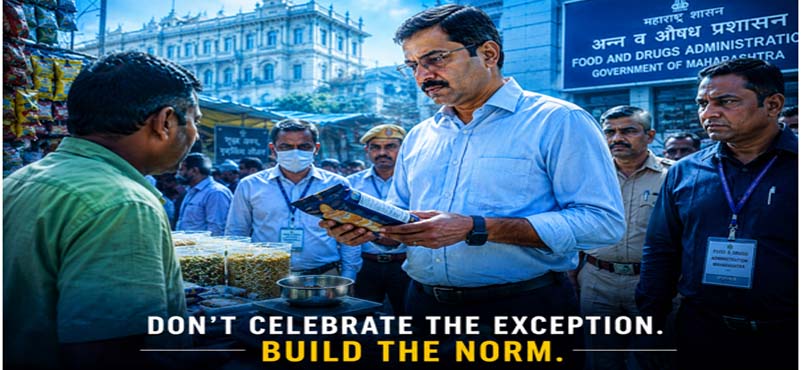
By now, Tukaram Munde needs little introduction. His work in the Food and Drugs administration, his relentless field orientation, inspections, enforcement actions and visible determination to protect the ordinary citizen have made him one of the most recognisable faces of public administration. Whatever one may think of his methods or the controversies that have accompanied his career, one fact is difficult to ignore: he has made the exercise of public office visible.
And that is precisely why Munde is interesting.
Not because India has produced only one honest or capable officer. Nor because he possesses powers unavailable to other administrators. Across the IAS, IPS and allied services are thousands of officers selected through one of the world’s most demanding competitive examinations, trained extensively and entrusted with enormous authority.
Yet Munde has become a phenomenon. Why? That is the more important question.
The real Munde phenomenon is not that one officer works with unusual intensity. It is that exceptional commitment to public duty has become exceptional enough to attract public attention.
A citizen should not have to celebrate an officer for doing his job with integrity, courage and urgency. These should be the ordinary characteristics of the Indian State. And therein lies the larger story.
The question is not how we got one Munde. The question is why we do not have thousands.
Why Is Everyone Not Like Him?
The easy answer would be to say that Munde possesses something others do not. That would, however, miss the larger issue.
The raw material is broadly similar. The officers entering the IAS, IPS and allied services are among India’s brightest young people. They have competed through an exceptionally rigorous selection process. They receive specialised training. They enjoy considerable authority, institutional support and access to the machinery of government.
Yet the quality, speed and intensity of administration can vary dramatically from one officer to another. The missing ingredient, therefore, is not necessarily capability. It is character in action.
An examination can test knowledge. Training can teach procedure. Rules can define responsibility. Government can confer authority. But none of these, by themselves, can guarantee moral courage, ownership, initiative, empathy, decisiveness or the willingness to stand alone when necessary.
India’s civilisational tradition understood this distinction remarkably well. Dharma was never merely a rule book. It was the responsibility attached to one’s position. Rajadharma placed an ethical obligation upon those who exercised power. The Bhagavad Gita elevated disciplined action into a philosophy of life: one’s duty had to be performed with commitment, regardless of personal reward.
Modern administration has sometimes reduced this profound idea to a narrower equation: job description equals duty.
But public office is more than employment. An IAS officer is not merely a government employee. An IPS officer is not merely an administrator of law and order. Each is temporarily entrusted with a portion of the State’s power—and therefore with a portion of the people’s destiny.
The fundamental question, then, is uncomfortable: Have we perfected the selection of administrators while neglecting the formation of public servants? If that is so, the solution cannot be another circular, another rule or another training lecture.
We must change the way we select, form, motivate and hold accountable those who govern.
How Do We Make a Munde?
The objective should not be to manufacture thousands of identical Tukaram Mundes. Institutions cannot and should not produce clones.
The objective should be to create a civil service in which the qualities that make Munde exceptional become institutional norms.
- Select for Character, Not Only Competence. The UPSC examination is extraordinarily effective at identifying intellectual ability, knowledge, perseverance and analytical capacity. But administration requires another dimension.
Can the candidate take responsibility? Can he resist improper pressure? Can she make an unpopular decision when public interest demands it? Can the officer stand alone without becoming reckless? Does the person possess empathy without becoming sentimental, and firmness without becoming arrogant?
The Armed Forces recognised this problem long ago. A young person seeking a commission does not enter merely through a written examination. The Services Selection Board looks beyond knowledge to personality, leadership, psychological attributes, group behaviour and officer-like qualities. There is a lesson here for civil administration. We need an administrative equivalent of SSB—not a military imitation, but a serious assessment of character, leadership, ethical reasoning, resilience and public orientation.
The people entrusted with civilian power over millions deserve scrutiny of character no less serious than scrutiny of intellect.
- Train Hard — Don’t Merely Teach. The second transformation must occur after selection.
NDA does not merely teach military subjects. It deliberately places young men and women through a demanding process that builds discipline, physical robustness, teamwork, leadership, endurance, responsibility and a sense of belonging to something larger than themselves.
Civil-service training need not become military training. But it should become character formation. Young administrators should spend substantial time in the field before they are given the comfort of the office. They should work in villages, hospitals, schools, police stations, disaster zones, construction sites and difficult districts.
They should see what administrative delay actually means. A delayed file is not merely a delayed file. It can mean a farmer waiting for a decision, a patient waiting for treatment, a village waiting for a road, an entrepreneur waiting to invest or a family waiting for justice.
Administration must be experienced before it is exercised.
- Rediscover Dharma, Seva and Rashtra. The third transformation is deeper. India needs to recover an idea that its civilisation understood intuitively: power without purpose is dangerous; authority without responsibility is hollow.
Three words can provide the moral foundation: Dharma. Seva. Rashtra.
Dharma is the duty attached to one’s position. Seva is the understanding that authority ultimately exists for others. Rashtra is the larger purpose that rises above personal career, comfort and advancement. This should not mean partisan indoctrination. It should mean constitutional and civilisational patriotism. A young officer should understand that he has not merely secured a prestigious government job. The Republic has entrusted him with a portion of its sovereignty. That should change the psychology of public service.
The officer stops asking, “What is required of me?” and begins asking, “What does the mission require?”
That is the difference between an employee and a Karmayogi. Swami Vivekananda captured the spirit beautifully: “They alone live who live for others.” The modern administrator can translate that philosophy into remarkably practical action.
A road completed on time is service. A corrupt practice stopped is service. A citizen heard with dignity is service. A decision taken without fear is service.
Competence itself becomes patriotism when it is placed at the service of the nation.
- Make Accountability Real. Character, however, cannot survive indefinitely in a system where performance and consequences are disconnected.
We need measurable outcomes. An officer who demonstrates integrity, speed, innovation and measurable public benefit should be recognised. An officer who repeatedly delays decisions, evades responsibility or performs poorly should face consequences.
The principle should be simple: Good governance must become professionally rewarding; bad governance must become professionally costly.
Performance assessment should therefore move beyond confidential reports and routine compliance towards measurable outcomes, citizen impact and demonstrated leadership.
The objective is not to create fear. It is to create ownership.
- Protect and Incentivise Courage. This may be the most important reform of all. We cannot ask officers to be courageous and then leave them institutionally exposed whenever they take difficult decisions. A bona fide decision taken in good faith, even if it subsequently proves wrong, must be distinguished from corruption or wilful misconduct.
Officers who take difficult decisions, innovate and deliver results should see those qualities reflected in postings, promotions, recognition and responsibility.
The system must send a clear message: If you serve the public interest with integrity, the State will stand behind you.
That is how an individual quality becomes an institutional culture. Select character. Form character. Give responsibility. Protect courage. Measure outcomes. Reward performance.
That is how we stop producing occasional heroes and start producing a culture of public service.
From Munde Phenomenon to Indian Norm
Tukaram Munde should therefore not be reduced to a story about one unusually energetic officer.
His real significance lies in the question he raises about the State itself. India does not lack intelligent administrators. It does not lack laws, schemes, money or institutions. What we sometimes lack is the conversion of authority into responsibility, responsibility into action and action into results.
Imagine an Indian civil service in which integrity is routine, decisions are timely, accountability is real, citizens are treated with dignity and public office is understood as a trust. The impact would extend far beyond corruption. It would improve the scale, speed and quality of governance. And that is why the Munde phenomenon deserves to be studied—not merely admired.
Our ancient civilisation never regarded power as a privilege without obligation. It called that obligation Dharma. Our spiritual tradition elevated selfless action into Karma Yoga. Our Republic gives public servants extraordinary authority in the name of the people. We do not need thousands of officers who look like Tukaram Munde.
We need thousands who possess the Munde mindset—the courage to act, the integrity to resist, the discipline to deliver and the conviction that public office is not a career to be enjoyed, but a trust to be honoured.
The real Munde phenomenon will begin when Munde is no longer an exception.
ABOUT THE AUTHOR
Lt Gen Rajeev Chaudhry (Retd) is a social observer and writes on contemporary national and international issues, strategic implications of infrastructure development towards national power, geo-moral dimension of international relations and leadership nuances in changing social construct.