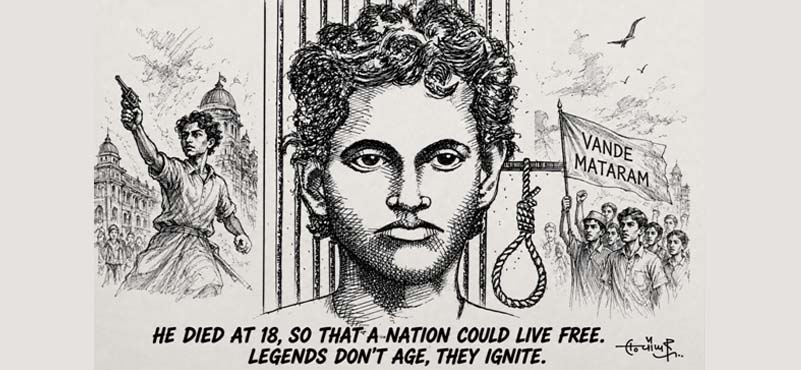
There are moments in a nation’s history when age becomes irrelevant, and courage becomes immortal. On the morning of 11 August 1908, outside the walls of Muzaffarpur Jail, the British Empire prepared to execute what it believed was another rebellious native. The prisoner was barely eighteen years old. Frail in appearance, dressed simply, and with a smile that astonished even those who had come to witness his end, Khudiram Bose walked steadily towards the gallows. There was no plea for mercy, no trembling of limbs, no regret. In that fleeting moment, the Empire possessed all the power, yet the young revolutionary possessed something infinitely greater—the unshakeable conviction that a nation was worth dying for.
The noose ended a young life, but it gave birth to an immortal legend.
History often remembers those who led movements and negotiated freedom. Yet every great struggle begins with unknown men and women who dare to dream before victory appears possible. Khudiram Bose belonged to that first generation of revolutionaries who transformed India’s yearning for freedom into fearless action. Long before Bhagat Singh, Chandrashekhar Azad or Subhas Chandra Bose became household names, Khudiram had demonstrated that the spirit of liberty could not be chained by an empire.
Born on 3 December 1889 in the Midnapore district of Bengal, Khudiram’s childhood was marked by sorrow. He lost both his parents at an early age and was brought up by his elder sister. But hardship often moulds character in ways comfort never can. The Partition of Bengal in 1905 ignited an unprecedented wave of patriotic awakening. The cries of Vande Mataram echoed through towns and villages. Young Khudiram absorbed this atmosphere like dry earth receiving the first monsoon rain. While most boys his age were occupied with books and games, his young mind was already wrestling with questions of justice, freedom and national dignity.
He soon became associated with the revolutionary organisation Jugantar, whose members believed that foreign rule could not be ended by petitions alone. Khudiram distributed nationalist literature, participated in protests and gradually accepted increasingly dangerous responsibilities. He knew that the path he had chosen offered no promise of a long life. Yet he walked it without hesitation.
His defining mission came in 1908. The target was Douglas Kingsford, a British magistrate whose harsh sentences against Indian nationalists had made him a symbol of colonial repression. Khudiram and his fellow revolutionary, Prafulla Chaki, were entrusted with the task of eliminating him. On the night of 30 April 1908, believing Kingsford to be travelling in a particular carriage, they threw a bomb at it. The carriage carried the wife and daughter of a British barrister instead of Kingsford. Both women lost their lives.
Remembering Khudiram does not require us to celebrate violence; rather, it calls upon us to understand the desperate circumstances in which an entire generation confronted an empire that denied Indians even the most basic political rights. Their choices were shaped by an age of repression, humiliation and shattered hopes.
Separated from Prafulla Chaki after the attack, Khudiram walked for miles through the countryside before being arrested near Waini railway station. Exhausted, hungry and alone, he was surrounded by armed policemen. Yet the frightened teenager whom the British expected never appeared. Instead stood a young man whose courage seemed to grow stronger as his fate became inevitable.
His trial attracted enormous public attention across India. Newspapers followed every development. Crowds gathered outside the courtroom. Many hoped that his youth would persuade the British to show mercy. But the colonial administration was determined to make an example of him. Khudiram accepted the verdict with extraordinary composure. He neither begged for life nor abandoned the ideals that had brought him there.
Then came that unforgettable morning. Witnesses later recalled the serenity with which he approached the gallows. Some remembered his radiant smile. Others spoke of his calm demeanour and quiet courage. Whether every detail has been polished by memory hardly matters, for the larger truth remains unquestionable. The teenager who walked towards death without fear conquered the moral imagination of an entire nation.
Outside the prison, thousands mourned. His funeral procession became a public expression of national grief and pride. People collected ashes from his cremation as sacred keepsakes. Songs celebrating Khudiram echoed across Bengal. Young men wore dhotis bearing his name. Mothers narrated his story to their children. A boy had died, but a legend had been born.
Among those deeply moved by stories of Khudiram’s sacrifice was a young Bhagat Singh. Like countless others of his generation, he found in Khudiram not merely a revolutionary but an ideal of fearless devotion to the motherland. The flame lit at Muzaffarpur did not die with the gallows; it travelled silently into the hearts of thousands who would continue the struggle for freedom in different ways and under different leaders.
Every nation is built not only by statesmen who draft constitutions or generals who win battles. It is also shaped by dreamers who refuse to surrender hope when success appears impossible. Khudiram Bose belonged to that rare fraternity. He did not live to witness the tricolour flying over a free India. He never heard the midnight proclamation of independence. He never experienced the democracy for which generations struggled. Yet his sacrifice became one of the countless unseen foundations upon which that freedom eventually stood.
Today, when independence is often taken for granted, Khudiram’s life offers lessons far beyond the politics of his time. Patriotism is not loud rhetoric; it is quiet conviction. It is the willingness to place the nation above oneself. It is integrity when no one is watching, courage when fear seems natural, and hope when circumstances appear hopeless. Every generation must define its own service to the nation. Ours may not demand the sacrifice of life, but it certainly demands honesty, responsibility, compassion and an unwavering commitment to strengthen the Republic that others purchased with their youth.
The British believed that hanging an eighteen-year-old revolutionary would extinguish rebellion. They misunderstood the power of sacrifice. Ideas cannot be executed. Love for one’s motherland cannot be imprisoned. Courage cannot be strangled by a rope.
Khudiram Bose walked to the gallows as one of the first martyrs and the youngest revolutionary to be hanged.
More than a century later, his smile continues to illuminate the long and often difficult journey of our nation. As long as India remembers those who gave everything without asking for anything in return, the young boy from Midnapore will never truly die. He will remain what he became on that August morning in 1908—an eternal son of Bharat, whose brief life proved that the measure of greatness lies not in the number of years one lives, but in the ideals for which one is prepared to lay them down.
(The pen sketch accompanying this article has been drawn by the author as a humble tribute to one of India’s youngest immortal martyrs.)
ABOUT THE AUTHOR

Lt Gen Rajeev Chaudhry (Retd) is a social observer and writes on contemporary national and international issues, strategic implications of infrastructure development towards national power, geo-moral dimension of international relations and leadership nuances in changing social construct.