Introduction
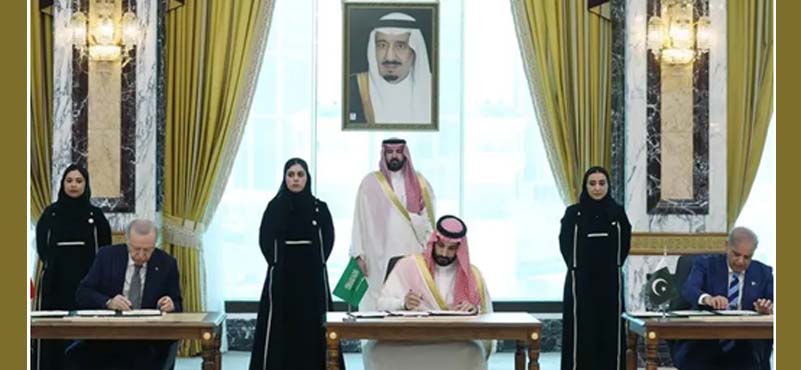
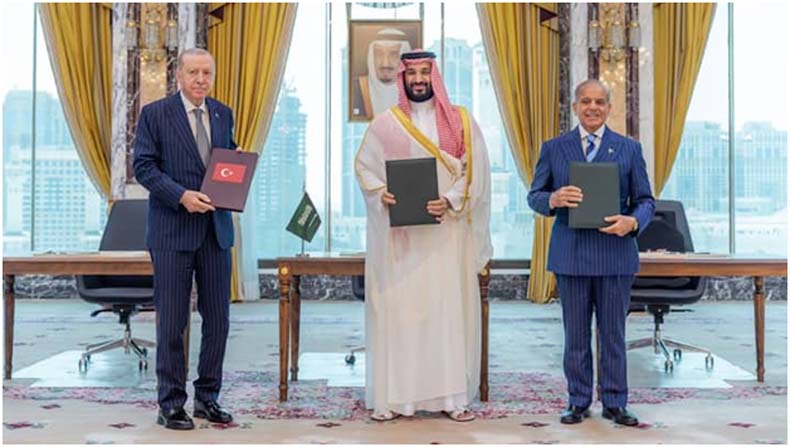
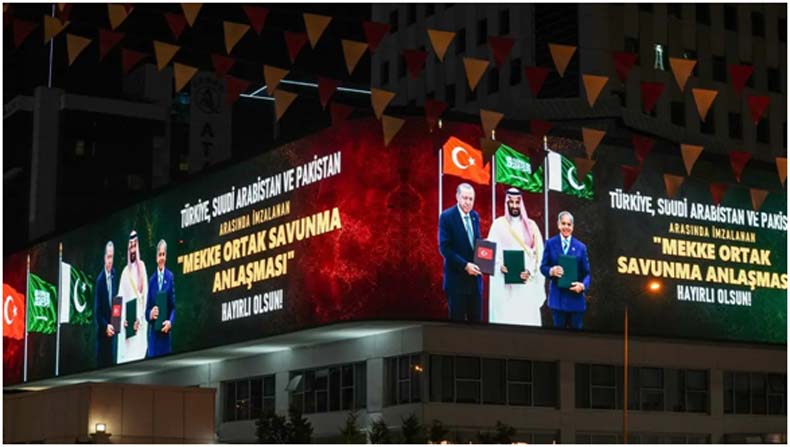
On 07 August. Saudi Crown Prince Mohammed bin Salman, Turkish President Recep Tayyip Erdogan and Pakistan’s Prime Minister Shehbaz Sharif signed the Makah Defence pact during the ‘Makkah Al-Mukarramah Summit for Joint Defence’.
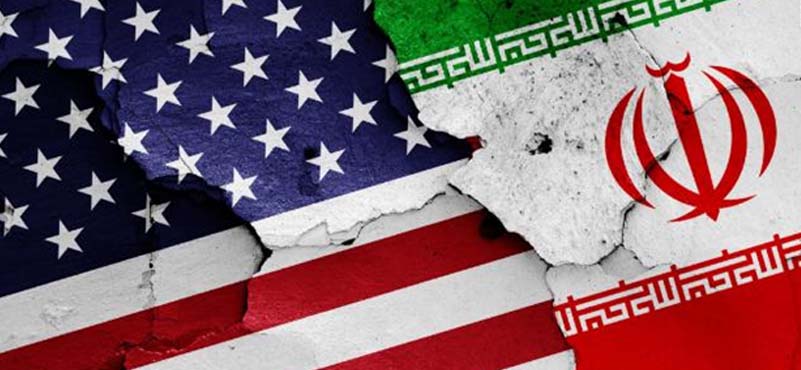
The signing takes place at a time when the Iran war has settled into an unusual pattern, one that swings between talks and bombings. When talks reach an impasse, missile attacks start and when those fail to achieve a breakthrough negotiation resumes while the Strait of Hormuz remains closed.
It also comes at a time when the American defence umbrella has proved of little help in protecting Saudi Arabia and the other Gulf Arab states which are caught in a mess of the US making. The presence of US military assets in their countries has instead pulled them into the war.
But the Iran War is only one context in which this agreement needs to be seen. While the pact aims at strengthening collective deterrence there many questions that surround it. At the heart of the agreement is a single clause that any armed attack on Saudi Arabia, Pakistan or Turkey is to be treated as an attack on all three.
While the commonality between the three countries is that they are all Sunni Muslim countries, yet each brings to the table distinct assets; Saudi Arabia being the richest country brimming with oil revenues and custodian of the Holy shrines. Turkey is the only Muslim NATO member is trying to resurrect the position it held when the Ottoman Empire reigned and with its advanced military-industrial base is emerging as a leader in military drones. Pakistan on the other hand is the only Muslim nuclear state and has close relations with China. It also has a large, and experienced military with a history of defence ties with both Saudi Arabia and Turkey.
Turkish Foreign Minister Hakan Fidan has compared the principle behind the agreement to NATO’s Article 5. The three states would decide through consultations what form and degree of assistance is required, while a ministerial committee and a permanent secretariat based in Saudi Arabia are expected to develop the alliance’s institutional and operational framework.
But the fact is that for each of these countries their adversary differs, for Saudi Arabia it is presently Iran, while for Turkey their issues are with Israel and Syria and for Pakistan their focus is India. Hence bringing these nations together is not the same as aligning their interests.
Saudi Arabia
For Saudi Arabia and the Gulf states the Iran War has shown that partnership with the US, however deep, is not an automatic guarantee of protection. The question is not the magnitude of American power, but the predictability of its use. Iranian attacks exposed the vulnerability of its cities, energy infrastructure and ambitious economic transformation agenda.
The fact is that in spite of purchasing billions worth of US weapons, hosting its bases and troops, selling it oil and cultivating deep ties, the US decision to act in a crisis remains determined by American domestic politics and geopolitical calculations and not threats to the Gulf region. Hence while the alliance with the US needs to be preserved, they perceive the need to build options beyond it.
If the US role recedes, then the rules in the region could be dictated by Iran and Israel. Iran has spent decades building regional influence beyond its borders in the form of its proxies and has also developed a formidable missile and drone arsenal by which it has targeted several Gulf countries. While Israel has demonstrated military and intelligence superiority that has seen it involved in Gaza, Lebanon, Syria and Iran in recent years.
The Saudi Defence Minister Prince Khalid bin Salman has described the agreement as establishing a long-term partnership that strengthens “deterrence, coordination and integration”.
Dr Rayed Krimly, undersecretary at the Saudi Ministry of Foreign Affairs, has made clear that it does not establish a military or sectarian bloc, is unrelated to nuclear ambitions or an arms race, and does not come at the expense of Saudi Arabia’s strong Gulf, Arab and international relationships.
Turkey
Turkey has insisted that Iran or any other country is not identified as an adversary, saying the pact applies only when a member comes under attack. To quote Fidan “There is no common threat that we have put in writing”. His remarks were a response to media reports which claimed the pact would prompt joint action against Iran.
He said the agreement was “the most important step toward bringing lasting stability to this region” and suggested the alliance could expand further, hinting that Egypt might join the trio in the near future.
Fidan said increasing regional ownership of security issues is central to Turkey’s approach.” “External hegemons coming into the region do not solve the problems; they make them more acute, and the cost becomes very high,” he said, arguing that regional countries should develop more institutional mechanisms through which they can ensure their own security, economic stability, development and prosperity.
Turkey has undoubtedly has benefitted by a larger role in Gulf security and new markets for drones and missiles.
Pakistan
Pakistan’s Deputy Prime Minister Ishaq Dar said in a post on X that “the Makkah Accord is purely defensive in nature”. Pakistan shares a long border with Iran and is unlikely to open a permanent front by attacking Iran in case of an Iran – Saudi Arabia conflict. Pakistan’s interests lie in maintaining a balance in relations with both Saudi Arabia and Iran.
Similarly, both Saudi Arabia and Turkey are unlikely to declare war on Afghanistan under the provisions of this pact incase tensions increase between Pakistan and Afghanistan in the form of terror attacks and regarding the disputed Durand Line.
Pakistan’s military ties with China add another dimension as its contribution brings to the table Chinese weapons, technology and infrastructure.
There are many questions to be asked. Will Turkish technology now complement Chinese-origin systems in Pakistan’s drone, missile and air-defence capabilities. Will intelligence or maritime cooperation connect the pact more closely to China and will Pakistan now provide a nuclear umbrella to Saudi Arabia and Turkey? Presently, Pakistan’s deterrent remains solely oriented towards India.
Pakistan’s focus has always been India and as happened prior to the 1965 conflict when it was part of both the CENTO and SEATO, the pact will embolden Pakistan as it feels it has the security backing of both Saudi Arabia and Turkey. This may lead Pakistan to internationalise the bilateral Kashmir dispute or to carry out certain actions against India in the guise of plausible deniability against which India needs to be vigilant.
Implications For India
India has reasons to be concerned about any enhanced military coordination, technology sharing and money for increasing Pakistan’s defence industry and capabilities from Turkey and Saudi Arabia. But at the same time, it has been prepared for this development due to the evolution of Pakistan’s military ties with both these countries.
Pakistan is now part of an unequal formal security framework with two nations that possess financial resources, technology and diplomatic influence. This sits alongside Pakistan’s deeper strategic and defence relationship with China and transforms a bilateral rivalry into a wider network of alignments.
Saudi Arabia has so far been balanced in its stance towards India due to its economic ties and the presence of a large Indian diaspora. During Operation Sindoor they focused on de-escalating tensions, ending military confrontations, and promoting the resolution of all disputes through dialogue and diplomatic channels. It is expected that Saudi Arabia will respect mutual interests and sensitivities.
However, Turkey has consistently taken a pro-Pakistan position on Kashmir at the UN and has also helped Pakistan militarily the most recent being Operation Sindoor when they not only supplied drones to Pakistan but also sent advisors. Turkey is Pakistan’s second-largest arms supplier after China since the signing of joint arms production pact in 2021. Marked by collaborative military projects, joint exercises, and strategic dialogues, Turkey and Pakistan have significantly strengthened their defence ties in recent years. A tighter trilateral alignment may risk Saudi Arabia leaning towards Turkey’s aggressive stance towards India.
The maritime domain also needs consideration as there now exists an arc on Indias Wester seaboard between Turkey’s Navy in the Eastern Mediterranean, to Saudi’s presence from the Red Sea to the Persian Gulf and Pakistani naval presence in the Arabian sea.
The Indian Ministry of External Affairs stated that it is “closely following the development” but has not issued a formal condemnation. India needs to now leverage its massive economy and develop its hard power by building its defence capabilities and capacities while deepening its strategic partnerships with countries like the UAE and Israel as well as strengthening its relationship with Saudi Arabia.
Conclusion
While Saudi Arabia and Pakistan had signed a Strategic Mutual Defense Agreement in September 2025, pledging that an attack against either country would be considered an attack against both. The new agreement expands that mutual defence framework to Turkey, which has one of the region’s largest militaries. The three will benefit from intelligence sharing, joint exercises, interoperability, and the psychological effect of collective deterrence.
The three countries offer a combination of financial resources, manpower, military technology and strategic geography. The pact’s value will be measured in integration: joint air defence, early warning, intelligence, munitions, cyber defence, and a joint command able to function during conflict. Just as important will be defence cooperation to include co-production and co-development of weapon systems. The maritime dimension will also be crucial.
For Turkey and Pakistan, Saudi investment could help to finance new programmes while providing access to one of the world’s largest defence markets. The result could eventually be a defence-industrial triangle capable of jointly producing equipment particularly drones, missiles, air-defence systems, electronic warfare platforms and naval capabilities.
Unfortunately, the emergence of overlapping security arrangements in a volatile region where traditional guarantees by the US has been questioned is unlikely to provide stability. The emerging geometry has widened geography by reducing the strategic distance between the Gulf, Eastern Mediterranean and South Asia and has only added to the existing fissures.
But the fact is that collective defence is only as effective as the operational readiness of forces and the political will behind them.
ABOUT THE AUTHOR
 Maj Gen VK Singh, VSM was commissioned into The Scinde Horse in Dec 1983. The officer has commanded an Independent Recce Sqn in the desert sector, and has the distinction of being the first Armoured Corps Officer to command an Assam Rifles Battalion in Counter Insurgency Operations in Manipur and Nagaland, as well as the first General Cadre Officer to command a Strategic Forces Brigade. He then commanded 12 Infantry Division (RAPID) in Western Sector. The General is a fourth generation army officer.
 Major General Jagatbir Singh was commissioned into 18 Cavalry in December 1981. During his 38 years of service in the Army he has held various command, staff and instructional appointments and served in varied terrains in the country. He has served in a United Nations Peace Keeping Mission as a Military Observer in Iraq and Kuwait. He has been an instructor to Indian Military Academy and the Defence Services Staff College, Wellington. He is a prolific writer in defence & national security and adept at public speaking.