The Future Is Already Here
Every generation has been told the same thing: the youth are the future. It sounds inspiring. It appears on banners, in speeches and at conferences. But perhaps it is time we questioned the phrase.
The youth are not merely the future. They are the present.
On 12 August, the world celebrates International Youth Day. This year’s theme, “Different Contexts, Common Aspirations,” captures something profound. A young person growing up in Mumbai, Nairobi, Kyiv, a Himalayan village or a Pacific island may inhabit completely different worlds. Yet beneath those differences lie remarkably similar aspirations: a good education, meaningful work, dignity, belonging, security, freedom and the opportunity to build a life of consequence.
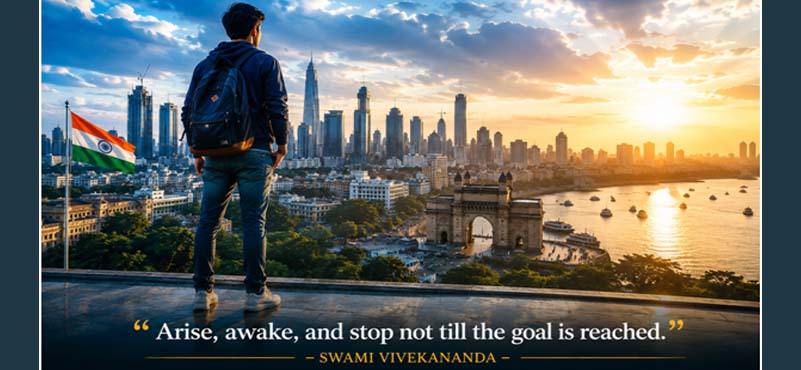
More than a century ago, an Indian monk understood something remarkably similar about the young. Swami Vivekananda did not see youth merely as a demographic category. He saw in them energy, potential and the power to transform society. His message was not simply to dream. It was to arise, awake and act.
That message is perhaps more relevant today than ever before. Young people are entering adulthood in an age of wars, climate anxiety, economic disruption, demographic change and artificial intelligence. They have more information than any generation before them, yet often less certainty about what to do with it. They can communicate instantly with almost anyone on earth, yet many struggle to find genuine human connection.
The great paradox of our age is that we have given young people unprecedented access to information without necessarily giving them the wisdom to distinguish information from knowledge, popularity from achievement, or freedom from responsibility.
Vivekananda would probably have recognised the problem. For him, education was never merely the accumulation of information. He spoke of education that builds character, strengthens the mind, expands the intellect and enables a person to stand on their own feet. The Ramakrishna Mission continues to describe this as his ideal of “man-making education.”
That distinction matters enormously today. We measure young people by examination scores, degrees, salaries, followers, start-ups and medals. We ask what college they will attend, what job they will get and how successful they will become.
We ask much less often: What kind of human being will you become?
That may be the most important question of all. India has a special stake in this conversation. We are a young nation, and our demographic strength is often described as our greatest economic advantage. But a young population does not automatically become a demographic dividend. Youth becomes an asset only when energy is converted into capability, capability into opportunity and opportunity into productive contribution.
Otherwise, demographics are merely numbers. Our challenge, therefore, is not simply to educate the young. It is to prepare them for a world changing faster than many of our institutions can adapt. Artificial intelligence is already transforming the meaning of work. The green transition is creating new industries while disrupting old ones. Digital platforms have changed how young people learn, earn, organise and express themselves. Skills that secured employment yesterday may not be sufficient tomorrow. But technical competence alone will not be enough.
Vivekananda’s idea of strength offers an important corrective. He repeatedly emphasised strength, self-belief and the overcoming of fear and weakness. The philosophy was not about physical power alone. It was about discovering the inner capacity to act, endure and rise above one’s limitations. That is precisely what the young need today. Not merely more information. More inner strength.
The young citizen of tomorrow will need curiosity without arrogance, ambition without entitlement, confidence without contempt and technological sophistication without losing humanity. Machines may become extraordinarily intelligent. That makes human qualities more valuable, not less. Empathy. Judgement. Courage. Integrity. Creativity. Collaboration. The ability to listen. The ability to disagree without hatred. The ability to take responsibility when nobody is watching.
These are not obsolete qualities.
They are becoming scarce—and therefore increasingly precious.
There is another challenge we must confront. We frequently complain that young people are impatient. But perhaps impatience is sometimes the natural response of a generation that has grown up watching change happen at extraordinary speed.
We cannot tell a young person that transformation is impossible when that person has watched a mobile phone become a bank, a classroom, a cinema, a workplace and an entire social universe. We cannot ask young people to think boldly while institutions continue to reward conformity. We cannot ask them to innovate while punishing failure. And we cannot ask them to care about society while giving them little voice in shaping it.
Young people do not need to be endlessly praised. They need to be trusted.
Vivekananda’s faith in the younger generation was extraordinary. He believed that young people, if given character, courage and a sense of purpose, could become instruments of national transformation. The Ramakrishna Mission continues to place his message of strength, character-building and service at the centre of its youth programmes.
That faith deserves an answer. Trust means giving young people responsibility before they feel completely ready for it. It means allowing them to participate in decisions that affect their lives. It means creating spaces where a young person can disagree with an older person without being dismissed simply because of age.
Every generation has something to teach the next. But every generation also has something to learn from it. The young understand a world of digital interconnectedness that many older generations are still learning to navigate. They see possibilities that experience sometimes teaches us to dismiss. They are often more comfortable crossing boundaries of geography, language and culture. But experience possesses something equally valuable: perspective.
It teaches that not every crisis is permanent, not every victory is final and not every failure is fatal. Perhaps the answer lies not in choosing between youth and experience, but in bringing the two together.
The wisdom of age and the energy of youth are not competitors. They are complementary forms of national capital.
And there is another Vivekananda lesson that deserves to be rediscovered: education and success have little meaning if they do not ultimately serve society. He famously argued that education could not be separated from the suffering of ordinary people. For him, the educated individual carried a responsibility towards those who remained trapped in hunger and ignorance. That idea is particularly relevant in an age obsessed with individual success. The purpose of education cannot simply be to escape society.
It must be to strengthen society.
Imagine a country where an experienced teacher mentors a young entrepreneur; where a retired soldier guides a young leader; where scientists work alongside students; where young innovators sit with farmers, craftsmen and community leaders; where technology meets experience and ambition meets wisdom. That is how civilizations renew themselves. But there is one more thing young people must understand. The world owes them opportunity. It does not owe them success. Success has always demanded effort, discipline, resilience and the willingness to fail repeatedly without surrendering one’s purpose.
A generation cannot build a better society merely by demanding rights. It must also accept responsibilities. Citizenship is not a spectator sport. The young must participate—in communities, institutions, public life and the nation itself. They must challenge injustice, but also challenge their own indifference. They must demand accountability, but also practise it. They must use technology, but never allow technology to use them.
Above all, they must resist the temptation to confuse visibility with significance. The loudest voice is not necessarily the most important one. The person with a million followers may leave little behind. The quiet young teacher in a village, the nurse serving in a remote district, the engineer building a bridge, the entrepreneur creating ten jobs, the soldier guarding a difficult frontier, the student helping another student succeed—these may never trend on social media. But they are building the nation.
This is where Vivekananda’s philosophy moves beyond inspiration and becomes a challenge.
International Youth Day should therefore not become another annual celebration in which older generations congratulate young people for being wonderful and then return to making all the decisions themselves.
Perhaps that is the deeper message hidden in this year’s theme, “Different Contexts, Common Aspirations.” Our circumstances may be different. Our languages may be different. Our cultures, economies and histories may be different. But the young person everywhere asks essentially the same question: Does the world have a place for my dreams?
And perhaps, somewhere in the distance, Vivekananda’s voice still provides the most appropriate answer—not a promise of an easy future, but a call to strength, courage, self-belief and action.
Because the youth are not waiting somewhere beyond the future. They are already here—studying, questioning, creating, failing, succeeding, serving, inventing and dreaming.
The future has already arrived. It is young. And it is asking us what we intend to do with it.
ABOUT THE AUTHOR

Lt Gen Rajeev Chaudhry (Retd) is a social observer and writes on contemporary national and international issues, strategic implications of infrastructure development towards national power, geo-moral dimension of international relations and leadership nuances in changing social construct.