Every generation reinvents the art of protest. Our parents marched with empty stomachs and full conviction. Our generation marched with slogans. Present generation, it appears, marches with a food coupon.
Once upon a time, the first question at a protest was, “What are the demands?” Today, it seems to be, “What’s on the menu?”
Looking at the spread available at one recent protest, one couldn’t help wondering whether one had reached a demonstration or India’s biggest open-air food festival. There were pizzas in every conceivable flavour. Samosas crisp enough to deserve a Padma Shri. Pakoras that could settle ideological differences over a cup of tea. Vada pav, burgers, biryani, noodles, sandwiches, cold coffee, milkshakes, assorted soft drinks, bottled water and enough refreshments to convince a wedding caterer that he had entered the wrong profession.
If democracy had a food court, this was it. The logistics were breathtaking. Some of our civic departments struggle to deliver basic services. Disaster relief sometimes takes days. But protest catering? Military precision.
Food ordered from different cities and even countries remotely connected with the agenda of the protest, donations flowed generously and the supply chain functioned with such remarkable efficiency that management institutes may soon introduce a new elective: Advanced Protest Logistics and Catering Management.
Case Study: How to feed thousands before they finish shouting the first slogan.
The food, however, was only half the entertainment. When young protesters naturally grew tired after the third helping of pizza and the second plate of biryani, thoughtful organisers ensured that large speakers filled the air with lively music. Local DJs took charge with admirable professionalism.
After all, digestion is important. A few energetic dance moves would burn sufficient calories, revive the appetite and prepare everyone scientifically for the next round of snacks. Nutritionists may call it interval training. The organisers simply called it crowd engagement.
Somewhere nearby, a fitness watch must have been thoroughly confused. “Congratulations! You have completed today’s exercise goal. Reward yourself with another burger.”
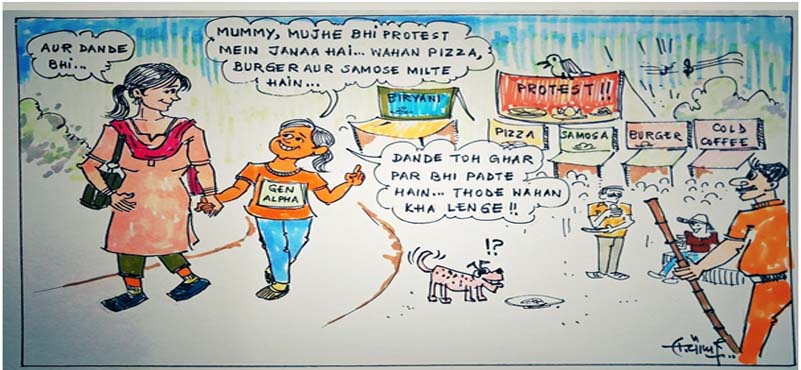
Social media, meanwhile, discovered paradise. Reels multiplied faster than rumours. Memes travelled faster than slogans. One particularly delightful clip showed a little girl pleading with her mother.
“Mummy, mujhe bhi protest mein jana hai. Wahan pizza, samose aur burger milte hain.”
Her mother asked cautiously, “Aur dande?”
The child replied with complete innocence, “Dande to ghar par bhi padte hain… thode wahan kha lenge.”
Children possess that rare gift of exposing adult absurdities without intending to. Soon people were no longer discussing speeches. They were reviewing menus. One gentleman suggested introducing Michelin Stars for protest sites.
⭐⭐⭐⭐⭐
“Outstanding biryani. Excellent pakoras. Passionate slogans. Parking slightly difficult.”
Tourism companies sensed opportunity. Weekend Protest Package. Breakfast included. Lunch sponsored. Evening DJ Night. Slogans complimentary. Cancellation charges applicable only after the first plate of pakoras.
Food delivery companies are probably updating their apps as we speak.
Deliver to:
□ Home
□ Office
□ Railway Station
□ Protest Site
Estimated delivery time: “Depends on traffic, speeches and dance performances.” Loyalty programmes cannot be far behind. Attend five protests. Get the sixth pizza absolutely free. Premium members receive extra garlic bread.
Influencers, naturally, found their calling. “Hello friends! Welcome back to my channel. Today we’re ranking the country’s Top Ten Protest Menus. Number One wins the Golden Samosa Award. Don’t forget to like, share and subscribe.”
One can almost visualise the future. School children will no longer ask, “Papa, where did you meet Mummy?”
The answer may well be, “Beta, near the pakora counter during the Great Protest Food Festival.”
Yet, beneath all this laughter hides a serious thought. A protest is one of democracy’s most powerful instruments. It exists to awaken the conscience, not merely the appetite. Food offered out of compassion is a noble Indian tradition. Hospitality is one of our finest cultural values.
But when the menu becomes more memorable than the message, when the playlist receives louder applause than the speeches, and when people remember the biryani but forget the cause, perhaps the balance has shifted.
Maybe we should stop calling such gatherings protests. Let us simply call them what they increasingly resemble—The National Festival of Pizzas, Pakoras and Protests.
Free Entry. Unlimited Opinions. DJ on Demand. Calories in abundance. Convictions Optional.
ABOUT THE AUTHOR

Lt Gen Rajeev Chaudhry (Retd) is a social observer and writes on contemporary national and international issues, strategic implications of infrastructure development towards national power, geo-moral dimension of international relations and leadership nuances in changing social construct.