
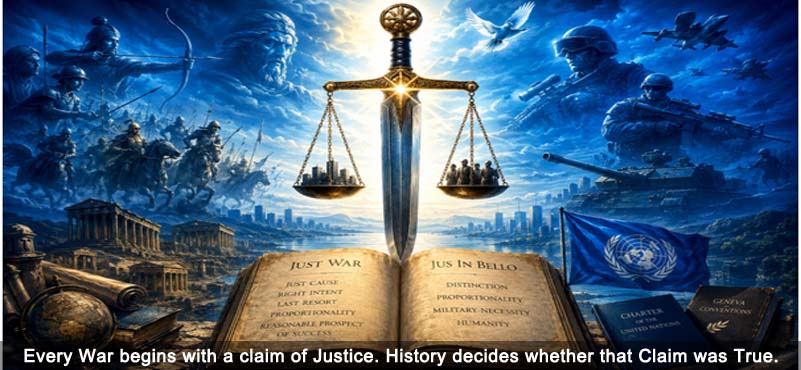
Who Decides When Killing Becomes Moral?
Can Wars Be Just
Wars do not begin with gunfire. They begin with words.
Before the first soldier crosses a border, before the first missile leaves its launcher, and before the first casualty is counted, someone stands before a nation to explain why blood must be shed. The language may differ across civilizations and centuries, but the message remains remarkably consistent. Every war is presented as necessary. Every campaign is described as righteous. Every army is told that it marches not for conquest but for justice.
No ruler has ever announced to his people that they are about to wage an immoral war.
History, however, is far less generous than contemporary politics. Many wars once celebrated as glorious have since been condemned as reckless adventures, imperial aggression, or crimes against humanity. Victors have become villains. Heroes have become subjects of moral scrutiny. The banners of liberation have often concealed the ambitions of empire.
This raises one of the most uncomfortable questions in international politics.
Is there truly such a thing as a just war, or are there only wars that governments successfully justify?
The distinction is not merely semantic. It lies at the heart of military ethics, international law and statecraft. Every sovereign nation reserves the right to defend itself. No responsible government can abandon its citizens to aggression in the name of pacifism. Equally, history repeatedly reminds us that aggression often disguises itself as self-defence, conquest masquerades as liberation, and expansion is wrapped in the language of security.
The challenge, therefore, is not to determine whether war is always evil. Such absolutism ignores the realities of international politics. The real challenge is to identify the narrow moral boundary beyond which the use of organised violence becomes legitimate.
That boundary has occupied philosophers, soldiers, jurists and statesmen for over two millennia. It remains as relevant today in an age of drones, cyber warfare and artificial intelligence as it was on the battlefields of antiquity.
The Search for Moral Rules
Civilisations have long understood that while war may sometimes be unavoidable, it cannot remain morally unconstrained.
If society accepts that killing is ordinarily wrong, then it must also establish exceptional circumstances under which organised violence becomes permissible. This intellectual search gave birth to what is now known as the Just War tradition.
The earliest systematic ideas emerged in classical philosophy, but it was later theologians such as Saint Augustine and Thomas Aquinas who attempted to reconcile the harsh necessities of war with moral responsibility. They argued that the legitimacy of war depended not merely upon victory but upon the reasons for fighting and the manner in which force was employed. Centuries later, Hugo Grotius transformed these ethical principles into foundations of international law, laying the groundwork for modern legal restraints on warfare.
Following the devastation of two World Wars, these principles acquired institutional expression through the Geneva Conventions and the Charter of the United Nations. While imperfectly enforced, they established an important global norm—that the use of force should remain the exception rather than the rule.
Three enduring principles emerged from this tradition.
- The first, jus ad bellum, concerns the justice of entering a war. Was there a legitimate cause? Was every peaceful alternative exhausted? Was the objective defensive rather than expansionist? Was the decision taken by a lawful authority? Could the anticipated benefits outweigh the inevitable human cost?
- The second, jus in bello, governs conduct during war. Even where the cause is just, the methods employed cannot be unlimited. Civilians are not legitimate targets. Prisoners must be treated humanely. Force should remain proportionate to military necessity. The morality of a war is therefore judged not only by why it is fought but also by how it is fought.
- A third and increasingly relevant principle, jus post bellum, asks how peace should be restored once hostilities cease. A just peace demands more than military victory. It requires reconciliation, reconstruction and political stability. Punishment without healing merely plants the seeds of the next conflict.
These principles are neither idealistic nor impractical. They recognise an enduring truth of strategy. Military success that destroys moral legitimacy eventually weakens political victory. Tactical brilliance cannot compensate for ethical failure.
History repeatedly demonstrates that while armies may win battles through superior firepower, nations secure lasting peace only when justice accompanies power.
History’s Courtroom
History resembles an impartial courtroom where military victories are reconsidered long after the smoke of battle has cleared. Political speeches fade. Wartime propaganda disappears. National myths gradually weaken. What survives is a quieter and more demanding question: Was the war itself morally justified?
Few conflicts illustrate this dilemma better than the epic struggle described in the Mahabharata. Often misunderstood as a celebration of war, the narrative is, in reality, one of humanity’s strongest arguments against it. The Pandavas did not seek conflict. Years of exile were endured. Negotiations continued until the very end. Krishna himself travelled as a peace envoy, asking not for a kingdom but merely for five villages. Only after every peaceful avenue had failed did war become unavoidable.
Even then, victory brought no celebration. Kurukshetra left behind millions dead, shattered families and a victorious king overwhelmed by grief rather than triumph. The lesson was profound. A war may be morally necessary, yet remain a human tragedy. Justice does not erase suffering.
The defence of the Greek city-states against repeated Persian invasions presents another example that history has largely vindicated. Facing overwhelming odds, the Greeks fought not for territorial expansion but for political independence and civilisational survival. Resistance at Thermopylae and eventual victory at Salamis became symbols of collective self-defence rather than imperial ambition.
Centuries later, the American Revolution similarly derived legitimacy from resistance against colonial rule. Whatever its internal contradictions, its principal objective remained political self-determination rather than conquest.
The Allied response during the Second World War occupies perhaps the strongest position within modern Just War theory. Nazi Germany’s repeated aggression, combined with systematic genocide and totalitarian expansion, created circumstances where military resistance became both legally and morally necessary. Few conflicts better satisfy the traditional criteria of a just war. Yet even here history refuses simplistic conclusions.
The bombing of Dresden, the atomic destruction of Hiroshima and Nagasaki, and the immense civilian casualties continue to provoke ethical debate. They remind us that a just cause does not automatically sanctify every military action undertaken in its name.
History also records wars that stand on far weaker moral foundations.
Alexander’s campaigns are often admired for military brilliance and administrative vision, yet they were fundamentally wars of expansion. They enlarged an empire rather than defended a homeland.
The Crusades invoked religion but frequently served dynastic ambition and political competition as much as spiritual conviction. Napoleon began as the defender of revolutionary France but gradually transformed into Europe’s foremost conqueror. The moral legitimacy that accompanied resistance dissolved as ambition overtook necessity.
The First World War remains perhaps history’s greatest lesson in strategic failure. Triggered by alliance obligations, nationalism and political miscalculation, it consumed millions of lives while producing no enduring peace. The punitive settlement that followed merely prepared the ground for an even greater catastrophe two decades later.
More recently, the 1991 liberation of Kuwait represented a relatively rare example of collective international action to reverse aggression under broad legal authority. In contrast, the 2003 invasion of Iraq, justified by allegations of weapons of mass destruction that were never found, remains a cautionary reminder that strategic narratives may collapse under historical scrutiny.
History, therefore, does not divide wars neatly into good and evil. Instead, it evaluates them against enduring moral principles. Some wars are remembered because nations had no honourable alternative but to fight. Others are remembered because powerful states convinced themselves that they did.
The difference between the two is often understood only after the battlefield has fallen silent.
The Great Deception
If history teaches one enduring lesson, it is this: nations rarely go to war for the reasons they publicly proclaim.
The vocabulary changes with time, but the pattern remains remarkably constant. Kingdoms once marched in the name of God. Empires claimed to civilise. Colonial powers spoke of bringing order and progress. During the Cold War, military interventions were justified as battles against communism or capitalism. Today, wars are launched in the name of democracy, humanitarian intervention, pre-emptive self-defence, counter-terrorism or the protection of national security. The language evolves; the political objective often does not.
No government tells its citizens that young men and women are being sent to die for prestige, resources, domestic political survival or geopolitical advantage. Public support for war demands a moral narrative. It requires the transformation of national interest into national virtue.
This does not imply that every stated justification is false. Nations do face genuine threats. Terrorism is real. Aggression is real. Genocide is real. States have both the right and the obligation to protect their citizens. The danger lies elsewhere. It lies in the ease with which legitimate concerns can be expanded into unlimited military objectives.
The twenty-first century offers several sobering examples.
The international intervention in Afghanistan in October 2001 following the attacks of 11 September 2001 began with a narrowly defined and widely accepted objective: dismantling terrorist infrastructure and bringing those responsible to justice. Few questioned the legitimacy of that initial response.
Over time, however, the mission expanded into state-building, nation-building and social engineering. Military success became increasingly disconnected from political reality. After two decades of conflict, enormous expenditure and countless casualties, the original strategic objective had become blurred. The lesson was unmistakable. A just beginning does not guarantee a just or successful end.
The invasion of Iraq in March 2003 presents an even starker warning. The principal justification rested on the existence of weapons of mass destruction. When those weapons failed to materialise, the moral and legal foundations of the intervention collapsed. Whatever strategic calculations may have influenced the decision, history remembers not the intentions claimed but the evidence produced.
The modern information environment further complicates ethical judgement. Governments, media organisations, intelligence agencies and increasingly social media platforms compete to shape public perception. Images travel faster than facts. Narratives often outrun evidence. Strategic communication has become an integral component of warfare itself.
This places an extraordinary responsibility upon democratic societies. Patriotism should never require the suspension of critical judgement. Citizens may support their nation’s security while still asking difficult questions about the necessity, proportionality and objectives of military action.
The true strength of a democracy lies not in its ability to manufacture consent but in its willingness to scrutinise power before blood is shed.
Perhaps the most enduring deception, however, is psychological. Leaders often convince themselves that military victory can solve fundamentally political problems. History repeatedly demonstrates the opposite. Armies can occupy territory, destroy military capability and compel surrender. They cannot, by themselves, manufacture legitimacy, reconcile divided societies or erase historical grievances.
Strategy succeeds only when military power serves a realistic political purpose. When force becomes a substitute for political wisdom, even the strongest armies discover the limits of victory.
When the Sword Becomes Sacred
There comes a moment in life of every civilisation when refusing to fight becomes a great moral failure than choosing to fight.
That is the moment when the sword ceases to be an instrument of ambition and becomes an instrument of duty. It does not become glorious. It becomes sacred. Indian civilisation understood this distinction perhaps better than any other. The Mahabharata does not celebrate war; it sanctifies only the reluctant use of force in defence of dharma.
India’s contribution to the ethics of war differs in a fundamental way from much of Western strategic thought. It does not begin by asking how to win wars. It begins by asking how to avoid them without surrendering justice.
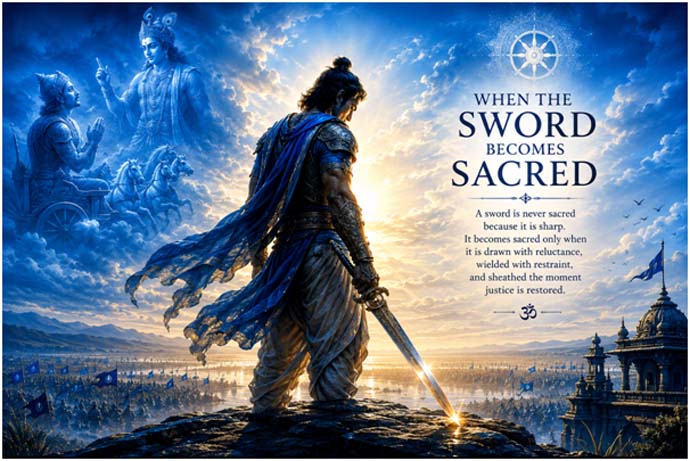
The Mahabharata is often described as the world’s greatest war epic. In truth, it is perhaps humanity’s greatest meditation on the tragedy of war. The central message is not that victory is glorious but that even necessary wars carry consequences that no victor escapes.
Krishna’s counsel to Arjuna is frequently misunderstood as an endorsement of violence. It is nothing of the sort. Arjuna is not urged to fight because war is noble. He is urged to fight because every peaceful avenue has failed, injustice has become institutionalised, and abandoning duty would permit adharma to prevail. The moral burden of action is accepted only after the moral burden of inaction becomes greater.
Equally significant is what follows the war. There is no triumphant celebration of conquest. The battlefield is littered with relatives, teachers and friends. Yudhishthira ascends the throne burdened not by pride but by sorrow. The epic reminds us that justice achieved through violence remains painfully incomplete.
This ethical restraint finds resonance throughout Indian civilisation.
The transformation of Emperor Ashoka after the Kalinga campaign remains one of history’s most remarkable examples of strategic introspection. Having achieved overwhelming military success, Ashoka recognised that conquest by the sword could never equal conquest through moral authority. His embrace of Dhamma did not arise from military weakness but from philosophical strength. Few conquerors have publicly acknowledged that their greatest victory exposed their deepest defeat.
At the same time, Indian thought never embraced absolute pacifism. Kautilya understood the realities of power politics. He recognised that states exist in an environment where threats are real and preparedness indispensable. Diplomacy, alliances, intelligence and military capability formed essential instruments of governance.
Yet even Kautilya treated war as one instrument among many, not as the preferred expression of statecraft. Successful rulers achieved their objectives through persuasion, negotiation, deterrence and strategic balance whenever possible. Resorting to arms represented not the first instinct of wise leadership but its final necessity.
This balanced tradition offers an enduring lesson for contemporary strategic thinking.
A nation that refuses to defend itself invites aggression. A nation that seeks conflict invites eventual exhaustion. Enduring security lies between these extremes, where military strength is guided by ethical restraint and political wisdom.
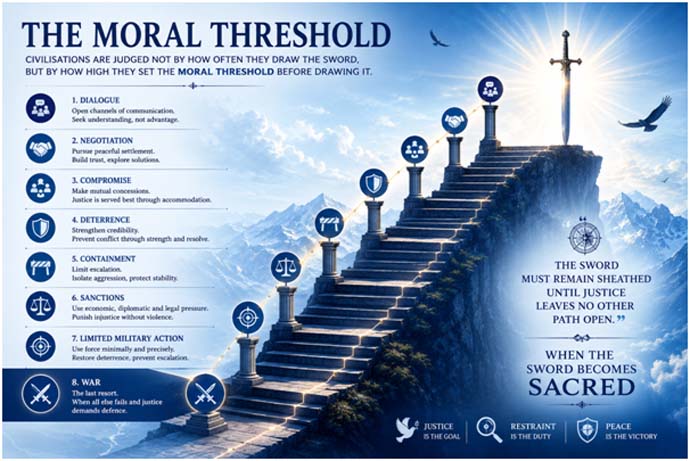
India’s strategic culture has largely reflected this philosophy since Independence. Its major wars have arisen in response to external aggression or the defence of national integrity rather than territorial expansion. This does not make every military decision beyond criticism, but it illustrates an important principle: the legitimacy of force is strengthened when it is exercised reluctantly, proportionately and for clearly defined political objectives.
Power acquires its greatest moral authority when it possesses the capacity to strike but exercises equal discipline in deciding when not to. A sword is never sacred because it is sharp. It becomes sacred only when it is drawn with reluctance, wielded with restraint, and sheathed the moment justice is restored.
The Verdict
Can there, then, be such a thing as a just war?
The answer is yes—but only under exceptionally narrow and demanding conditions.
Not every war is unjust. A nation confronted with aggression cannot surrender its sovereignty in the hope that violence will disappear. The defence of one’s people, freedom and territorial integrity is both a legal right and a moral obligation. History honours those who resisted tyranny when surrender would have legitimised oppression.
Yet the opposite conclusion is equally important. Very few wars deserve the description of truly just.
Most occupy an uneasy space between necessity and ambition, between legitimate security concerns and political calculation, between self-defence and strategic overreach. Many begin with limited objectives but gradually expand beyond their original moral justification. Others are built upon assumptions that later prove false. Time has a remarkable ability to expose what wartime rhetoric conceals.
This suggests a useful distinction.
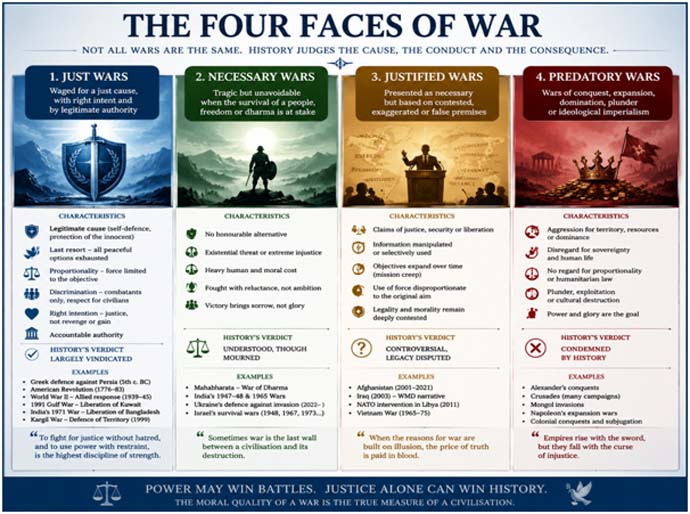
- There are just wars, fought as a genuine last resort to resist aggression or defend fundamental justice.
- There are necessary wars, tragic but unavoidable if freedom is to survive.
- There are justified wars, where governments sincerely or strategically present military action as morally essential, even when history remains unconvinced.
- And there are predatory wars, driven primarily by conquest, domination or plunder, regardless of the language employed to disguise them.
Recognising these distinctions does not weaken national security. On the contrary, it strengthens strategic judgement. States that apply rigorous moral standards before employing force are less likely to become trapped in costly conflicts whose political objectives cannot be achieved.
As warfare enters an age of autonomous weapons, cyber operations, artificial intelligence and space-based capabilities, technology will continue to evolve at extraordinary speed. Human nature, however, changes far more slowly. Fear, ambition, pride and insecurity will remain powerful drivers of conflict.
The central ethical question, therefore, will endure. Not whether nations possess the capability to wage war, but whether they possess the wisdom to recognise when war has become the only honourable choice.
History ultimately renders the final verdict. Politicians justify wars. Generals plan them. Soldiers fight them. Families bear their losses. Historians analyse them. But civilisation lives with their consequences.
The measure of a great nation is not how frequently it wages war, nor even how often it wins. It is measured by the moral threshold it sets before asking its sons and daughters to make the ultimate sacrifice.
Peace is not merely the absence of conflict. It is the presence of justice, secured by strength, guided by restraint and sustained by wisdom. Only when these three virtues stand together can a nation claim that its sword was drawn not for ambition, but for conscience.
ABOUT THE AUTHOR

Lt Gen Rajeev Chaudhry (Retd) is a social observer and writes on contemporary national and international issues, strategic implications of infrastructure development towards national power, geo-moral dimension of international relations and leadership nuances in changing social construct.