History has a curious habit. It rarely settles its accounts within a generation.
Nations, like individuals, often spend decades living with the consequences of decisions whose significance was scarcely understood when they were made. Empires are no exception. They conquer territories, redraw borders and reshape societies, believing that history ends with the lowering of a flag. It rarely does. Long after the armies have departed and the administrators have gone home, the consequences continue their silent journey across generations.
Britain today stands at one such historical crossroads. A nation that once governed a quarter of humanity now finds itself grappling with political instability, questions of national identity, demographic transformation and an increasingly complex debate over social cohesion. None of these developments should be viewed as divine punishment or historical revenge. They are, perhaps, something far more enduring—the long arc of consequence.
A Line That Divided Lives
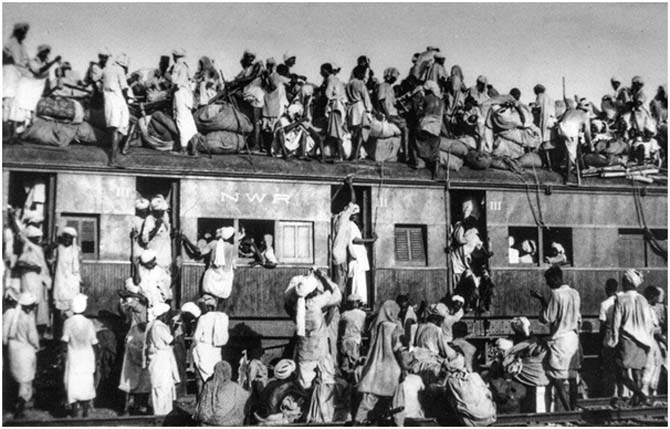
In August 1947, millions of people across the Indian subcontinent went to sleep in one country and woke up in another. They had not moved an inch. The border had.
Families that had lived together for centuries discovered that a line drawn on a map had become more powerful than memory, kinship and history. The tragedy of Partition has been recounted in countless books, but few have captured its enduring human cost as powerfully as Shattered Lands by Sam Dalrymple. It reminds us that maps are not merely instruments of geography. They are instruments of destiny. A line drawn by a departing empire can alter the lives of millions long after the cartographers have vanished.
The British departure from India was hurried, improvised and tragically indifferent to the human consequences of dividing one of the world’s oldest civilisations. Partition was not simply the division of territory. It was the division of hearts, homes and histories. Millions were displaced. Hundreds of thousands were killed. Trains arrived carrying not passengers but corpses. Entire communities disappeared from places where they had lived for generations.
Yet the most profound lesson of Partition is not about 1947. It is about consequences. History often records events. It is consequences that shape the future.
Consequences Without an End Date
The suffering of Partition did not end in 1947. The border survived. So did the wounds.
India and Pakistan have fought multiple wars. The Kashmir dispute remains unresolved. Vast resources that could have transformed the lives of millions have instead been devoted to military preparedness. Two nuclear powers remain locked in a relationship shaped as much by history as by contemporary politics.
Even today, families separated during Partition continue to tell stories of homes they never saw again. The memories have outlived those who created the crisis. The striking reality is that the border was created in weeks, but its consequences have endured for nearly eight decades. This is a truth often overlooked by statesmen and strategists. Actions have no expiry date.
Governments change. Policies change. Leaders come and go. Consequences remain.
Civilisational Idea of Karma
In Indian thought, karma is often misunderstood as punishment. It is not. Karma is consequence.
It is the simple yet profound principle that actions create effects, and those effects eventually return to shape the future. Some consequences are immediate. Others travel across generations. This principle applies not only to individuals but also to nations and civilisations.
Empires create institutions, identities, migration patterns, alliances and conflicts. They imagine that these can be managed and controlled. Yet once unleashed, historical forces acquire a life of their own. The consequences of power often survive long after power itself has disappeared.
An empire may withdraw its armies, lower its flag and close its colonial offices. What it cannot withdraw are the consequences of the world it helped create.
History remembers victories. Karma remembers consequences.
When History Comes Home
This brings us to Britain. For centuries Britain stood at the centre of the largest empire the world had ever seen. It governed territories across continents and influenced the destinies of hundreds of millions of people. Decisions taken in London shaped lives in Delhi, Cairo, Nairobi, Singapore and countless other places.
Today Britain is a very different nation. Its empire has vanished. Its relative economic and strategic weight has declined. Political turbulence has become a recurring feature of public life. Within little more than a decade, Britain has witnessed an extraordinary turnover of seven prime ministers. Brexit exposed deep divisions within society. Scotland periodically questions the future of the Union. Debates over immigration, identity and social cohesion dominate public discourse.
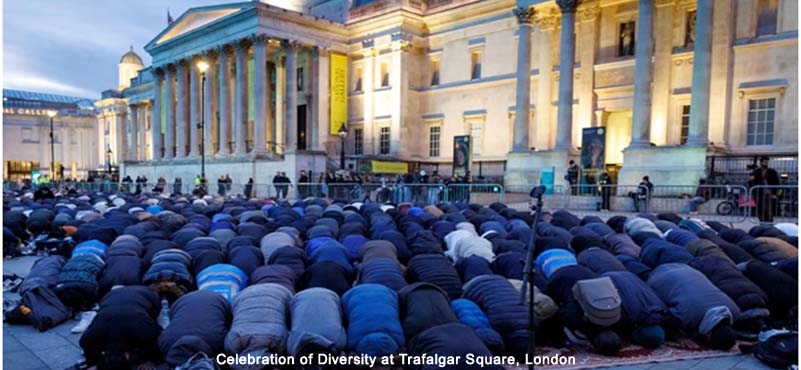
None of this should be interpreted as punishment. History is not a courtroom. Yet it would be equally naïve to assume that these developments are disconnected from Britain’s imperial past. The empire facilitated the movement of people, ideas, institutions and capital across vast distances. It created networks that outlived colonial rule. The multicultural Britain of today is, in many ways, a product of Britain’s own history.
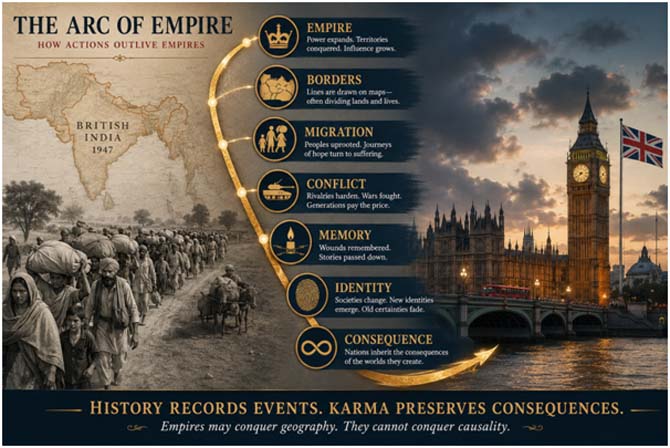
The empire exported people and ideas to the world. The world eventually came back to Britain. The debates now unfolding in British society are therefore not simply about immigration or economics. They are questions about identity. What does it mean to be British in a post-imperial age? How does a nation integrate diversity while preserving social cohesion? How does a former imperial power redefine itself after empire?
These are difficult questions. They are also entirely natural consequences of history. The imperial centre is now experiencing some of the very forces it once projected outward.
History, it seems, has come home.
The Lesson for Every Great Power
The deeper lesson is not about Britain. It is about power itself.
Every great nation is tempted to believe that its actions are temporary while its interests are permanent. History repeatedly proves otherwise. Borders outlive governments. Policies outlive politicians. Wars outlive generals. Consequences outlive intentions.
The United States, China, Russia and Europe are all subject to the same law. The decisions they make today will shape realities long after contemporary leaders have passed into history.
No nation is exempt from the consequences of its actions. No civilisation can permanently escape the world it creates.
History’s Long Memory
The farmer divided by Partition is long gone. Many of those who drew the lines are gone too. Yet the border remains. The consequences remain. The memories remain. That is the enduring lesson of history. Empires rise and fall. Governments come and go. Political fashions change with remarkable speed. But history possesses a memory far longer than politics.
The law of karma is not that nations are punished for their actions. It is that they eventually inherit them. The line drawn through Punjab in 1947 did not stop at Punjab. Its consequences travelled across generations, shaping lives, nations and destinies. So it is with every great act of power. Empires may conquer geography. They may command armies, control trade routes and redraw maps. But they cannot conquer causality.
And in the end, every civilisation must live with the world it has created.
ABOUT THE AUTHOR

Lt Gen Rajeev Chaudhry (Retd) is a social observer and writes on contemporary national and international issues, strategic implications of infrastructure development towards national power, geo-moral dimension of international relations and leadership nuances in changing social construct.