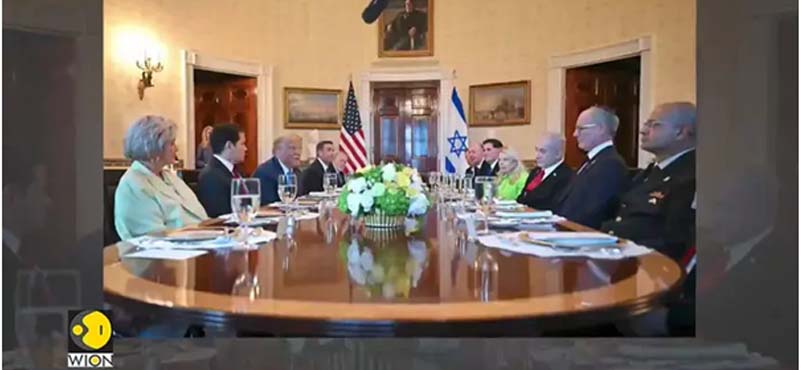
When Donald Trump publicly urged Saudi Arabia, Qatar, Pakistan, Turkey, Egypt and Jordan to join the Abraham Accords, many in Washington dismissed it as another bold geopolitical play. As Trump being Trump, the announcement came wrapped in sweeping language about a “historic settlement” and a transformed Middle East. But away from the headlines, the reaction across the region was noticeably restrained.
Pakistan rejected the suggestion almost immediately. Others remained cautious and largely silent. That silence itself tells a story.
Despite the optimism surrounding the Abraham Accords during Trump’s first presidency, the political climate in West Asia today is markedly different from that of 2020. Back then, several Arab governments had quietly concluded that Iran posed a more immediate challenge than Israel. Strategic calculations overtook old taboos. The United Arab Emirates and Bahrain moved first, followed by Morocco and Sudan. Washington celebrated the agreements as the beginning of a new regional order.
The Gaza war has derailed that trend. Since then, public opinion in most Muslim countries has hardened against Israel. Politically, it might be easier for Arab governments to quietly assist Tel Aviv with intelligence, technology, or even trade, but embracing a new normalisation policy in the middle of a humanitarian emergency is harder. This is something the leaders in the region understand. Even though he may sometimes pretend otherwise, Washington knows it.
This is particularly sensitive in Saudi Arabia. In the Saudi capital, the issue of Israel is not just a diplomatic file. It relates to religion, legitimacy and leadership in the Islamic world. Mecca and Medina are in Saudi Arabia. The political ramifications of any action that appears to marginalise the Palestinian issue will go far beyond foreign policy. Hence, the kingdom has kept its balance. While it has never ruled it out, it has yet to consider normalising relations with Israel without a credible roadmap to a Palestinian state.
At present, that condition is more important than it was two years ago. Trump’s latest offer seems to suggest that the strategic pressures on Iran can be combined with Arab recognition of Israel into a single negotiation package. It seems good in principle. It doesn’t work out that way in reality.
The Islamic Republic of Iran and Palestine are two emotionally and politically charged issues in the Arab world. Governments: Tehran can’t afford to shrug off Gaza. In America, diplomacy frequently misunderstands the region. It tends to view politics as a matter of state interests and to underestimate memory, identity, and public sentiment.
In the Middle East, things don’t always proceed on a business-as-usual basis. History offers lessons. Egypt negotiated peace with Israel in 1979, but little social normalisation followed in the decades that followed. In the 1990s, the Oslo Accords raised high expectations, which later gave way to bitter resentment and violence. Even the Abraham Accords were less about reconciliation than about the convergence of strategic interests.
This is significant because if this weren’t the case, the present moment would feel stable. It was thus not surprising that Pakistan rejected it. The issue of Israel’s recognition is not popular in the country. In particular, the Pakistani military establishment has consistently made Palestine a part of its overall stance on Muslim political issues. A radical shift would result in disorganisation and no tangible gains.
Turkey is also full of paradoxes. Much of President Recep Tayyip Erdoğan’s regional image has been built on his vocal support for Palestinian issues. There is still trade between Ankara and Tel Aviv, but at this point, Erdoğan has little reason to rush into a high-profile American effort.
Jordan and Egypt already have relations with Israel, but both governments are acutely aware of domestic sensitivities. Decades of formal diplomacy have put them under pressure due to public anger over Gaza.
The big picture is that West Asia is undergoing a long transition. The old order is declining, and the new order has not yet been fully formed.
The U.S. remains the dominant external influence in the region – just not with a significant military presence as in earlier decades. China is steadily expanding its economic influence under the radar. The Gulf monarchies are seeking other allies to diversify their relationships, rather than relying on Washington alone. Israel seeks greater integration with the region. Proxies and asymmetric influence remain Iran’s means of maintaining strategic depth. All participants move at the same time.
This has great implications for India. The ties between India and West Asia have grown beyond oil consumption and expatriate communities. Today, the region stands at the crossroads of India’s economic, maritime and strategic aspirations. The Indian population is spread across the Gulf, numbering millions. The trade routes across the Arabian Sea continue to play a crucial role in India’s development. Regional stability and energy security go hand in hand.
Meanwhile, India has built an out-of-the-box relationship with the opposing political factions. New Delhi has strong defence ties with Israel and strong economic and political ties with Saudi Arabia and the UAE. It has managed to maintain working relationships with Iran despite US sanctions pressure. A few countries today can be in a comfortable position with all parties in the region. Diplomatic balance has been one of India’s greatest strengths.
Amid this changing paradigm, the proposed India-Middle East-Europe Economic Corridor stood out. The project wasn’t only a matter of transport infrastructure. It was a broader concept of geopolitical connectivity that linked India, the Gulf, and Europe through ports, railways, energy infrastructure, and digital networks.
It takes a fairly stable Middle East to support such aspirations.
In a scenario of gradual economic integration, India may become one of the big winners. Indian companies perform well in the infrastructure, logistics, digital services and technology segments. Long-term strategic opportunities may emerge when innovation developed in Israel is combined with capital from the Gulf and scale from India.
However, there is another aspect to the equation. If the normalising process continues without more comprehensive political backing, instability can manifest in new forms. Governments can join hands even as societies are angry. The imbalance can generate surface instability for extended periods. This is not the first time this has happened in the Middle East.
India is therefore not interested in triumphalist accounts of the ‘new’ Middle East. Stability, connectivity and strategic balance should remain New Delhi’s priorities. This requires patience.
India cannot afford to get involved with any specific regional group. It has to keep working on Israel’s technology and defence cooperation agreements, build ties with Arab countries, and maintain contacts with Iran. An imbalanced region would be more injurious to Indian interests than a balanced one.
There is also a larger lesson to be taken from it all. Rights to trade corridors, energy routes, digital infrastructure and tech ecosystems will be the basis of geopolitical influence, which will count for more in the future than military alliances. The struggle in West Asia today is not just ideological but about connectivity.
Trump is well aware of the importance of a strong political image ahead of the next polls. However, symbolism alone is not enough to change a region with decades of unresolved conflict.
The diplomatic landscape has been reshaped by the Abraham Accords once. It would be much more difficult to expand them under the current conditions.
Yet, the bigger change taking place in West Asia is a reality. The era of conflict is coming to an end, giving way to growing economic, infrastructural, and strategic competition in the region. The transition, however, will probably not be smooth.
The challenge for India is not picking winners in India’s competition. The challenge for them is to stay “relevant” to everyone while also looking out for their own long-term interests in an unknown and volatile Middle East.
ABOUT THE AUTHOR
 Lieutenant General A B Shivane, is the former Strike Corps Commander and Director General of Mechanised Forces. As a scholar warrior, he has authored over 200 publications on national security and matters defence, besides four books and is an internationally renowned keynote speaker. The General was a Consultant to the Ministry of Defence (Ordnance Factory Board) post-superannuation. He was the Distinguished Fellow and held COAS Chair of Excellence at the Centre for Land Warfare Studies 2021 2022. He is also the Senior Advisor Board Member to several organisations and Think Tanks.