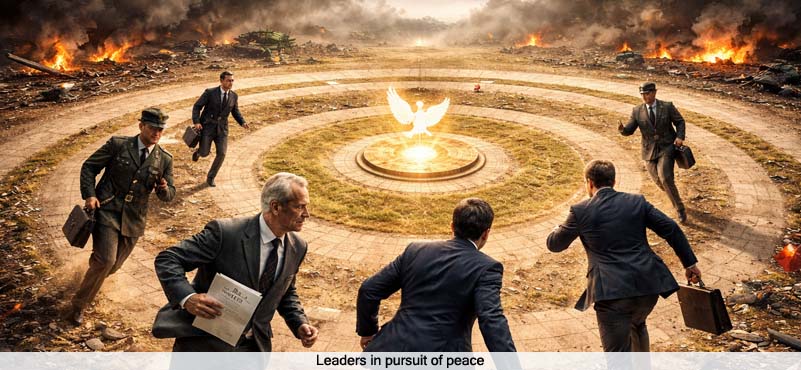

“We have guided missiles and misguided men.”
Martin Luther King Jr.
 The ashes of history are barely cold before we begin striking matches for the next inferno. Every few decades, as more treaties are signed and guns temporarily fall silent, we convince ourselves that humanity has finally outgrown its primal thirst for war. We believed this seductive lie after World War I, and again when the Cold War subsided. As the world stands today in May 2026, the intricate diplomatic architecture we built to prevent wars has collapsed under the weight of our own arsenals. The illusion of lasting peace stands brutally shattered. The chilling reality is that we are not moving away from conflict at all; we have simply treated it as an engineering problem to be optimised. We have sanitized the slaughter, removed the moral friction of the battlefield and replaced it with the cold, frictionless calculus of the algorithm. In fact, we are not moving away from conflict; we are merely perfecting its execution. The chilling realisation is not that war returns, but how it evolves. We are witnessing an era where our brightest minds and astronomical fortunes are poured into a singular objective: the modernisation of annihilation. Humanity is relentlessly using its own genius to engineer weapons of unprecedented destruction. The defence-industrial complex remains one of the world’s most lucrative sectors, offering massive research grants and high salaries. Consequently, top-tier talent in physics, aerospace engineering, artificial intelligence, and computer science is heavily recruited into weapons development. Instead of dedicating this intellectual capital to solving renewable energy bottlenecks or curing disease, much of humanity’s top cognitive power is tasked with calculating more efficient ways to neutralize targets.
The Trillion-Dollar Ledger and the Software Revolution
To understand the scale of this tragedy, one must look at the ledger. According to the Stockholm International Peace Research Institute, global military expenditure reached a staggering $2,887 billion in 2025. But a number this massive often blurs the reality of what it represents. This is not a temporary spike caused by a single, isolated conflict in Eastern Europe or the Middle East; it is the culmination of more than a decade of aggressive, consecutive growth. It represents a compounding planetary arms race that dwarfs the defence spending seen even at the most paranoid heights of the Cold War. But it is not just the volume of money that is shifting—it is where that money goes.
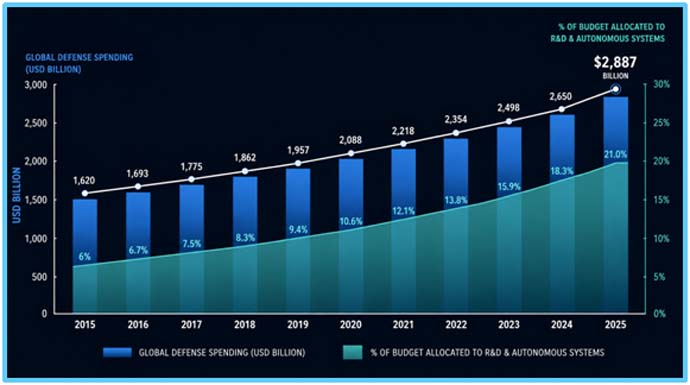
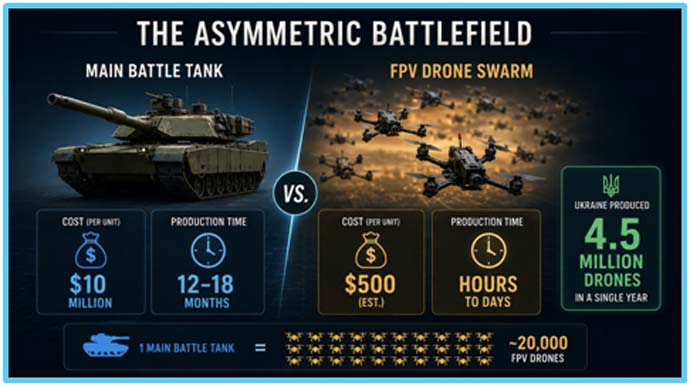
In the 20th century, military might was defined by heavy hardware. Power was measured by steel armour or a bomber’s payload. Today, that lumbering hardware is merely a physical vessel for the true weapon of the 21st century: software. Today’s wars are fought with artificial intelligence, machine learning algorithms, and lines of code that decide who lives and dies in fractions of a second. We are watching fifty-million-dollar fighter jets and ten-million-dollar battle tanks neutralised by five-hundred-dollar drones powered by commercial computer chips. The era of “dumb iron” is dead, the era of the algorithmic kill-web has begun.
Russia-Ukraine: The Algorithmic Meat Grinder
A decade ago, few military strategists would have predicted the grinding reality of the Russia-Ukraine conflict—a bizarre collision of World War I-style artillery duels and autonomous robotics. By May 2026, estimates indicate combined military casualties are approaching a staggering two million. This demographic catastrophe is heavily driven by a new software-centric battlefield ruled by drones. Ukraine alone produced 4.5 million last year.
The proliferation of unmanned aerial vehicles has fundamentally altered modern combat, offering unprecedented precision and lethality from afar. Yet these remote systems have long relied on a fragile lifeline: the continuous radio frequency and video links connecting the machine to its human operator. As drone warfare has expanded, so too has the invisible battleground of the electromagnetic spectrum. Defenders have increasingly weaponized this space, deploying powerful jammers designed to sever these digital tethers. By flooding the airwaves with disruptive “noise,” the defender can effectively blind pilots and neutralize incoming threats, leaving remote-controlled munitions to drift aimlessly or crash harmlessly into empty fields once their signal is lost.
To counter massive Electronic Warfare jamming, the technology had to evolve. Enter “machine vision” and “terminal guidance.” Because human operators frequently lose their video feeds just before impact, algorithms now allow the drone to take over the “last mile.” The operator clicks a target on a screen, and the AI locks on. Even if the signal is severed, the drone autonomously completes the kill. We have removed the human from the final, fatal loop of combat. Furthermore, we are witnessing AI-powered “mothership” drones that fly deep behind enemy lines to autonomously identify and deploy smaller attack drones against anti-aircraft systems. What was once science fiction is now daily reality on the Ukrainian Steppes.
Israel-Gaza: “Smart” Destruction in the Urban Jungle
“Ours is a world of nuclear giants and ethical infants. We know more about war than we know about peace, more about killing than we know about living.”
General Omar Bradley
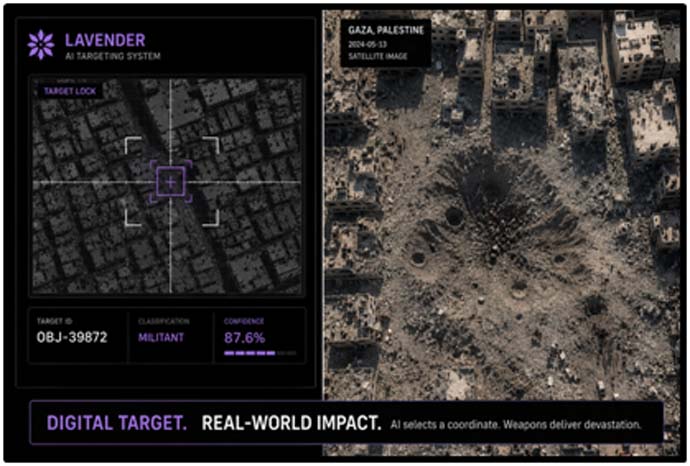
If Ukraine showcases the terror of autonomous drones, the conflict in Gaza forces us to confront a deeply uncomfortable truth about “precision” warfare—and the ethical infancy General Bradley warned us about. As of May 1, 2026, the death toll in the Gaza Strip has surpassed a devastating 72,700. This loss of life is the direct result of pairing brutal hardware with lethal software. Israel’s military campaign relies heavily on AI-driven target generation systems, notably “Lavender” (which processes surveillance data to identify individuals) and “The Gospel” (which identifies militant structures). Historically, human intelligence officers carefully vetted targets to ensure compliance with international law. With systems like Lavender, human review has reportedly reduced to a mere 20 seconds per target—essentially a rubber stamp on a machine’s decision to end a life. The tragic paradox is that while the AI’s identification process is highly technical, the execution remains purely kinetic. When rapidly generated coordinates are fed to 2,000-pound MK-84 bombs, the result is the wholesale erasure of neighbourhoods. The software may be “smart,” but the physics of massive explosives dropped into a dense urban jungle remain entirely indiscriminate.
US/Israel-Iran: The High-Tech Asymmetric Chessboard
While Gaza burns, the broader escalations involving the United States, Israel, and Iran showcase a high-stakes, multi-billion-dollar technological standoff. Iran has mastered asymmetric warfare. Instead of building fifth-generation stealth fighters, they mass-produce thousands of ballistic missiles and cheap drone swarms. A Shahed drone costs roughly $20,000. An Emad medium-range ballistic missile costs perhaps $250,000. In response, the US and Israel have deployed the most sophisticated air defence shields ever conceived. Israel relies on the Arrow-3 system ($2–$3 million per interceptor). The US deploys Terminal High Altitude Area Defence ($15 million each), naval SM-3 missiles ($9 million), and GMD Strategic Interceptors (upwards of $75 million per unit).
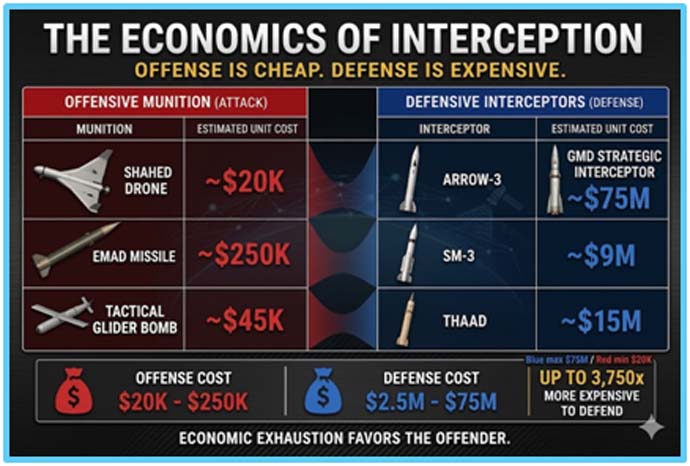
This is a war of economic exhaustion. The math is brutal. In a single exchange, Iran can launch $200 million worth of offensive munitions. To achieve a 90% interception rate, the US and Israel need to expend over $2 billion in defence. You cannot win a long-term war when it costs fifteen million dollars to shoot down a two-hundred-thousand-dollar threat. The adversary weaponises the defender’s own technological sophistication against them, forcing Western militaries to rapidly deplete exquisite stockpiles just to maintain the status quo.
The Indian Awakening: Operation Sindoor
“Strength respects strength. We must be strong not only as a military power but also as an economic power.”
Dr. A.P.J. Abdul Kalam
Viewing this global chessboard from the outside is no longer viable. As Dr. Kalam noted, the geopolitical arena only respects holistic strength. Surrounded by a heavily militarised, tech-forward China and a persistently unstable Pakistan, this stark reality hit home during the May 2025 Pahalgam terror attack and India’s decisive response: Operation Sindoor. The operation proved that the lessons of Ukraine and the Middle East had been quietly absorbed in India. In launching precision strikes against terror infrastructure, India did not just rely on traditional infantry or sheer artillery mass. The operation was a real-world test of multi-domain integration. The seamless use of locally manufactured ‘kamikaze’ loitering munitions, high-altitude surveillance drones feeding real-time coordinates to fighter jets, and the indigenous Akash air defence system blunting retaliatory strikes proved one thing: the era of the modern “kill-web” had arrived in South Asia. Recognizing that it cannot fight tomorrow’s wars with yesterday’s imported hardware, the Indian government increased its 2025 defence spending by nearly 9% to $92.1 billion. Through initiatives like Innovations for Defence Excellence, India is aggressively pivoting to homegrown, tech-heavy solutions—from electronic warfare jammers to AI-backed platforms. Self-reliance in defence software is now just as critical as securing physical borders.
The Ultimate Paradox
When we view the totality of these conflicts, we stand at the precipice of a terrifying paradox. Humanity possesses boundless genius. We map the human genome, eradicate ancient diseases, and instantly connect billions across oceans. Yet we relentlessly weaponise that very same genius. We write complex algorithms designed solely to extinguish human life more efficiently. We spend trillions of dollars engineering the absolute perfection of our own demise. The existential crisis of our era is not a lack of intelligence, but a profound deficit of wisdom. The speed of technological advancement has vastly outpaced our moral capacity to govern it. This software revolution has sanitised the horror of war. When war is reduced to data points on a monitor, the moral weight of killing evaporates.
“Every gun that is made, every warship launched, every rocket fired signifies, in the final sense, a theft from those who hunger and are not fed, those who are cold and are not clothed.”
Dwight D. Eisenhower
Consider the staggering opportunity cost. The nearly three trillion dollars spent annually on global defence could fund the eradication of extreme poverty, finance a massive transition to renewable energy, or establish permanent settlements on the Moon. Instead, we are locked in a zero-sum game of planetary suicide, trading our collective future for the fleeting security of a smarter munition. We keep telling ourselves that if we write just one more targeting algorithm, we will finally achieve absolute security. History proves otherwise. Every leap in military technology only begets a more devastating countermeasure. We are rapidly approaching a singularity in warfare—a point where the ‘kill-web’ operates so fast that human oversight becomes a fatal bottleneck, forcing us to hand the keys of our survival entirely over to the machines we built. True security cannot be built on the fear of mutual destruction; it must be rooted in compassion. When we finally choose to fund schools over missiles and prioritise healing over hostility, humanity will thrive. How can we speak of peace when countless children go to sleep hungry in war-torn regions, or when desperate refugees seek asylum only to be met with closed borders? The cost of a single fighter jet could build modern hospitals, fund agricultural resilience against climate change, and provide quality education to thousands of impoverished children. Somehow, we have collectively decided that funding the architecture of our own destruction is a non-negotiable expense, transforming defence contractors, software developers, and silicon-chip manufacturers into the true masters of our geopolitical future. Until the global community undergoes a fundamental shift in consciousness—deciding that investing in human survival and equitable growth is more essential than the geopolitical arms race—a lasting era of peace will remain exactly what it has always been. It is a beautiful, fleeting illusion. An illusion, waiting patiently to be shattered by the very next line of code.
ABOUT THE AUTHOR
 Lt Gen Tarun Chawla, was commissioned into the Regiment of Artillery in Jun 1984. He has served with the United Nations Mission in Liberia and has been an instructor at the College of Defence Management at Secunderabad. The officer has commanded an Artillery Brigade in the LC Sector in J&K, and an Artillery Division as part of Army’s Western Command. He was the Director General Financial Planning, prior to assuming the role of Director General of Artillery.