
A new open letter from the Wall Street brokerage says India risks falling short of its promise unless it moves faster on AI, manufacturing, agriculture, energy and innovation, Bernstein has warned in a new open letter to Prime Minister Narendra Modi.
The Wall Street brokerage’s India Strategy note, authored by Venugopal Garre and Nikhil Arela and dated 23 April, is its first such letter to Modi since 2019.
It praises India’s recent macroeconomic gains and the government’s emphasis on capital expenditure, but argues that the country faces a narrower window to act as artificial intelligence, supply-chain realignment and energy transition redraw the terms of global competition.
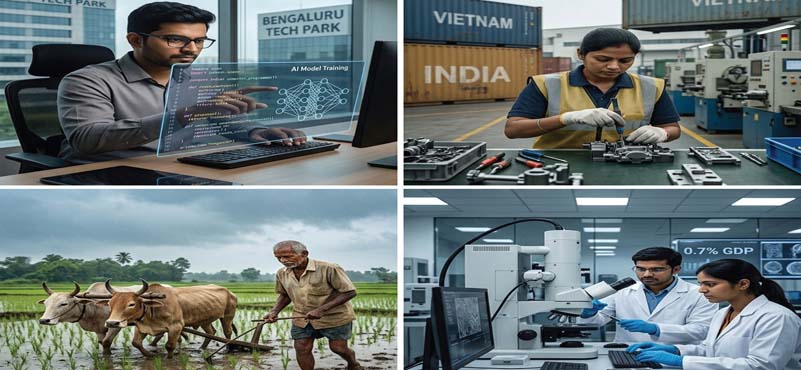
AI Dependence: Bernstein says India risks becoming a consumer of AI rather than a creator of the core technologies that will define the next economic cycle. The concern is not just that India lacks frontier models but that value in AI is increasingly concentrated in models, platforms, compute infrastructure, intellectual property and data governance systems, areas where the US and China dominate.
 That creates a deeper risk for India’s services-led growth model. The country’s technology and business-process services industry has been one of the main engines of middle-class job creation over the past two decades. Generative AI now threatens many of the tasks that built that advantage, from coding and testing to customer support and back-office operations.
Bernstein’s warning is that India cannot afford to remain only a data-rich market and talent supplier while others capture the economics of AI. It calls for investment in compute infrastructure, domestic foundation models and stronger data governance so that Indian data and demand translate into domestic capability.
The implication is that without a stronger AI production base, India’s demographic dividend could weaken into a labour-market trap, with educated workers displaced from services and too few high-productivity sectors ready to absorb them.
Manufacturing Gap: Bernstein is also cautious about the China-plus-one story, the investment thesis that global companies would diversify manufacturing away from China and toward markets such as India.
The thesis remains attractive. The execution, Bernstein says, has been slower than the narrative.
“India’s limited gains from the China+1 shift highlight the time required to build capabilities, but also the cost of delayed action,” Garre and Arela wrote.
The problem is not demand but depth. India’s supply chains remain thin, private capital expenditure is still selective, and capabilities in advanced manufacturing are not broad enough to absorb labour at scale. Countries such as Vietnam, Bangladesh and Mexico have moved faster in some export-linked sectors.
That leaves India with a jobs problem. Workers are not moving in large numbers from farms to factories. Many are moving instead into low-end urban services and informal self-employment.
The brokerage argues that India needs earlier entry into future manufacturing sectors such as robotics, advanced materials and AI-integrated production, rather than arriving late after global production systems have already hardened around other countries.
Subsidy Trap: The most politically sensitive part of the letter concerns subsidies and cash transfers.
Bernstein credits the Modi government for choosing productive capital expenditure over broad-based giveaways at the central level. It says that shift has helped macroeconomic stability and earnings growth. But it warns that state-level welfare programs, especially cash transfers linked to electoral politics, are creating a fiscal squeeze.
The issue is not whether income support is justified, but its opportunity cost. Money directed toward broad cash schemes is money unavailable for roads, irrigation, logistics, power systems, hospitals and schools.
Bernstein describes cash-transfer-led growth as “a very expensive way to buy growth.”
Agricultural subsidies add to the problem. Loan waivers and input subsidies may provide short-term relief, but they do not fix the underlying productivity problem. They also distort cropping decisions and often delay the harder reforms needed in irrigation, storage, logistics and market access.
Farm Drag: Agriculture remains one of India’s largest structural imbalances.
Roughly 42% to 45% of the workforce is tied to agriculture, while the sector contributes only about 15% to 16% of gross domestic product (GDP), according to figures cited in public reports on the Bernstein note.
That mismatch limits income growth and keeps labour stuck in low-productivity work. Fragmented landholdings, monsoon dependence, weak irrigation coverage and poor post-harvest systems all keep productivity below potential.
Bernstein calls for better irrigation, storage, logistics and support systems that do not distort production decisions. Its broader point is that India cannot become a manufacturing and innovation power while such a large share of its workforce remains trapped in low-return agriculture.
Energy Risk: India imports about 88% of its crude oil requirements, leaving it exposed to global price shocks and geopolitical disruption. Bernstein frames this not just as a balance-of-payments issue, but as a strategic vulnerability.
The remedy, in its view, is faster electrification of transport and a clearer policy roadmap to reduce dependence on internal combustion engines. Bernstein questioned the need for production-linked incentives for auto original equipment manufacturers, arguing that the sector needs a sharper transition rather than subsidy support for incumbents.
Innovation Deficit: India spends about 0.6% to 0.7% of GDP on R&D, far below countries it wants to compete with. South Korea spends about 5%, Israel about 6%, and China about 2.4%, according to the Bernstein note.
That gap matters because innovation capacity is built through universities, national laboratories, deep-tech startups, venture capital, intellectual property systems and patient public funding.
The risk, Bernstein argues, is that India’s ambition will outrun its innovation base. That is particularly acute in semiconductors, advanced manufacturing and AI, where dependency can become difficult to reverse once global ecosystems consolidate.
Financial Reform: In 2019, Garre’s letter focused heavily on public-sector bank recapitalization, liquidity, and faster resolution of stressed assets under the Insolvency and Bankruptcy Code. Public reporting says Bernstein continues to see financial-sector strength as central to India’s ability to lower borrowing costs, improve credit transmission and support private investment.
The financial-sector agenda is less dramatic than AI or China-plus-one, but it remains central to the investment cycle Bernstein wants India to unlock. Without stronger banks, faster credit transmission and deeper private investment, the capital needed for manufacturing, infrastructure and innovation will remain uneven.
The Narrowing Window: India does not lack capital. It does not lack talent. It does not lack ambition. What it lacks, the brokerage argues, is speed and decisiveness in converting those advantages into structural strength.
“The window to act is still open, but it is narrowing,” the letter says.