
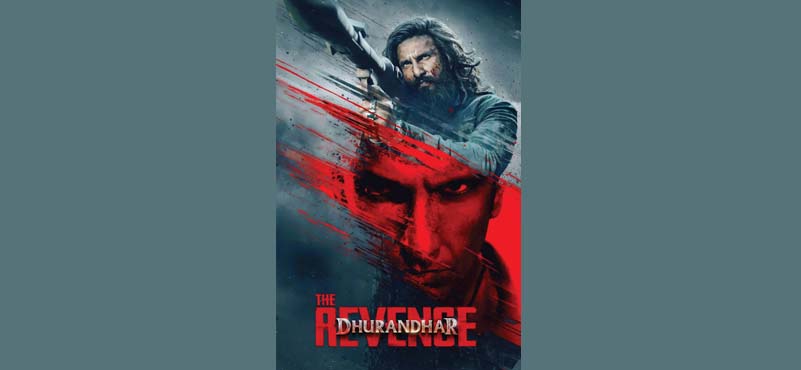
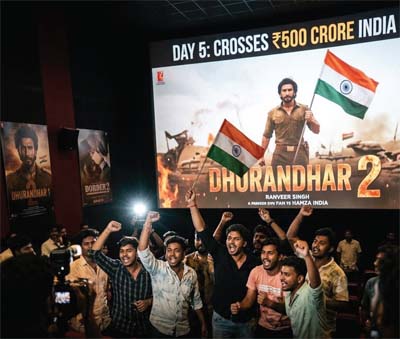
Just a week since the release of Dhurandhar- 2, writer-director Aditya Dhar’s sequel to his mega-blockbuster Dhurandhar 1, and the box office is roaring with its success! Audiences are lapping up D2, that brazenly bats bigger, hits higher and sounds shriller than its prequel. The not-so-subtle messaging for right wing politics and the cleverly guised support for the actions of the incumbent government may be raising eyebrows amongst film critics, influencers and ‘political experts,’ but the numbers reveal that movie-goers are revelling in its magic. On day 5 of its release, the film has crossed the Rs 500 crore mark in India. Worldwide, collections have breached Rs 850 crore- making it a mega blockbuster, and one of the highest grossing Hindi films of all time. And with barely a week gone since its release, the party for the film has just begun!
 The Dhurandhar duology features an undercover Indian intelligence agent, Hamza Ali Mazari, played by Ranveer Singh, who infiltrates Karachi’s criminal syndicates and political power structures in Pakistan, at the behest of the Indian Intelligence Chief, Ajay Sanyal (portraying current NSA and former IB Chief Ajit Doval) to neutralise a terror network targeting India! Hamza learns of the devastation being planned against India and through the course of the film, does away with the men masterminding the attacks on his homeland. Some of his efforts however do go in vain, as the Pakistanis execute some of their devious plans, including the 26/11 Taj Mumbai attack, IC 814 hijacking (with whose reference the story begins) and the Indian Parliament Attack, shown impactfully in the film with shot footage interspersed with real-life visuals and recordings of the actual events at various points.
The complex mix of real events with fictionalised elements are packed individually in chapters in both parts of the film. Woven skilfully into a riveting plot and strongly supported by swaggering performances, pulsating music, action-packed sequences and stylised edits, has caught the fancy of cine goers and brought them out of their OTT cocoons, straight into movie theatres.
But critics, influencers and some political experts are up in arms against the high octave jingoistic tone of the film and veneration for the Modi led government, which in both parts, is undeniable. Be it Ajay Sanyal’s dialogue in Dhurandhar 1 wherein he ‘hopes for a government that cares for the nation to take over one day…’ or the explanation that demonetisation was done to curb the fake currency racket offset by Pakistan in India in Dhurandhar 2 – the pro-government stance can be seen throughout the 534-minute combined run time of the duology! Terror acts planned and executed on Pakistani soil that remain in the collective memory of Indians are emphatically revived through the narrative. The lawlessness of Karachi, the infighting of the Pakistani political brass in Lyari, the hatred towards India and the cruelty meted out by Pakistani Jihadists, supported in full measure by their government, towards Indians, is highlighted throughout.
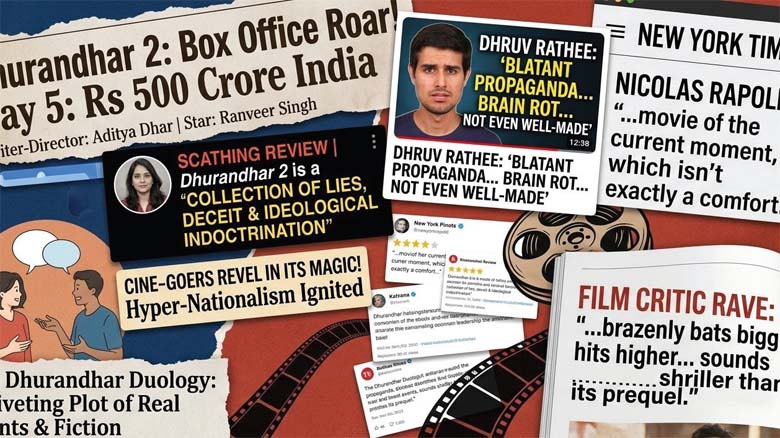
It is no surprise therefore that the film has ignited hyper nationalism amongst a sizeable percentage of movie goers in the country. The audience is vehemently questioning the stance of the neighbouring country, which indeed has been the epicentre of anti-India activities, since several decades. Social media is flooded with reels and videos of audiences exiting film theatres, shouting slogans of Bharat Mata Ki Jai and Vande Mataram! Interviews of young audience members who have felt provoked on hearing dialogues, such as one wherein a plane hijacker calls Hindus a cowardly race, dot search engines and YouTube videos intermittently.
Journalist and author, Arfa Khanum, has gone on record and in a scathing review, has called Dhurandhar 2 a “collection of lies, deceit & ideological indoctrination…’ Influencer Dhruv Rathee shared on YouTube that the film is ‘blatant propaganda,’ ‘brain rot,’ and ‘is not even well-made propaganda anymore…’ Nicolas Rapold of the New York Times wrote, “ it’s a movie of the current moment, which isn’t exactly a comfort…” and Sarah Manveh in her review on Movies We Texted About writes, “…the gore is so serious that the use of Rasputin by Boney M in one frankly racist sequence is not actually funny. The entire experience is sociopathic…”
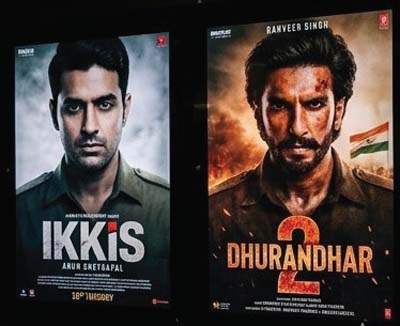 While audiences and critics stand on two sides of the spectrum on the Dhurandhar debate, Aditya Dhar’s duology has also divided Bollywood and filmmakers in their approach towards story telling. Just twenty-five days after the release of Dhurandhar 1, which met with stupendous success, Sriram Raghavan’s war film Ikkis was released on 1st Jan’2026. Based on the life of the 21-year-old Param Veer Chakra awardee, Second Lieutenant Arun Khetrapal, portrayed the bravery and supreme sacrifice of the young soldier in the 1971 war. A poignant tale of a 21-year old soldier who bravely fought against Pakistan in 1971 and refused to abandon his tank despite the orders of his senior commanding officer because his gun still had ammunition in it. Arun kept firing, destroying seven enemy tanks before his tank was hit which led to his death in battle.
The story is told through Brigadier ML Khetrapal’s (Arun Khterapal’s) father’s narration wherein he recalls his visit to Pakistan, wherein he is hosted by Brigadier Khwaja Mohammad Nisar in 2001, 30 years after his son’s death at a college reunion. During his visit to Pakistan, Nisar confesses to Brigadier ML Khetrapal that it was his strike that killed his son, and finally acknowledges that it was Arun who was ‘singularly responsible’ for Pakistan’s defeat. The film portrays a humane side of the Pakistani Brigadier, respect between the two men from either side of the border and presents their humanity rather than just conflict.
But the makers of the film sniffed out the mood the nation after Dhurandhar 1’s success. Realising that a film with an anti-war stance, and one that portrays a Pakistani soldier as a sensitive, humane character may not go down well with the current temperament of the audience, the makers decided to add a disclaimer in the film which stated:
‘the humane treatment of Pakistani Brigadier K.M. Nisar is an exceptional case. Otherwise, our neighbouring country is not at all trustworthy. Pakistan’s armies, both during war and in times of peace, have behaved very cruelly and inhumanely with our soldiers and citizens. In torturing them, they have repeatedly and openly violated the Geneva Convention. Given the terrorist activities sponsored by Pakistan, we as concerned citizens need to remain vigilant and prepared.”
The disclaimer however did little for the film at the box office. The film tanked at the ticket counter. Despite being lauded by critics for being an atypical war film- one which sensitizes the audience to the horrors of war and shows the humane sides of soldiers on either side of the border- Ikkis cut no ice with the audience that was riding on the Dhurandhar wave.
Ever since, production houses and studios in Bollywood have been cautious with approving scripts for both OTT and theatrical releases. They have set the Dhurandhar duology as the benchmark in assessing what the audience wants and what kind of stories should be told. The reservation on going ahead with rom coms, light hearted drama, slapstick comedy or even thrillers seem to be justified. The first quarter of 2026 has seen Dhurandhar 2 as the biggest blockbuster. The only other film that has hit the jackpot so far has been Border 2 – another war film set against the 1971 war, only this time a hard-hitting take on India-Pakistan tensions. The film shows Colonel Fateh Sing Kaler mobilising his battalion against the Pakistani regiment- complete with night raids, ambushes and sabotage missions. The film showcases war tactics presumably taken up by India against the Pakistanis in the 1971 war which led to India’s victory against a formidable enemy.
In contrast stands Bejoy Nambiar’s Tu Ya Main! Starring Adarsh Gautam and Shanaya Kapoor, the film is an official remake of the Thai movie The Pool. The story revolves around two social media stars who get trapped in a swimming pool and have to save themselves from a deadly crocodile.
The survival thriller once again met with rave reviews and encouraging words from critics and a section of audiences. But despite its unique genre, stylised storytelling, riveting music and spine chilling thrills, Tu Ya Main failed to make a mark at the box office.
Vishal Bharadwaj’s mega starrer O’Romeo, based on the book Mafia Queens of Mumbai by S Husaain Zaidi, tells the complex tale Ustara and Afshan Qureshi, set against the underbelly of Mumbai. The film met with mixed reviews and despite grossing over Rs 100 crore, is yet to recover its budget cost of Rs 130 crore.
Other major releases like Mardaani 3 starring Rani Mukerji, Assi starring Tapsee Pannu, Rahu Ketu and Do Deewane Seher Mein too have done average to low business at the box office. In times like these, it thus is not surprising that producers and studios are opting for more ‘right’ kind of stories, pun intended!
But Indian audiences are more dynamic and unpredictable than what they are made out to be. What will attract them to the theatres again- is anyone’s guess. A well-told romance (Saiyaara’s success took the entire industry by surprise last year) or the star powered KING starring none other than Shah Rukh Khan… the mafia story of MIRZAPUR coming up in September or Priyadarshan’s comedy drama BHOOTH BANGLA!
At the end, film producers and studios may take a leaf out of celebrated author Shobha De’s book as they commission new projects! De emphasised:
“why cant you just watch a movie for what it is, a movie? She defended her right to enjoy the film without political labelling, calling for focusing on craft, action and storytelling over ideological agendas.”
Rather than chasing any formula or trying to predict the pulse of the people, studios might do well by just telling stories from different genres, differently and well! All the films that have tanked this year, didn’t quite catch the fancy of the audience perhaps for want of a better story, better script and better presentations. In an industry, as whimsical as Bollywood- the best any film maker can do, is tell a good story as best as she can to the audiences. That perhaps is the only way to offset the Dhurandhar frenzy rather than find stories and ways to capitalise on the mood it has set across the nation!
ABOUT THE AUTHOR
 Ankita Kumar is Delhi based free lance writer. She comes from Bihar and remains in close touch with ground realities in the state.