
In the 1947 partition of the British India, humanity collapsed and the politics of religion succeeded in drawing the border lines – mostly with blood. Compassion was buried under political stages when the Muslim League managed to create Pakistan for their political master Mohammed Ali Jinnah, who saw politics from the prism of religion and his own hunger for power. To create a Pakistan seemed well within the British and Western interests, whereby they were able to maintain their domination through the Pakistani Army, while keeping the Soviets away from accessing the warm waters through Afghanistan or Indus. Partition would also mean dividing a professional British Indian Army, who won for them the Second World War; divide It and then allow them to be consumed in mutual conflicts. Or else, left alone as one, they would make the new Independent India a military super power, and thus, could not be left united.
The partition of British India into India and Pakistan was announced on 3 June 1947 in New Delhi and London, following the Mountbatten Plan, which was approved by Prime Minister Clement Attlee and accepted by Nehru, Jinnah, and Patel. This left only nine weeks for millions of people to choose their new country of residence. It took another five months for Mountbatten plan to be approved. This led to the Indian Independence Act (not partition Act) on 15 July 1947 which meant that the country would be partitioned in one month’s time, creating Pakistan on 14 August and India on 15 August 1947. As leaders on both sides were rejoicing over their victory of having won independence, they completely and criminally forgot and overlooked the fate of 14–16 million people who were to migrate across borders; those same borders that they had agreed to create.
The peoples of Punjab and Bengal were left to fend for themselves, where an estimated over one million succumbed to senseless violence while scrambling to find a shelter in the new nation they were forced to choose. Families were separated, properties lost, while the trauma continued for decades even after partition. Migration was more sudden and violent in the west as compared to the east. In the partition of West Pakistan, over six million Muslims moved from India to West Pakistan, while four to five million Hindus and Sikhs moved from West Pakistan to India. Similarly, in the creation of East Pakistan (now Bangladesh) around two to three million people were displaced.
On transfer of power by the British, paramountcy was retroceded from the King Emperor to the 565 rulers, who had never exercised any authority in respect of external affairs, defence and communications. With paramountcy lapsing, each of the 565 rulers were expected to accede to either of the two dominions (India or Pakistan) according to their choice, not on the basis of the religious beliefs of the people; however, the people of Punjab and Bengal were divided on religion.
 By 15 August 1947, the instrument of Accession to India was signed by all rulers except Jammu &Kashmir, Junagadh and Hyderabad. The states of Junagadh and Hyderabad were asked to accede to India on the basis of contiguity of geography. J&K was to be handed over by the British to Maharaja Hari Singh who was to decide its future. The British miscarried the handing over the territories of Gilgit – Baltistan (GB), instead, they staged a coup through Major William Brown of Gilgit Scouts to disable the Maharaja from establishing his control. It therefore was clear that the British in an oblique yet direct manner allowed the territory of GB to be passed into the hands of Pakistan.
Soon after partition, in October 1947 the rest of the state of Jammu and Kashmir was attacked by Pakistan led Kabaili raiders, who were mostly tribal from Afghanistan. This plan was made clandestinely by Pakistan, with the tacit understanding of their British collaborators, who supposedly kept this secret even from the British High Command in Delhi. The larger part of GB was already occupied by Pakistan, even when the raiders advanced to capture rest of state. The Indian Army could legally defend the state only when the letter of accession was signed, on 26 October 47 by the Maharaja. The Indian Army took over a year in repelling attacks and reclaiming the lost territory. As the Indian Army was pushing back the attackers, the Indian troops were halted in the winters of 1948 from reclaiming rest of the lost territories due to complexity of higher decisions, resulting in accepting a Ceasefire line (CFL) based on which the Karachi agreement was signed in 1949, leaving large areas as Pakistan Occupied Kashmir (POK). Many wars were fought, yet the Indian forces were prevented from reclaiming the Pakistan Occupied territories. This was further reinforced by the Shimla Agreement 1972 that converted the CFL into the Line of Control (LoC). In the 1999 Kargil Conflict, this line (LoC) once again, bound by the Shimla Agreement, prevented our troops from capturing the Pakistan occupied Kashmir.
On the eastern part of J&K i.e., the Ladakh region, the story is a bit different where a number of boundary lines with Tibet were contemplated by the British during their rule. Historically, the British considered the Sino-Sikh and Tibetan treaties, however they started marking boundary lines in 1865 starting with the Johnson Line and thereafter, six such lines were drawn in succession till 1947 – when they left the boundary un-demarcated. The map was reflected by a yellow color-wash, leaving an ambiguous boundary. The Survey of India marked a line in 1954, based on the ownership of J&K state that gave us claims over the Aksai Chin. It went un-noticed that the Chinese had built a road linking Xinjiang to Tibet which they announced in 1957. India took a note of it only a year later that resulted in the bloody conflict of 1962. During the war, the Chinese PLA attacked and captured large areas in Ladakh and in NEFA (now Arunachal). After declaring victory on India, the PLA returned to their bases probably owing to the harsh winters, extended logistics and other extraneous reasons.
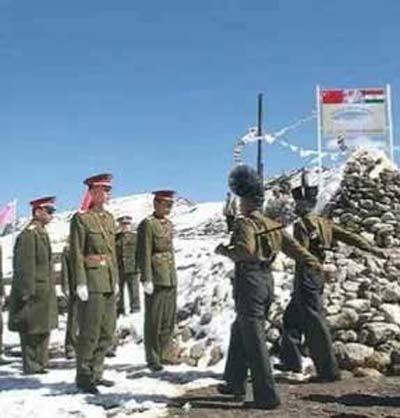
24 years later, in 1986, the Chinese came back and captured areas in Somdrong Chu (Northeast of Tawang), establishing that all of McMahon Line was disputed and then laying claim to 90,000 sq km (entire state Arunachal Pradesh). So far, 24 boundary talks by the Special Representatives of two countries have failed to reach any resolution. A question of swap deal between Aksai Chin and Arunachal was also thought over but it is unlikely to have been put on the table formally. Meanwhile, the Chinese continue the salami slicing that was witnessed in 2013 at Depsang, 2014 at Chumar, 2017 at Doklam (Sikkim) and in 2020 at Galwan.
After nearly 80 years of India’s independence, the scars of partition remain open, with Pakistan running a full-fledged Proxy war with the ‘thousand cut’ strategy. This is now concerting with the ‘salami slicing’ strategy of China. This combined threat is spiked with tearing down treaties, presenting narratives that project a collusive ambition on territory through terrorism and technology. To complicate matters further, the geopolitical churn surprisingly has made the US led West, again choosing Pakistan over India to be their ally – probably to ensure Pakistan does not yield space to China, spinning a new great game.
Bangladesh, a creation of India has re-emerged as another frontier in the East. Supported by Pakistan on religious grounds, who wants to turn the tables on India in avenging its defeat of the 1971 War. This circles history back to having a return of another East Pakistan, but under a different name, one that is bitter than before. This is a region again where China, and probably the US, co-exist to the detriment of India. Any development in Northern Bangladesh around the Rangpur region near Dinajpur, where the Chinese are building infrastructure, directly impacts India’s security, due to the vital Siliguri corridor. The chaos In Bangladesh, with its anti-India political parties in fiery campaigns, make that country a rapidly emerging flash point. Sharing of waters, and border disputes have been leveraged by the opposition. In a coup by the youth through proxy, they have overthrown Sheikh Hasina who has taken a hurried refuge in India which in itself also builds this alarming anti-India case.
Today, India suffers from multi-faceted challenges. The often-announced intention of reclaiming POK, claims on Aksai Chin and holding in abeyance the Indus Water Treaty, are a bundle of issues to deal with. Nepal boundary claims inside India in Kalapani-Lipulekh area, the Chinese strengthening their military presence in Chumbi Valley, and Bangladesh’s growing animosity with India make threats to India more than just binary.
The ongoing Operation Sindoor where India-Pakistan clashed on May 2025, has adequate evidence of Chinese support. Now, Pakistan is even more emboldened with US support. This is no easy situation, nearly 80 years after independence. India is certainly facing a ‘New Normal’ and must inevitably be ready to face more surprises. As of now, we will have to watch and wait, where “readiness” is all.
ABOUT THE AUTHOR
 Lt Gen PJS Pannu, PVSM, AVSM, VSM (Retd) was the former Deputy Chief Indian Integrated Defence Staff (Operations). He was responsible for raising the Defence Space and Cyber Agencies, as well as the Special Forces Division. He was head of Training of the three services in 2017, where he was responsible for writing Doctrines, making Net assessments and overseeing Premier Defence Institutions. He was the Chairman of the Executive Committee of CENJOWS and USI, premier Defence Think Tanks.