

Some men retire from service. Others simply find a new mission. Some coursemates remain etched in our memory for their sporting prowess, some for their academic brilliance, and a rare few for a quality that becomes apparent only with time: the ability to keep moving towards an objective long after others have stopped looking for one.
CV Prakash belongs to that rare category. To the world, he is Lieutenant Commander CV Prakash (Veteran), the man behind CV Hydro and its work in soilless cultivation. To those of us who knew him at the National Defence Academy, he was simply CV, a fellow cadet whose journey would eventually take him from the depths of the ocean to the cultivation of turmeric without soil.
His story is not about a naval officer who retired and took up gardening. It is about a man who refused to let retirement define his possibilities. He spent years mastering the demanding world of submarines and anti-submarine warfare. He then carried the same discipline, patience and precision into agriculture, eventually devoting himself to a crop that holds an important place in India’s kitchens, culture and export economy.
The uniform changed. The mission did not.
Bijapur to NDA
In July 1972, a nine-year-old boy entered Sainik School, Bijapur. When he left in December 1979, he carried away more than a school certificate. He had acquired the habits of discipline, perseverance and self-reliance that would shape the rest of his life.
In 1980, CV moved to the National Defence Academy at Khadakwasla, where the process of turning a schoolboy into an officer continued. The NDA has a way of bringing young men from different backgrounds onto common ground. Cross-country runs, drill, swimming, riding, academics and the relentless demands of training test both physical endurance and mental resilience. Friendships formed in those years often survive because they are built on shared hardship rather than convenience.
CV eventually chose the Indian Navy, an interesting decision for a boy who had grown up far from the coast. While many of us went on to serve in the Army, he chose a life in which the most demanding work could take place far beneath the sea, beyond the reach of daylight.
Fourteen Years Beneath the Sea
Submarine service demands a particular kind of temperament. Confined spaces, limited contact with the outside world and the constant need for vigilance leave little room for carelessness. Every reading matters, every procedure has a purpose, and the safety of the entire crew depends on each individual doing his job correctly. CV served in the Executive Branch and specialised in anti-submarine warfare. His professional world required patience, precision and the ability to interpret incomplete information. A faint signal could be significant. A wrong assumption could be costly. The task was to observe, analyse and act only when the picture was sufficiently clear.
In 1997, he left the Navy as a Lieutenant Commander, choosing an early exit from service rather than continuing towards the retFor someone who had built his professional identity around a demanding technical discipline, this was a major turning point. But CV was not looking for a quiet life. He was looking for another challenge. Perhaps the most revealing part of his later journey is how much of the submariner remained unchanged. The equipment was different, the environment was different, and the stakes were different, but the underlying approach was familiar: measure carefully, record accurately, follow procedures and never leave a critical variable to guesswork.
From the Ocean to Soilless Agriculture
CV encountered hydroponics and soilless cultivation in Australia and learnt the technology through practical work. The basic idea is deceptively simple: plants can grow without conventional soil if their roots receive the right support, water, nutrients and environmental conditions. Mastering the science, however, is anything but simple. The grower must understand the plant’s needs at different stages, maintain the right nutrient balance, manage the root environment and monitor conditions consistently. What appears to be a clean and modern growing system is, in reality, a demanding exercise in observation and control.
CV brought this knowledge to India and began developing practical applications. Through the Pet Bharo Project, he worked on hydroponic cultivation, including a garden at an orphanage in Bengaluru in 2009. His subsequent work included controlled-environment strawberry cultivation, a hydroponic garden in a multispecialty hospital, soilless ginger cultivation and the establishment of training and demonstration facilities.
Over time, his work evolved into CV Hydro, associated with Aggragannya Skills Private Limited. He also invested heavily in training, helping thousands of people understand how soilless cultivation could be translated from technical knowledge into practical farming. He calls those trained in his programmes AgriVeers — agricultural warriors. The expression is revealing. CV sees agriculture not merely as an occupation but as a field in which trained, disciplined and enterprising people can contribute to national prosperity.
Yet the most ambitious chapter of his agricultural journey was still to come.
Mission Haldrak: The Golden Challenge
The COVID-19 lockdown in 2020 disrupted training activities and sent trainees home. For many, the interruption would have meant waiting for normality to return. CV chose to use the time differently. He began focused research into growing turmeric through soilless technology.
Why turmeric? Because a crop of immense cultural and commercial importance presented a problem worth solving. India is a major producer of turmeric, a spice that finds its way into our food, traditional practices and countless household remedies. Yet quality assurance remains important, particularly when the produce is destined for demanding domestic and international markets. Contamination, pesticide residues and inconsistent quality can undermine confidence in a product even when its origins are associated with a long agricultural tradition. Turmeric grows underground, and the quality of the growing environment matters. Soil may contain contaminants that can affect the crop. The challenge, therefore, was not simply to produce more turmeric but to develop a method that offered greater control over the growing environment and a more consistent, verifiable product.
CV approached the problem with the mindset of a naval specialist. Instead of concentrating only on detecting a problem after it had occurred, he looked for a way to reduce the possibility of that problem arising in the first place. His answer was to take conventional soil out of the equation.
Under Mission Turmeric, launched in January 2021, his team developed the work that became known as Mission Haldrak. The research programme brought together trials, measurements, cultivation protocols and quality assessment, with the objective of developing a commercially viable model for soilless turmeric production. Early trials reported encouraging results. One recorded experiment produced 8.17 kilograms of rhizomes from 120 grams of seed rhizome. The team also reported promising curcumin results in the Salem variety. These figures were important milestones in the research, although trial results must always be distinguished from independently verified, repeatable commercial performance.
That distinction is central to CV’s approach. A promising experiment is a beginning, not the end of the mission.
A Farm Run Like a System
At the Karamadai Soilless Training and Research Centre near Coimbatore, the research moved from an idea towards a working cultivation model.
Turmeric is planted in grow bags containing prepared cocopeat, a growing medium derived from coconut husk. Water and nutrients are supplied through drip fertigation, allowing the growing solution to be adjusted to the crop’s requirements. The grower monitors variables such as pH, electrical conductivity, temperature and humidity, while maintaining records throughout the crop cycle.
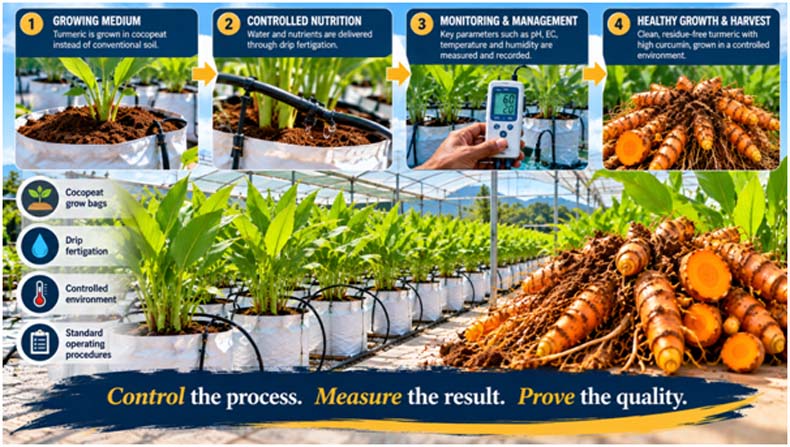
To the uninitiated, these may sound like technical details. In practice, they are the difference between a method that can be repeated and one that depends on luck. A crop cannot be managed properly if its inputs are unknown, its conditions are unrecorded and its problems are discovered too late.
CV’s team has developed written operating procedures for different stages of cultivation. Pest and disease management is integrated into the process rather than treated simply as a routine of chemical spraying. The aim is to make production more predictable and quality easier to control. This is where his naval background becomes especially relevant. A submarine operates through systems, procedures, checks and constant monitoring. Soilless cultivation, when properly managed, also depends on the interaction of many variables. In both environments, discipline is not an administrative burden; it is a safeguard against avoidable failure.
The reported yields have attracted interest from commercial growers. CV Hydro has also reported curcumin levels of approximately 4.30 per cent in its soilless turmeric, with a minimum target of 4 per cent under its own standard. Such figures need to be assessed against comparable varieties, growing conditions and laboratory results. Nevertheless, the effort to combine yield with measurable quality is an important part of the larger proposition.
The objective is not merely to grow turmeric without soil. It is to develop turmeric that can command greater confidence and potentially better value because its quality is demonstrable.
From Research to the Farmer
Research has limited value if it remains confined to a laboratory or demonstration farm. Its real test begins when another grower can understand the method, reproduce it and earn a livelihood from it.
CV appears to understand this distinction well. He has worked to convert his experience into a growers’ handbook, practical training programmes and standard operating procedures. His emphasis is on hands-on learning rather than theory alone. As he puts it, “Know-how is of no use unless we Do-How and Show-how.”
That philosophy is worth remembering. Agriculture has no shortage of advice. What farmers need are methods that work under actual field conditions, an honest assessment of investment and risk, access to reliable buyers, and the confidence that quality will be recognised and rewarded. The commercial model being developed around soilless turmeric seeks to address some of these concerns. Growers are expected to follow a common cultivation standard, while laboratory testing provides an independent check on quality. The proposed arrangements also include a payment mechanism designed to protect transactions between buyers and growers.
These are important principles, but their success will depend on implementation. Farmers will need transparent cost calculations, realistic estimates of returns, dependable market demand and support when crops do not perform as expected. Soilless cultivation should be presented as a specialised farming option with its own investment and management requirements, not as a universal substitute for conventional agriculture.
If the model proves commercially sustainable, it could create opportunities for trained growers, agricultural entrepreneurs and buyers seeking consistent, traceable produce.
SPICE100: Building Beyond One Farm
A successful research centre can demonstrate what is possible. Transforming an industry requires something larger: a network of people working to common standards.
That is the ambition behind SPICE100, the Strategic Portal for Indian Cultivators and Entrepreneurs. The initiative seeks to bring growers, investors, buyers, suppliers and other partners together around standardised, quality-focused soilless turmeric production. Its stated initial objective is to reach 100 growers across 100 acres during the 2027–28 season.
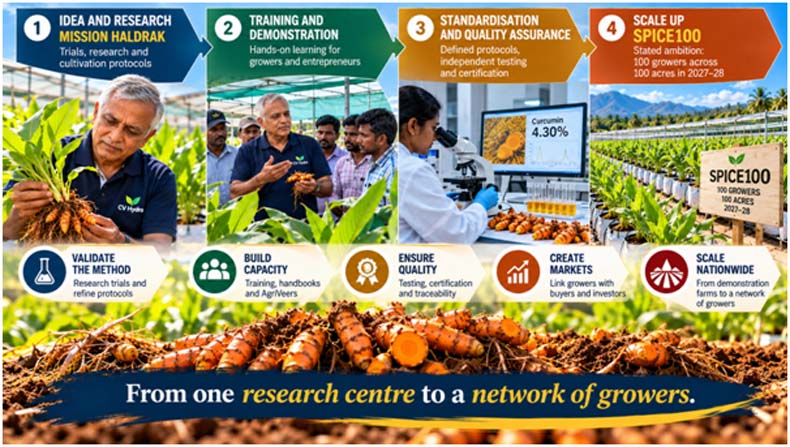
The model rests on a few essential ideas. Farms should follow defined cultivation protocols, product quality should be verified independently, and buyers and growers should have transparent commercial arrangements. CV Hydro’s intended role is to provide standards, training and certification while enabling participants to source suitable equipment from different vendors.
The larger ambition is to build a chain in which quality is not merely claimed but demonstrated, and in which the farmer’s effort translates into a credible commercial product. Scaling up will bring its own challenges. A process that succeeds on a carefully managed research farm must also perform across different growers, locations and operating conditions. Independent verification, sound economics and market acceptance will ultimately determine whether the model can grow beyond its early adopters.
CV’s next phase includes further research, collaboration with plant-breeding and genetics specialists, and the expansion of commercial cultivation. His work has also begun to reach scientific forums, giving him an opportunity to place his findings before a wider professional audience.
The ambition is considerable. So is the work that remains.
The Mission Continues
When I think of CV Prakash, I see more than a naval veteran, an agricultural technologist or an entrepreneur. I see a man who has been willing to begin again, learn a new discipline and remain a student long after acquiring expertise in his first profession.
The journey from Bijapur to Khadakwasla, from the depths of the sea to the growing bags of Karamadai, is not simply a story of career change. It is a story of continuity: discipline carried into a new environment, experience converted into practical knowledge, and personal ambition directed towards a larger contribution.
When asked about his purpose in life, CV offers a single word: “Contribution.” It is an uncomplicated answer, but it carries the weight of a lifetime. He served in a profession where much of the work was unseen. He has now chosen a field where success must be demonstrated through healthier growing systems, reliable data, trained people and commercially viable outcomes.
The ultimate measure of Mission Haldrak will not be the number of experiments completed or the acres brought under cultivation. It will be the confidence it earns, the livelihoods it sustains and the value it creates for Indian agriculture.
For an old coursemate, there is something deeply satisfying about watching a fellow cadet discover a new mission and pursue it with the same determination that marked his early years. The periscope is up, CV. The sea is behind you, the soil is no longer essential, and the horizon remains wide open.
Some men spend a lifetime guarding the nation. A few find new ways to serve it.
ABOUT THE AUTHOR
Lt Gen Rajeev Chaudhry (Retd) is a social observer and writes on contemporary national and international issues, strategic implications of infrastructure development towards national power, geo-moral dimension of international relations and leadership nuances in changing social construct.