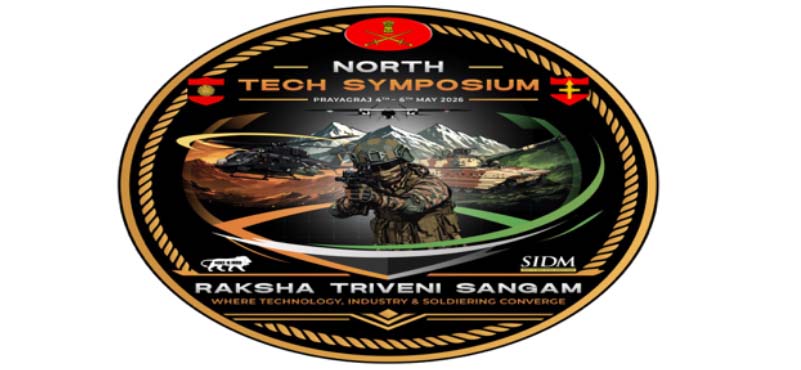
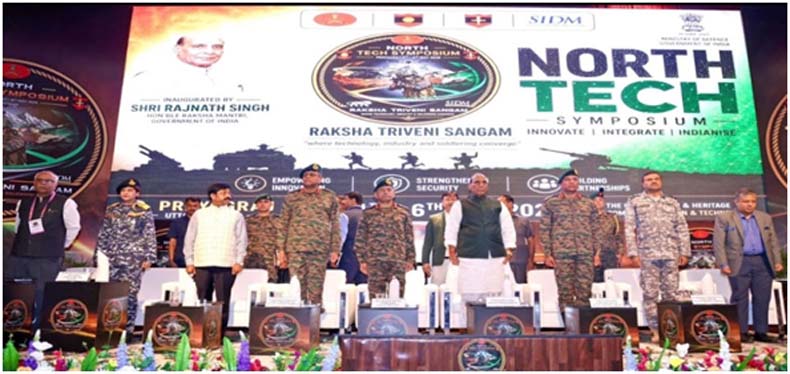
The modernisation of the Indian military has often been measured by the number of platforms inducted, squadrons raised, and budgets announced. Prayagraj presented a markedly different picture. North Tech Symposium 2026, held from 4 to 6 May, was less an exhibition of hardware and more a glimpse into how India increasingly views the future of warfare.
The venue’s symbolism mattered. Held at the confluence of the Ganga, Yamuna and the mythical Saraswati, the symposium carried the theme “Raksha Triveni Sangam: Where Technology, Industry and Soldiering Converge”. The phrase was not mere ceremonial branding. It reflected a deeper change gradually taking shape in India’s defence thinking. Larger formations and heavier firepower alone may no longer guarantee battlefield dominance. Future conflict will increasingly favour the military that can integrate technology, industrial strength and operational adaptability more quickly than its adversary.
That reality shaped the mood in Prayagraj.
Organised jointly by the Northern and Central Commands of the Indian Army, in partnership with the Society of Indian Defence Manufacturers, the event brought together more than 280 companies, start-ups, MSMEs, academia, operational users, and defence manufacturers. The scale of participation reflected a changing ecosystem. A decade ago, Indian defence exhibitions were dominated by foreign vendors selling equipment to a procurement-oriented military structure. Prayagraj looked noticeably different. The energy came from domestic innovation.
The displays and discussions centred on autonomous systems, battlefield AI, drone swarms, robotics, electronic warfare suites, loitering munitions, advanced surveillance systems, and next-generation communication networks. Yet the symposium’s deeper significance lay not in the demonstrations themselves, but in the institutional intent behind them.
India’s military leadership increasingly recognises that future wars will unfold quickly, span wider operational spaces, and blur the line between physical and digital battlefields. The battlefield itself is becoming more transparent. Satellites, drones, sensors and real-time data flows are steadily reducing the scope for concealment. Under such conditions, military advantage may depend less on numbers alone and more on who can innovate and adapt faster and generate operational surprise despite persistent surveillance.
Defence Minister Rajnath Singh captured this shift in direct and unambiguous terms. His observation that “there is no substitute for research” carried significance well beyond a routine policy statement. His emphasis that future wars are increasingly shaped in laboratories and research centres reflected a recognition that military strength today rests as much on scientific depth as on conventional force structure.
His references to artificial intelligence, quantum systems, hypersonic technologies and autonomous warfare platforms were important not because these are fashionable strategic terms, but because they mark the next major competition space among leading military powers. The global military balance is increasingly shaped by nations capable of shortening the cycle from innovation and experimentation to battlefield deployment.
Equally significant was his focus on surprise. For decades, Indian military thinking remained heavily influenced by attrition-based conventional conflict. The underlying assumption was that wars would be decided by force concentration and sustained operational endurance. That paradigm is steadily changing. In modern warfare, surprise increasingly stems from technological asymmetry and operational unpredictability rather than from concealment alone.
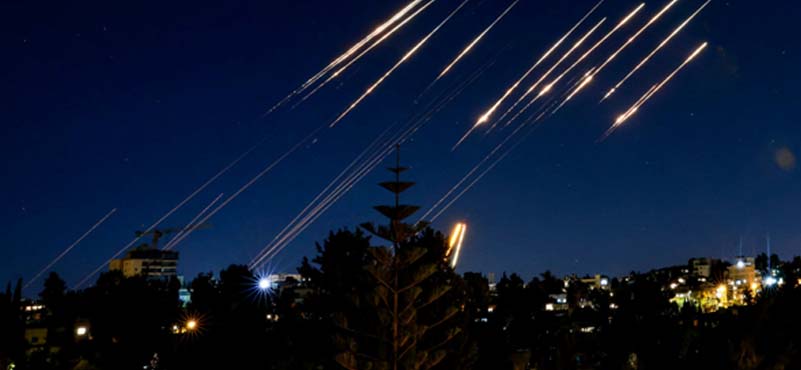
Conflicts in Ukraine, West Asia and the Red Sea region have already shown how low-cost drones, precision systems and electronic warfare capabilities can impose disproportionate operational costs on far larger military formations. Militaries that fail to innovate rapidly risk losing strategic relevance, regardless of numerical strength.
Prayagraj reflected an Indian military establishment’s attempt to absorb those lessons.
General Upendra Dwivedi, the COAS, reinforced through his interactions with industry and academia that the Army’s modernisation effort is no longer confined to replacing ageing platforms. The focus is shifting towards building integrated combat ecosystems. This distinction is critical.
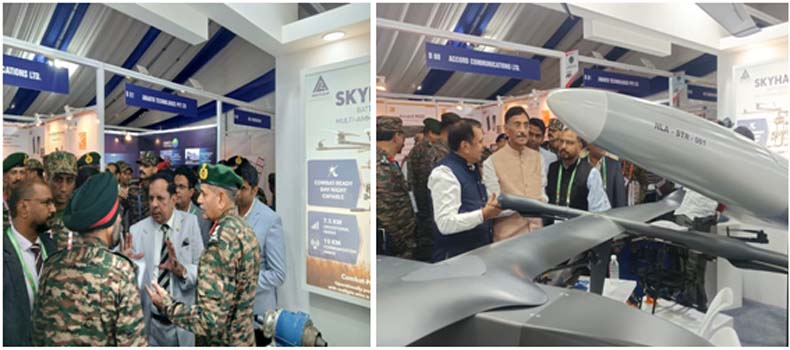
A modern tank, for instance, can no longer be merely an armoured platform focused on firepower and mobility. It must evolve into a node in a larger battlefield network, capable of sharing data, operating alongside drones, surviving electronic attack, and contributing to multidomain operations. The same logic now applies to artillery, infantry combat vehicles, air defence systems, and logistics chains.
The future battlefield will reward integration over isolation and reactive innovation over proactive transformation.
That may ultimately be the symposium’s most important takeaway. India’s defence modernisation is gradually shifting from fragmented procurement to integrated capability development. This transformation is far more complex than merely buying advanced equipment. It demands doctrinal reform, technological integration, institutional flexibility and sustained collaboration among the armed forces, industry and research institutions.
The symposium also highlighted how seriously India is now pursuing defence self-reliance.
For years, “self-reliance” in defence remained caught between slogans and import-substitution targets. The broader ecosystem required for indigenous innovation remained weak. Research cycles were slow, private-sector participation was limited, and institutional collaboration was fragmented.
That landscape has begun to change. India’s defence exports offer perhaps the clearest indicator of this transition. Over a little more than a decade, exports have risen from ₹686 crore in 2013-14 to over ₹21,000 crore in 2023-24. India now exports defence equipment to more than 85 countries. More importantly, the export basket itself has evolved.
India is no longer exporting only components, protective equipment, or low-end systems. It is now supplying strategic platforms such as the BrahMos supersonic cruise missile and the Pinaka multi-barrel rocket launcher system. Countries such as the Philippines and Armenia increasingly view India not merely as a buyer in the global arms market but as a credible defence partner.
This shift carries geopolitical consequences.
Defence exports are never purely commercial transactions. They create strategic relationships, long-term maintenance dependencies, training linkages and political influence. Nations that purchase military systems also become part of supply chains, technical ecosystems and strategic partnerships.
India’s expanding defence footprint, therefore, represents more than industrial success. It reflects a growing effort to build strategic influence through defence diplomacy.
Much of this growth has been driven by structural reforms. Positive indigenisation lists have accelerated domestic manufacturing. Export clearances have become faster. Private-sector participation has expanded steadily. MSMEs and start-ups are now gradually becoming part of the defence production ecosystem.
Yet important vulnerabilities remain beneath the optimism.
India still faces persistent gaps in deep research ecosystems, indigenous semiconductor capabilities, advanced propulsion technologies and sustained innovation funding. The gap between successful prototype demonstration and large-scale military induction also remains substantial.
This is where the real challenge lies.
Building a globally competitive defence-industrial ecosystem requires more than isolated success stories. It demands long-term investment in research institutions, stable procurement pipelines, realistic testing environments, and an innovation culture that tolerates experimentation and failure.
Speed will matter equally.
Military technology cycles are shortening rapidly. Systems can become operationally outdated within years rather than decades. Procurement structures designed for slower industrial eras are increasingly incompatible with the tempo of modern warfare.
The message emerging from Prayagraj appeared to recognise this reality. The emphasis was not merely on producing indigenous systems but on accelerating adaptation.
That may ultimately prove to be the symposium’s most significant contribution.
North Tech Symposium 2026 was therefore far more than a defence conference. It was a visible marker of India’s evolving military mindset, one that increasingly recognises that future wars will be shaped by technological convergence, the tempo of innovation and integrated national capability.
The timing was equally symbolic. Organised close to the first anniversary of Operation Parakram, the symposium projected an Indian military seeking not merely to sustain deterrence but to redefine it. Conventional deterrence today is no longer measured solely by troop numbers or armour inventories. It increasingly rests on information dominance, compressed decision cycles, and the ability to impose technological costs on an adversary.
The overarching message emerging from Prayagraj was unmistakable. India’s defence ecosystem is shifting from dependence to design leadership, from siloed modernisation to integrated capability building, and from reactive adaptation to anticipatory transformation.
Whether this momentum can be sustained will depend on political continuity, military impetus, institutional reform, research investment and industrial execution. Yet the direction today appears clearer than at any time in recent decades.
Prayagraj may ultimately be remembered less as a symposium and more as a moment when India began aligning military power, technological ambition and industrial capability into a single strategic vision.
ABOUT THE AUTHOR
 Lieutenant General A B Shivane, is the former Strike Corps Commander and Director General of Mechanised Forces. As a scholar warrior, he has authored over 200 publications on national security and matters defence, besides four books and is an internationally renowned keynote speaker. The General was a Consultant to the Ministry of Defence (Ordnance Factory Board) post-superannuation. He was the Distinguished Fellow and held COAS Chair of Excellence at the Centre for Land Warfare Studies 2021 2022. He is also the Senior Advisor Board Member to several organisations and Think Tanks.