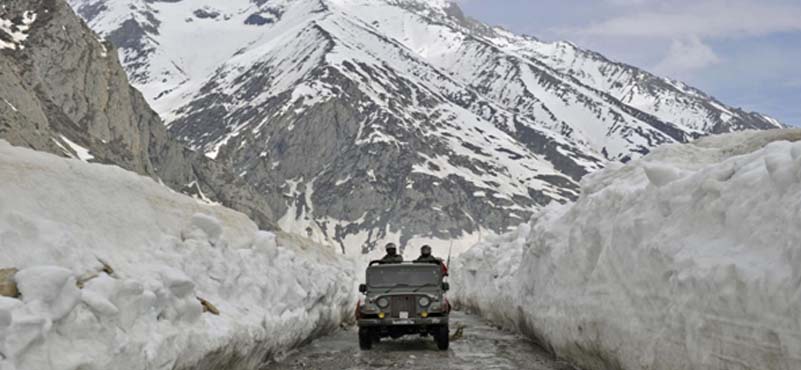
Receiving 50-80 feet of snowfall annually and enduring temperatures to -45 degree Celcius, Zojila is not merely a mountain pass but the strategic and socio-economic lifeline sustaining Ladakh’s connectivity, military readiness, and civilian resilience.
Zojila as a Strategic Artery, Not a Mountain Pass
At 11,575 feet, Zoji La is not merely a high-altitude road corridor; it is a strategic artery linking the Kashmir Valley to Ladakh. Its operational status directly influences military logistics, civilian sustenance, and economic continuity in one of India’s most sensitive frontier regions.
For decades, the pass remained closed for 160 to 180 days annually, severing surface connectivity through winter. This extended closure imposed a structural limitation: dependence on expensive and weather-sensitive air maintenance, delayed troop movement, and constrained supply chains. The implications were not episodic but systemic. Every additional day of closure widened the gap between requirement and response — operationally, economically, and psychologically.
Zojila, therefore, has never been just an engineering challenge. It is a test of India’s ability to sustain presence and mobility in high-altitude terrain under adverse conditions.
The question was not whether the pass could be reopened each year. The question was whether its closure could be progressively denied.
Post-Galwan Shift: When Infrastructure Became Strategy
The aftermath of the Galwan Valley clash marked a decisive recalibration in India’s approach to border infrastructure. The realities of high-altitude confrontation underscored a fundamental truth: logistics timelines are as critical as troop strength. Seasonal closure of Zojila was no longer a benign constraint. It represented a vulnerability — one that compressed operational flexibility and extended response timelines in a sensitive theatre.
A strategic decision emerged in 2020–21: Zojila would be kept open for the maximum possible duration. This was not an incremental administrative adjustment. It was a doctrinal shift from seasonal acceptance to operational persistence. The focus moved from reopening after winter to minimising closure during winter.
This shift required:
- Pre-emptive planning rather than reactive clearance.
- Continuous monitoring of terrain and weather patterns.
- Higher operational tempo under risk-prone conditions.
- Integration of technology to support precision and speed.
In essence, infrastructure transitioned from a support function to an active instrument of strategic posture.
Zojila was no longer a pass that reopened every year. It became a corridor that had to be kept alive as long as possible.
From 180 to 30 Days: The Measured Transformation
The success of this strategic shift is best understood through measurable outcomes — specifically, the steady reduction in winter closure days.
- Earlier Years: 160–180 days.
- 2020–21: 117 days.
- 2021–22: 72 days.
- 2022–23: 70 days.
- 2023–24: 30 days.
- 2024–25: 33 days.
- 2025-26: 29 days (cumulative closure time).
This trajectory reflects a systematic compression of winter downtime. The reduction is not linear, nor is it incidental. Each phase represents an improvement in planning cycles, execution speed, and operational coordination.
The sharp drop from over 100 days to nearly a month within a span of four years indicates that Zojila has transitioned from a seasonally constrained route to a near all-weather operational corridor. Importantly, the effort was not to eliminate closure entirely at the cost of safety, but to push the threshold of operability deeper into winter conditions.
Every day gained has operational value:
- Reduced logistics backlog.
- Enhanced forward stocking capability.
- Greater predictability in movement.
- Lower reliance on emergency alternatives.
The numbers therefore do more than indicate efficiency. They reflect a change in national capability to operate in extreme terrain.
Zojila is no longer reopening earlier. It is closing later and opening sooner — compressing winter itself.
Engineering Breakthrough: GIS and Precision Navigation
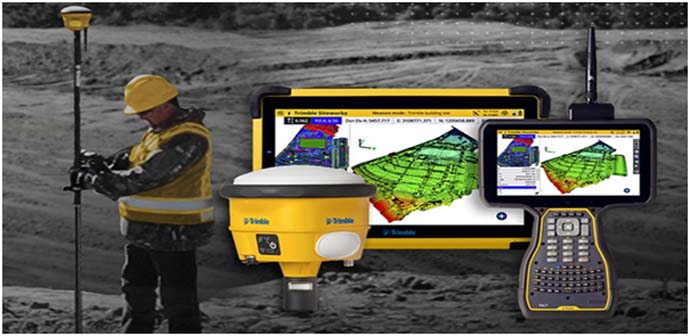
The reduction in closure duration was not achieved through manpower expansion alone. It required a shift from effort-intensive operations to precision-driven engineering.
A critical enabler was the integration of Geographic Information Systems (GIS) into road management. Complete road network of Border Roads Organisation (BRO) was digitised, capturing terrain profiles, alignment geometry, gradient variations, and avalanche-prone zones. This created a data-backed operational framework, allowing teams to anticipate challenges rather than respond to them. On ground, machine operations were enhanced using advanced positioning systems from Trimble Inc. In high-altitude snow conditions where visual references are often obliterated:
- GNSS-enabled dozers maintain alignment accuracy.
- Blade operations are controlled with precision.
- Hidden road edges are navigated without drift.
- Rework cycles are reduced.
- Time and fuel efficiency improve.
The result is a transition from approximate clearance to digitally guided execution. Technology, however, functioned as a force multiplier — not a substitute. Its effectiveness depended on the operator’s ability to interpret data in real time and translate it into action under extreme conditions.
Together, GIS mapping and precision navigation transformed snow clearance at Zojila into a measured, repeatable, and scalable operation.
Human Engine: Anayatullah Khan
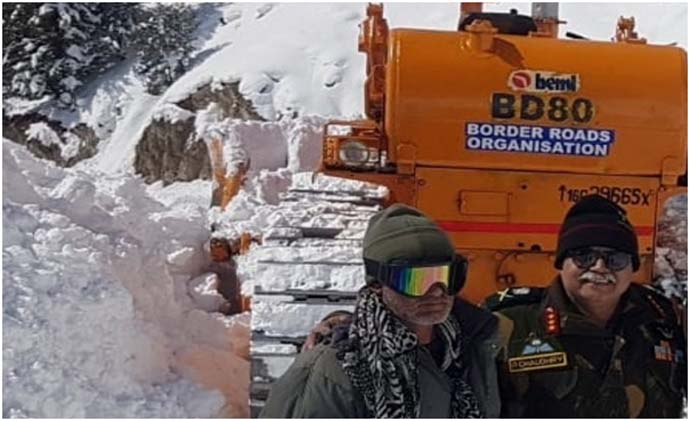
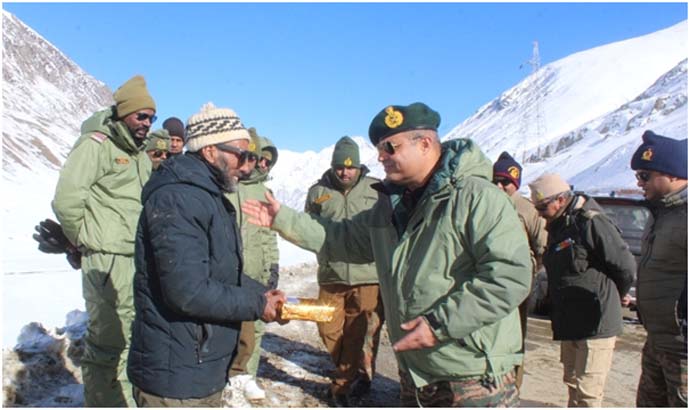
Amidst this transformation driven by policy, planning, and technology stands a figure who represents the human core of execution — Anayatullah Khan. Born in 1978 in Jammu & Kashmir and deaf and mute from birth, he joined the General Reserve Engineering Force (GREF) as a Casual Paid Operator. Over the years, he has served across some of the most demanding terrains where the BRO operates. At Zojila, he evolved into the leading dozer operator during snow clearance operations — the man who takes the first cut into winter.
In conditions where communication is critical and margins of error are minimal, his work is defined by precision and instinct. Without reliance on speech or radio communication, he operates through visual coordination, experience, and machine feedback.
He reads snow density through blade resistance. He identifies buried alignment through memory built over decades. He senses risk in terrain before it becomes visible to others. When the initial breach must be attempted — often under avalanche-prone slopes — his machine advances. His presence does not merely contribute to operations; it anchors them. In an environment where fatigue and risk are constants, his consistency establishes a standard.
His limitation has never defined his role. His reliability has.
Strategic, Psychological and Socio-Economic Impact
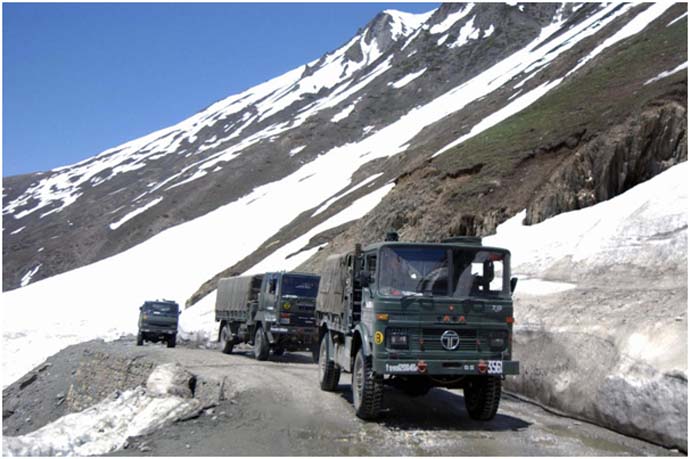
The compression of Zojila’s closure window has consequences that extend far beyond engineering achievement.
- Strategically, it enhances India’s ability to sustain and reinforce Ladakh with greater predictability. Reduced closure duration directly shortens logistics timelines, improves forward stocking, and strengthens operational readiness. In high-altitude environments, where response time is decisive, this translates into tangible advantage.
- Socio-economically, the impact is equally significant. Civilian access improves, supply chains stabilise, and economic activity faces fewer seasonal disruptions. The reduction in reliance on air maintenance — traditionally a costly fall-back — has resulted in estimated savings of approximately ₹450 crores per year in maintenance of troops deployed in Ladakh by air during winters and associated logistics expenditure (Figures are based on a study undertaken by HDMC with a conservative period of 90 days as closure time).
- Psychologically, it breaks a long-standing acceptance — that winter would inevitably dictate operational pause. The shift from seasonal closure to near-continuous access signals a new normal of persistence. For troops deployed ahead, it enhances confidence in sustained connectivity. For planners, it reduces uncertainty.
Equally important is the signalling effect. Sustained connectivity through Zojila reflects a broader shift in India’s infrastructure capability — one that is adaptive, resilient, and increasingly aligned with strategic requirements.
In high-altitude geopolitics, infrastructure endurance is deterrence in practice.
From Seasonal Isolation to Strategic Assurance
The transformation of Zojila from a pass defined by closure to a corridor defined by continuity represents more than operational improvement. It reflects a shift in national intent — from accommodating terrain to overcoming it through sustained effort, planning, and technology.
The steady reduction from 180 days of closure to nearly a month demonstrates that even the most rigid environmental constraints can be compressed with clarity of purpose and disciplined execution. Within this larger framework, individuals like Anayatullah Khan remind us that strategic outcomes ultimately rest on human foundations. Systems may guide, and policies may enable, but it is people who operate at the edge of risk and convert intent into reality.
Zojila will continue to receive snow. Winter will continue to impose difficulty. But it no longer determines the duration of disconnection. The pass remains open longer because the nation chose that it must — and ensured that it could.
(As BRO marks its 67th Raising Day, the story of Zojila stands not merely as an engineering achievement, but as a testament to how relentless resolve can transform geography from a national vulnerability into a strategic advantage.)
ABOUT THE AUTHOR

Lt Gen Rajeev Chaudhry (Retd) is a social observer and writes on contemporary national and international issues, strategic implications of infrastructure development towards national power, geo-moral dimension of international relations and leadership nuances in changing social construct.